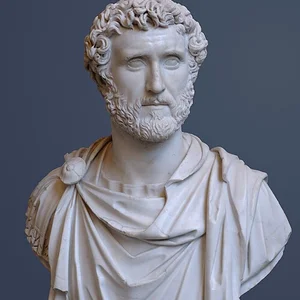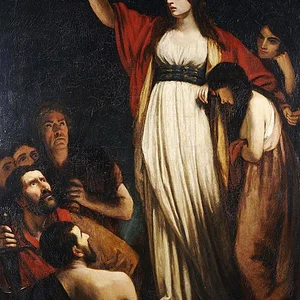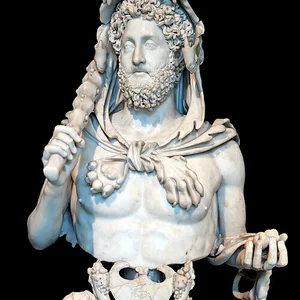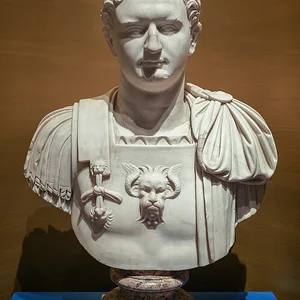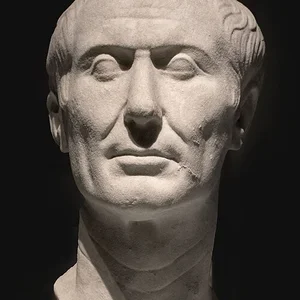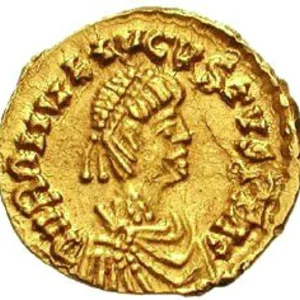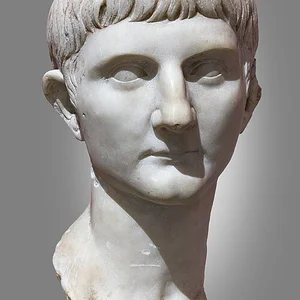

Roman general of the early Empire, nephew and adopted son of the emperor Tiberius. Popular for his campaigns in Germania, he died in Syria in AD 19 under suspicious circumstances often blamed on Tiberius.
Germanicus(14 av. J.-C. — 19)
Germanicus
Rome antique
5 min read
Frequently asked questions
Key Facts
- Born in 15 BC into the Julio-Claudian family, son of Drusus the Elder and nephew of Tiberius
- Adopted by Tiberius in AD 4 on the orders of Augustus, becoming a potential heir to the throne
- Led major campaigns in Germania from AD 14 to 16 to avenge the disaster of the Teutoburg Forest (AD 9)
- Father of Caligula (the future emperor) and of Agrippina the Younger (mother of Nero)
- Died at Antioch in AD 19, a death rumored to be a poisoning ordered by Tiberius through Piso
Works & Achievements
Restored order among the revolting armies upon the death of **Augustus** without resorting to usurpation, proving his loyalty to **Tiberius**.
Led several offensives beyond the Rhine, partly avenging the disaster of Teutoburg and recovering two legionary eagles.
Defeated the Germanic forces of **Arminius** in two great battles, the height of his military career.
Celebrated a triumph acclaimed by the crowd for his successes in Germania, reinforcing his immense popularity.
Granted an extended imperium, he stabilized the eastern provinces and installed Zeno-Artaxias on the throne of Armenia.
Adapted the Greek astronomical poem of *Aratus* into Latin verse, a literary work that has come down to us only in part.
Anecdotes
In AD 14, on the death of Augustus, the legions of Germania mutinied and offered Germanicus the chance to march on Rome and have himself made emperor. Loyal to Tiberius, he refused and restored order, not hesitating to stage the departure of his wife Agrippina and their young son to shame the rebellious soldiers.
His younger son grew up in the army camps of Germania, dressed in a miniature uniform with little soldier's boots (caligae). The legionaries affectionately nicknamed him “Caligula”, meaning “little boot” — a nickname that stuck and under which he would later reign as emperor.
In AD 15, Germanicus led his troops to the site of the disaster at Teutoburg, where Varus had lost three legions six years earlier. The soldiers found the bleached bones of their comrades and the lost standards; Germanicus held a funeral ceremony and had a burial mound raised to honour them.
His death in Syria in AD 19 caused immense mourning throughout the Empire. Convinced he had been poisoned, he accused the governor Piso before dying; the sensational trial that followed in Rome ended with Piso's suicide.
Germanicus was renowned for his learning: he spoke and wrote Greek, composed poems, and translated into Latin verse a famous Greek astronomical poem, the *Phaenomena* of Aratus.
Primary Sources
Germanicus, the closer he came to the summit of power, the more zealously he served Tiberius. At the sight of him, the soldiers redoubled their fervor.
He died, accusing Piso and Plancina, and charging his friends to avenge his death. The mourning was such that public business was suspended.
Caligula took his nickname from a joke made by the army, because he had grown up among the troops dressed in the garb of a common soldier.
An official inscription recounting the trial of Piso and recalling the virtues and honors bestowed upon Germanicus after his death.
Key Places
Capital of the Empire where Germanicus served as consul and celebrated his triumph in 17 AD before his departure for the East.
Site of the Varus disaster in 9 AD, which Germanicus visited in 15 to pay tribute to the lost legions and recover the missing standards.
Site of Germanicus's great victory over Arminius in 16 AD, the high point of his Germanic campaigns.
Great city of the East where Germanicus fell ill and died in 19 AD under circumstances considered suspicious.
Province visited by Germanicus in 19 AD; his entry without imperial authorization provoked the anger of Tiberius.
Typical Objects

Sacred standard carried by every Roman legion. Germanicus recovered several eagles lost during the disaster of Teutoburg, a symbol of the restoration of Rome's honor.

Short sword of the Roman legionary, designed for close combat. The emblematic weapon of the troops Germanicus led in Germania.

Ornate torso armor worn by Roman commanders. Germanicus appeared before his troops as a leader clad in the cuirass to embody military authority.

Laurel crown worn by the general during a triumph. Germanicus received the honors of a triumph in Rome in 17 AD for his campaigns in Germania.

Writing medium for ancient texts. A cultured man, Germanicus composed verses in Latin and Greek on it, including a translation of the *Phaenomena* of Aratus.

Warship used to transport and supply the legions. Germanicus had a fleet built to ferry his troops to Germania across the North Sea.
School Curriculum
Vocabulary & Tags
Key Vocabulary
Daily Life
Morning
On campaign, Germanicus rose early in the camp (*castra*) to receive the report from his officers and the night watch. He attended the morning sacrifices and consulted the omens before any important military decision.
Afternoon
The afternoon was devoted to inspecting the troops, training the legions, and organizing marches. As a magistrate, he also dispensed justice and received embassies from allied peoples.
Evening
In the evening, he sometimes shared a meal with his officers in the general's tent (*praetorium*). A learned man, he devoted time to reading and to writing poems in Latin and Greek.
Food
A Roman aristocrat's diet combined bread, cereal porridge, vegetables, olives, cheese, and wine diluted with water. On campaign, Germanicus often shared the simple food of his soldiers to win their affection.
Clothing
He wore the toga in Rome for official duties, and on campaign the *paludamentum*, the general's red cloak, over his cuirass. His sons sometimes accompanied him dressed in miniature military attire.
Housing
In Rome, he lived in a wealthy residence of the imperial aristocracy, on the Palatine close to the seat of power. On campaign, he lodged in the commander's tent at the heart of the fortified camp.
Historical Timeline
Period Vocabulary
Liens externes & ressources
Références
Œuvres
Répression de la mutinerie des légions de Germanie
14 apr. J.-C.
Campagnes de Germanie contre Arminius
14-16 apr. J.-C.
Victoires d'Idistaviso et du Mur des Angrivariens
16 apr. J.-C.
Triomphe à Rome
17 apr. J.-C.
Réorganisation de l'Orient et couronnement du roi d'Arménie
18 apr. J.-C.
Traduction des Phénomènes d'Aratos (Aratea)
vers 14-19 apr. J.-C.