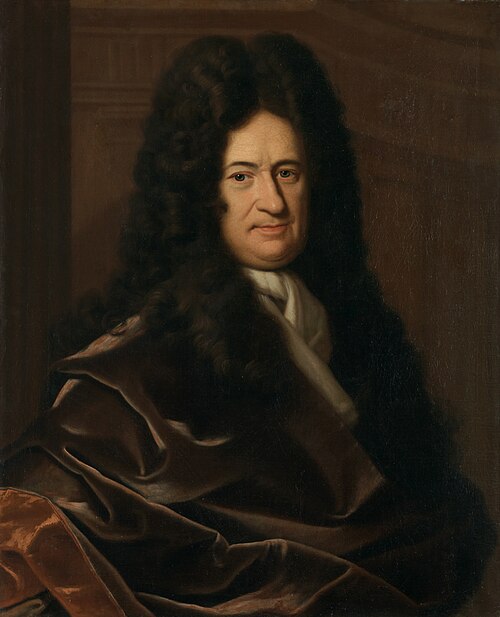
Gottfried Wilhelm Leibniz
Gottfried Wilhelm Leibniz
1646 — 1716
électorat de Saxe
German philosopher, mathematician, and diplomat of the 17th century. He invented calculus independently of Newton and developed a rationalist philosophical system. He also contributed to the foundations of logic and modern computing.
Famous Quotes
« Music is a hidden arithmetic exercise of the soul, which does not know that it is counting. »
« The present is saturated with the past and pregnant with the future. »
Key Facts
- 1646: born in Leipzig, Saxony (Holy Roman Empire)
- 1675–1676: invented calculus independently of Newton
- 1679: developed the binary number system, the foundation of modern computers
- 1700: founded the Berlin Academy of Sciences
- 1716: died in Hanover, leaving behind a vast philosophical and scientific body of work
Works & Achievements
The first published article on differential calculus, introducing the dy and dx notations still in use today. It laid the foundations of infinitesimal calculus independently of Newton.
A foundational text of his rationalist philosophy, laying out his conception of God, individual substances, and the pre-established harmony between soul and body.
The only major philosophical work published during his lifetime, attempting to justify divine goodness in the face of the problem of evil. It inspired Voltaire's satire in Candide.
A short treatise of 90 paragraphs outlining his metaphysics of monads — indivisible, immaterial units that make up reality. One of the most widely discussed philosophical works of the 18th century.
A direct response to Locke's Essay, defending rationalism against empiricism. Leibniz argues that certain ideas are innate and that the mind is not a blank slate.
An article presenting the base-2 numeral system, which Leibniz connected to his metaphysics. This work forms a conceptual foundation for modern computing.
Anecdotes
Around 1673, Leibniz invented a mechanical calculating machine capable of performing all four arithmetic operations. He demonstrated it to the Royal Society in London, impressing English scholars — though the machine proved difficult to manufacture with the precision required at the time.
The priority dispute with Newton over the invention of calculus poisoned the final years of his life. In 1713, the Royal Society published an official report accusing Leibniz of plagiarism — written in reality by Newton himself. Leibniz died in 1716, discredited in England, even though he had arrived at calculus entirely independently.
Leibniz dreamed of a 'universal characteristic' — a logical and mathematical language that would resolve all philosophical and scientific disagreements through calculation. He wrote: 'Let us calculate!' as if setting up an equation were enough to settle disputes between scholars and theologians.
Despite his immense intellectual contributions, Leibniz died nearly alone in Hanover in 1716. The court he had served for so long had gradually forgotten him. Only his secretary attended his funeral — a stark contrast to the honors bestowed upon Newton in London during the same decade.
Leibniz was among the first to conceive of the binary system (base 2) as a foundation for mathematics. He even saw metaphysical meaning in it: 1 represented God, 0 the void. That same binary system is today the foundation of all modern computing.
Primary Sources
Let AX be a straight line, and several curves such as VV, WW, YY, ZZ whose ordinates, perpendicular to AX, are called respectively v, w, y, z… I use dx as the symbol for the difference of x.
God has chosen the most perfect world, that is to say, the one which is at the same time the simplest in hypotheses and the richest in phenomena.
The Monads have no windows through which anything can enter or depart. Accidents cannot detach themselves from substances nor wander about outside of them.
Space is something absolutely uniform, and without the things placed in it, one point of space does not differ absolutely in any respect from another point of space.
We live in the best of all possible worlds. This does not mean that this world is perfect, but that no other arrangement would be better given all the constraints.
Key Places
Leibniz's birthplace, where he was born in 1646 and completed his university studies. Leipzig was at the time a major commercial and intellectual hub of the Holy Roman Empire.
Leibniz lived here from 1672 to 1676 on a diplomatic mission, and it was during this stay — in contact with leading European scholars gathered in the French capital — that he made his most significant mathematical discoveries.
The city where Leibniz spent most of his adult life, serving as librarian and adviser to the Dukes of Brunswick. He died here in 1716.
Leibniz founded the Royal Prussian Academy of Sciences here in 1700 and became its first president, extending his intellectual influence throughout the Prussia of Frederick I.
Leibniz met Spinoza here in 1676 during a memorable visit in which the two philosophers debated metaphysics and theology over the course of several days.
Gallery

Leibniz Hannover
Wikimedia Commons, Public domain — Andreas Scheits

German: Bildnis des Philosophen Gottfried Wilhelm Freiherr von LeibnizPortrait of Gottfried Leibniz (1646-1716), German philosophertitle QS:P1476,de:"Bildnis des Philosophen Gottfried Wilhelm Freihe
Wikimedia Commons, Public domain — Christoph Bernhard Francke

1711 circa unbekannter Meister Kopie Portrait Gottfried Wilhelm Leibniz, Geschenk an Raphael Levi, Foto Digitalisierungszentrum der Niedersächsischen Staats- und Universitätsbibliothek Göttingen
Wikimedia Commons, CC BY 4.0 — Foto: Digitalisierungszentrum der Niedersächsischen Staats- und Universitätsbibliothek Göttingen Ölgemälde: unbekannte

1711 circa unbekannter Meister Kopie Portrait Gottfried Wilhelm Leibniz, Geschenk an Raphael Levi, Kunstsammlungen der Georg-August-Universität Göttingen
Wikimedia Commons, Public domain — Vorlage: Universitätsbibliothek Hannover, Sammlung Haupt (Kunstsammlungen der Georg-August-Universität Göttingen)

German: Bildnis des Philosophen Gottfried Wilhelm Freiherr von LeibnizPortrait of Gottfried Leibniz (1646-1716), German philosophertitle QS:P1476,de:"Bildnis des Philosophen Gottfried Wilhelm Freihe
Wikimedia Commons, Public domain — Christoph Bernhard Francke

Forschungsreaktoren in Deutschland
Wikimedia Commons, CC BY-SA 2.5 — Lencer

Duisburg, Gottfried-Wilhelm-Leibniz-Gesamtschule, 2012-06 CN-02
Wikimedia Commons, CC BY-SA 3.0 de — kaʁstn Disk/Cat

Statuette von Leibnitz Hermann Knaur
Wikimedia Commons, CC BY-SA 3.0 — Jehmlich

Sculpture Leibniz-Denkmal Stefan Schwerdtfeger Georgsplatz Hanover Germany
Wikimedia Commons, CC BY-SA 4.0 — ChristianSchd

Domus Universitatis - Außenstelle ÖAW 9028
Wikimedia Commons, CC BY-SA 4.0 — Hubertl