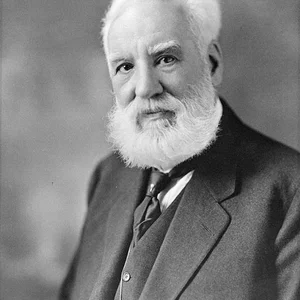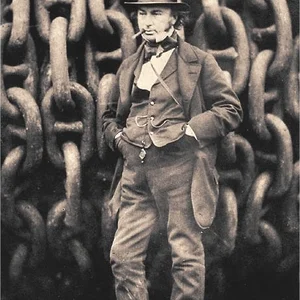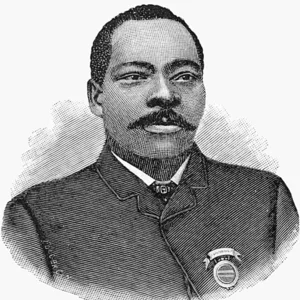

African American inventor and engineer (1856–1910), nicknamed the "Black Edison," he filed more than 60 patents in electricity and railroad engineering, including the multiplex telegraph that allowed communication between moving trains.
Granville Woods(1856 — 1910)
Granville Woods
États-Unis
9 min read
Frequently asked questions
Key Facts
- Born on April 23, 1856, in Columbus, Ohio, into an African American family
- Filed the patent for the "Synchronous Multiplex Railway Telegraph" in 1887, enabling communication between trains in motion
- More than 60 patents filed throughout his career, notably in electricity and railroad traction
- Thomas Edison himself attempted to buy out his patents and challenged some of his inventions in court
- Died on January 30, 1910, in New York City, in poverty despite the value of his inventions
Works & Achievements
His most celebrated invention, enabling for the first time communication between moving trains and fixed stations through electromagnetic induction. It revolutionized railway safety by making it possible to prevent collisions and alert drivers in real time.
A patent for a system powering streetcars with electricity through induction from the rails or a fixed source, without direct friction. This invention contributed to the development of electric streetcars that replaced horse-drawn trams in major American cities.
Woods's first official patent, focused on improving the energy efficiency of steam boilers used in locomotives and industrial factories. This patent marked the beginning of his career as an independent inventor.
An improvement on Bell's transmitter that increased the clarity and range of voice communications. The American Bell Telephone Company purchased this patent, acknowledging the commercial value of work by an inventor whom American society nonetheless refused to treat as the equal of white researchers.
A device using electricity to stop rail vehicles more quickly and safely in urban environments. This patent was acquired by the Westinghouse Air Brake Company, one of the most important industrial companies in the United States.
A system distributing electric current to streetcars through an underground conduit rather than overhead wires, improving safety in densely populated urban areas. This technical solution was adopted by several American cities seeking to modernize their public transportation.
Anecdotes
In 1887, Granville Woods filed the patent for his multiplex railway telegraph, making it possible for the first time to communicate between a moving train and a fixed station. Thomas Edison himself challenged this patent in court, claiming to be the original inventor. Woods took the case to trial and won twice in a row, forcing Edison to acknowledge that the invention was his.
Nicknamed the "Black Edison" by the American press, Woods had in fact received only a few years of formal schooling. He was largely self-taught, spending his nights reading textbooks on electricity and mechanics after long days in the railway workshops. This exceptional self-education allowed him to master complex technical disciplines without ever having attended a university.
Woods was one of the first African American inventors to establish his own company, the Woods Electric Company, founded in Cincinnati in the 1880s. Despite the technical success of his inventions, he constantly ran up against reluctant investors who refused to fund the projects of a Black man. He ultimately sold several of his patents to major companies such as General Electric and the American Bell Telephone Company in order to make ends meet.
In 1901, Woods patented an electric braking system for streetcars that significantly improved passenger safety in American cities. His invention allowed vehicles to stop much more quickly than the mechanical systems then in use. The patent was purchased by the Westinghouse Air Brake Company, one of the most powerful industrial firms in the United States at the time.
Primary Sources
The object of my invention is to provide a system of telegraphy which shall allow communication between moving trains and railway stations, and other moving trains, so that accidents from collisions and other causes may be prevented.
Be it known that I, Granville T. Woods, a citizen of the United States, residing at Cincinnati, in the county of Hamilton and State of Ohio, have invented certain new and useful Improvements in Steam-Boiler Furnaces.
My invention relates to a system for propelling cars or other vehicles upon railways or other tracks by electricity transmitted from a fixed station to the moving vehicle through the medium of an inductance-coil.
Mr. Woods is a thorough mechanic and electrician, and his inventions in the electrical field have attracted the attention of scientific men throughout the country. He is undoubtedly one of the most remarkable men of his race.
Key Places
Birthplace of Granville Woods, born on April 23, 1856. In this Northern state free from legal slavery, he received his brief formal schooling before beginning work at age ten in the local workshops and mines.
The city where Woods settled in the 1880s to found the Woods Electric Company and file his first major patents. Cincinnati was then a significant industrial hub with a substantial African American community and access to national railway networks.
The metropolis where Woods settled in the later years of his career, drawn by the concentration of electrical companies and railroad firms. He died there on January 30, 1910, in relative poverty, despite the considerable commercial value of his many inventions.
The federal institution where Woods filed his more than 60 patent applications. Each filing represented an administrative — and sometimes legal — undertaking to have his intellectual property recognized within a system still deeply shaped by racial inequality.
Typical Objects

The centerpiece of Woods's most celebrated invention, this device allowed messages to be transmitted in Morse code between a moving train and nearby stations through the phenomenon of electromagnetic induction. Its operation without any direct physical contact represented a major technical breakthrough for improving railway safety.

A fundamental electrical component used by Woods in several of his railway inventions, allowing energy to be transferred between two circuits without a physical connection. His communication systems and propulsion designs for electric streetcars were both built on this principle.

An instrument for measuring weak electrical currents, indispensable in the workshop of any electrical engineer in the late nineteenth century. Woods used it to develop and calibrate his telegraph circuits and induction systems while designing his prototypes.

A machine that converts mechanical energy into direct electrical current, a common fixture in the workshops and laboratories of the industrial era. Woods had mastered these machines firsthand, having learned to operate them as a worker in railway shops before becoming an independent inventor.

An essential working tool for any inventor, in which Woods recorded his circuit diagrams, calculations, and design notes before filing his patent applications. His drawings show a rigorous command of technical drafting despite an entirely self-taught education.

An official document issued by the United States Patent Office, certifying intellectual ownership of an invention for a period of seventeen years. Woods accumulated more than 60 of them over the course of his career — an exceptional achievement for any inventor of the era, and all the more remarkable for a Black man in post-Reconstruction America.
School Curriculum
Vocabulary & Tags
Key Vocabulary
Tags
Daily Life
Morning
Woods began his day very early, around five or six in the morning. Before heading to his workshop, he read technical journals and electricity treatises to stay informed of the latest scientific advances, compensating for his lack of university training through constant and rigorous self-directed study.
Afternoon
Most of his afternoons were spent in his workshop, where he designed, assembled, and tested his electrical prototypes. Surrounded by coils of copper wire, galvanic batteries, and measuring instruments, he proceeded through successive trials, meticulously recording his observations in technical notebooks that served as the basis for his patent applications.
Evening
In the evenings, Woods wrote technical descriptions and drew the diagrams required for patent filings with the United States Patent Office. This task demanded great legal and technical precision, as the validity of a patent depended on the clarity and completeness of its description. He sometimes consulted a specialized attorney to finalize his applications.
Food
Like most Black craftsmen of the American laboring class, Woods ate simple, nourishing food: salted meats, beans, cornbread, and seasonal vegetables. During periods of relative comfort — following the sale of a patent — he could afford more varied meals at establishments that accepted Black customers, particularly in Northern cities less subject to segregation.
Clothing
In his workshop, Woods wore sturdy work clothes in thick cotton or denim, protected by a leather apron against electrical sparks and machine oils. For professional or legal dealings, he wore the three-piece wool suit characteristic of Gilded Age businessmen, projecting a respectability that American society of the era too often refused to extend to Black men.
Housing
Woods lived in modest lodgings in the African-American neighborhoods of the industrial cities where he resided — first Cincinnati, then New York. His home also served as a space for reflection and reading. Despite the considerable value of his patents, he died in relative poverty, as the revenues from selling his inventions to large companies never secured him lasting financial stability.
Historical Timeline
Period Vocabulary
Liens externes & ressources
Références
Œuvres
Télégraphe multiplex ferroviaire (Synchronous Multiplex Railway Telegraph)
1887
Système de propulsion électrique pour tramways (Electrical Railway System)
1888
Four à vapeur amélioré (Steam Boiler Furnace)
1884
Transmetteur téléphonique amélioré
1884
Système de freinage électrique pour tramways
1901
Régulateur de courant pour chemin de fer électrique (Electric Railway Conduit)
1893