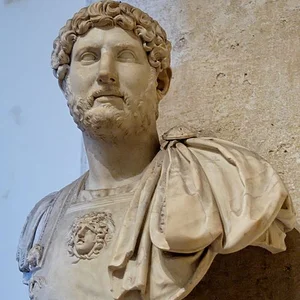

Hadrian was Roman emperor from 117 to 138 AD, successor to Trajan. A reformer and builder, he consolidated the Empire's borders and traveled to nearly all its provinces. A passionate admirer of Greek culture, he oversaw the construction of the Pantheon in Rome and Hadrian's Wall in Britannia.
Hadrian(76 — 138)
Hadrian
Rome antique
7 min read
Frequently asked questions
Famous Quotes
« Animula vagula blandula, hospes comesque corporis...»
Key Facts
- 117: Hadrian succeeds Trajan and becomes Roman emperor
- 122: Construction of Hadrian's Wall in Britannia (present-day northern England) to mark the northern frontier
- 125–128: Reconstruction and dedication of the Pantheon in Rome
- 130: Foundation of Antinoopolis in Egypt in memory of his beloved companion Antinous
- 138: Death at Baiae; succeeded by Antoninus Pius
Works & Achievements
A 118 km fortification crossing the island of Britain from east to west, complete with forts, turrets, and ditches. A masterpiece of Roman military engineering, it marked the northern frontier of the Empire and is a UNESCO World Heritage Site.
A temple rebuilt under Hadrian in honor of all the Roman gods. Its concrete dome, 43.3 meters wide and open to the sky through an oculus, is the largest unreinforced concrete dome ever built and has remained intact for nineteen centuries.
A 120-hectare palatial complex featuring baths, libraries, theaters, temples, and canals. Reflecting Hadrian's cultural eclecticism, it recreated monuments he had admired across the Empire and stands as a unique testament to ancient architecture.
A definitive codification of Roman praetorian law, drawn up at Hadrian's request by the jurist Julian. This major legal reform rationalized and stabilized the law applicable throughout the Empire.
A city founded in honor of Antinous, who had drowned in the Nile. Equipped with a temple, a hippodrome, and a Greek urban grid, it exemplifies the Greco-Roman-Egyptian cultural syncretism promoted by Hadrian.
A short Latin poem composed by Hadrian himself as death approached, addressed to his wandering soul. This deeply moving text is one of the few authentic documents written in an Roman emperor's own hand.
Anecdotes
Hadrian was so passionate about Greek culture that his contemporaries nicknamed him 'Graeculus' (the little Greek), sometimes as a mockery. He wore a beard — rare among Roman emperors — in imitation of Greek philosophers, thereby launching a fashion that lasted for several generations.
During his travels across the Empire, Hadrian often slept under the open sky with his soldiers rather than in palaces. He walked thousands of kilometers, personally inspecting the legions and sharing their frugal meals to assess their discipline.
Hadrian was deeply in love with a young Greek named Antinous, who drowned mysteriously in the Nile in 130 AD. Overcome with grief, the emperor had him deified and founded the city of Antinoopolis in Egypt in his honor, while temples dedicated to him were erected throughout the Empire.
A passionate architect, Hadrian is said to have personally designed his own mausoleum — today known as the Castel Sant'Angelo in Rome. Tradition holds that he quarreled with the architect Apollodorus of Damascus, whom he allegedly had executed for criticizing his plans — an anecdote that reveals his proud and uncompromising character.
Near the end of his life, gravely ill, Hadrian composed a short poetic epitaph addressed to his own soul: 'Animula vagula blandula...' ('Little soul, wandering and gentle...'). This moving poem, preserved to this day, reveals the literary sensitivity of a powerful man confronting his own death.
Primary Sources
In one and the same man there was severity and cheerfulness, affability and dignity, lasciviousness and restraint, cruelty and clemency, and always in all things change.
Animula vagula blandula, hospes comesque corporis, quae nunc abibis in loca pallidula rigida nudula...
Hadrian visited the provinces and the camps, inspecting everything, including weapons, siege engines, ditches, palisades, and ramparts.
Per lineam valli — along the line of the wall — the legions carved their names and their deeds on dozens of commemorative stones still visible today.
Key Places
A 118 km fortification built from 122 AD to mark the northern frontier of the Roman Empire. This military masterpiece, listed as a UNESCO World Heritage Site, symbolizes Hadrian's policy of consolidating the empire's borders.
A vast architectural complex built between 118 and 138 AD, inspired by the architectural wonders Hadrian encountered on his travels through Greece, Egypt, and Asia Minor. Listed as a UNESCO World Heritage Site, it covered more than 120 hectares.
A temple rebuilt by Hadrian around 125 AD, dedicated to all the gods. Its concrete dome, 43 metres in diameter with an open oculus facing the sky, remains one of the best-preserved architectural marvels of the ancient world.
Hadrian's favourite city, which he visited on several occasions and enriched with numerous monuments, including the Arch of Hadrian and the Temple of Olympian Zeus, completed in 132 AD. He was initiated into the Eleusinian Mysteries and was granted Athenian citizenship.
Hadrian's birthplace, a city founded by Scipio Africanus in 206 BC. The emperor commissioned a grand new monumental district there as a testament to his attachment to his Hispanic roots.
Typical Objects

An articulated armor made of iron strips worn by Roman legionaries. Hadrian would put it on during his military inspections to signal his belonging to the army and earn the respect of his soldiers.

A ceremonial garment reserved for the emperor, dyed with murex, a rare and costly shellfish. Hadrian wore it during official audiences and triumphs in Rome.

A stringed instrument emblematic of Greek culture, which Hadrian deeply admired. The Historia Augusta reports that he knew how to play it and composed his own poems and songs.

Common writing tools in Roman antiquity. Hadrian, an accomplished man of letters, used them to draft his imperial correspondence, poems, and travel notes.

An astronomical instrument representing the celestial spheres, prized by the intellectuals of antiquity. Hadrian, passionate about astronomy and philosophy, kept one in his personal library.

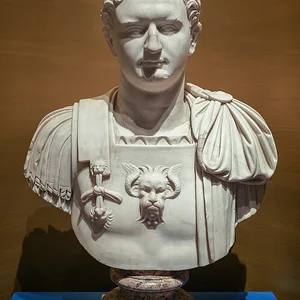
Hadrian popularized the use of bearded sculpted busts in official representations of Roman emperors. More than 100 authenticated portraits of him are preserved in museums around the world.
School Curriculum
Vocabulary & Tags
Key Vocabulary
Daily Life
Morning
Hadrian rose at dawn and began his day with physical exercise — he was renowned for his robustness and practiced hunting. He would then meet with his secretaries to review reports from the provinces and dictate his responses, often standing or walking as he did so.
Afternoon
Afternoons were devoted to imperial audiences, consultations with his jurists and military advisors, and inspections of construction sites when he was in Rome or Tivoli. He personally oversaw the plans and discussed technical details with his architects.
Evening
In the evenings, Hadrian retired to his private quarters to read, compose poetry, or play the lyre. He would receive a small circle of intellectuals and Greek philosophers for philosophical discussions, especially during his stays in Athens. The evening meal (cena) was an occasion for cultured conversation.
Food
Like many emperors keen to project an image of austerity, Hadrian boasted of sharing the simple rations of his soldiers: bacon, cheese, vinegar, and barley bread on campaign. At court, he enjoyed Mediterranean staples — olive oil, garum (fermented fish sauce), fruits, and roasted meats — accompanied by wine diluted with water.
Clothing
In public, Hadrian wore the white toga edged with purple, a mark of his imperial dignity. While traveling or conducting military inspections, he donned the paludamentum (purple military cloak) and sometimes a breastplate. His carefully groomed beard, inspired by Greek fashion, became a distinctive trademark that set a trend followed by his successors.
Housing
In Rome, Hadrian resided in the Imperial Palace on the Palatine Hill, but his preferred residence was Hadrian's Villa at Tivoli, 28 km from Rome. This vast estate included baths, Greek-style gardens, a double library (one Greek, one Latin), a theater, and private apartments spread across more than 120 hectares.
Historical Timeline
Period Vocabulary
Visual Style
Un style visuel ancré dans le classicisme gréco-romain du IIe siècle, jouant sur les marbres chauds, les colonnes lumineuses et la sérénité architecturale des grands monuments hadrianiques.
Sound Ambience
L'univers sonore d'Hadrien mêle la solennité des palais impériaux romains, le brouhaha des chantiers monumentaux et le vent froid soufflant sur les remparts des frontières de l'Empire.
Liens externes & ressources
Références
Œuvres
Le mur d'Hadrien
122-128 ap. J.-C.
Le Panthéon de Rome
vers 125 ap. J.-C.
La Villa Hadriana de Tivoli
118-138 ap. J.-C.
L'Édit de l'Édit perpétuel (Edictum perpetuum)
vers 130 ap. J.-C.
Fondation d'Antinooupolis (Égypte)
130 ap. J.-C.
Poème 'Animula vagula blandula'
vers 138 ap. J.-C.