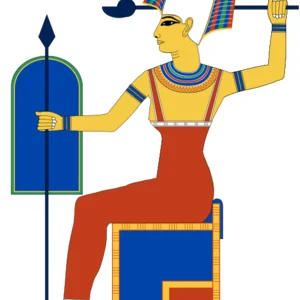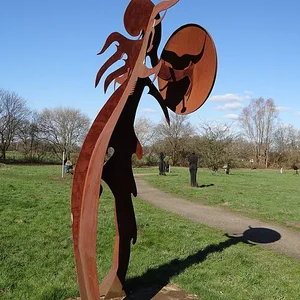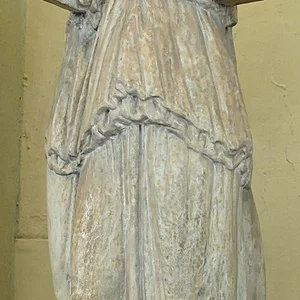

Greek goddess of magic, crossroads, and the underworld, daughter of Perses and Asteria. Often depicted with three faces, holding torches and accompanied by dogs. A chthonic deity associated with the moon, nocturnal rites, and witchcraft.
Hecate
Hecate
9 min read
Frequently asked questions
Key Facts
- Daughter of the Titan Perses and Asteria, granddaughter of the Titans Coeus and Phoebe
- Mentioned in Hesiod's Theogony (c. 700 BCE) as a powerful goddess honored by Zeus himself
- Depicted with three faces (Hecate triformis), symbolizing her dominion over the sky, the earth, and the underworld
- Associated with crossroads, where nocturnal offerings known as 'Hecate's suppers' were left
- Her cult continued through the Hellenistic and Roman periods, especially in popular magic practices
Works & Achievements
The first major description of Hecate in Greek literature, presenting her as a cosmic power honored by Zeus above all other gods. This text definitively established her place in Greek theology.
This foundational text of the Eleusinian Mysteries describes Hecate's role in the abduction of Persephone and her function as a guide between the living and the dead. It establishes her role as psychopomp and guardian of thresholds.
In this tragedy, Medea invokes Hecate as her patron deity before carrying out her revenge. The play durably popularized the image of Hecate as the patroness of witchcraft and the magical arts.
A Hellenistic epic describing Medea's initiation rites into the cult of Hecate and the preparation of magical potions in her honor. This text spread the cult of Hecate throughout the Mediterranean world and beyond.
A theurgical text that casts Hecate as a central cosmic power, the soul of the world mediating between the celestial and infernal planes. This corpus would profoundly influence Neoplatonism and Western esoteric traditions.
A collection of Egyptian magical texts containing numerous invocations to Hecate under various ritual names (Brimo, Phorphorba, Ereschigal). These papyri attest to the vitality of her cult in Roman Egypt and its pan-Mediterranean reach.
Anecdotes
When Persephone was abducted by Hades, Hecate was one of the few deities to hear her cries from the depths of the earth. Holding her flaming torch, she accompanied Demeter in her desperate search, then became Persephone's permanent companion in the Underworld. This episode, recounted in the Homeric Hymn to Demeter, earned her the role of guide between the world of the living and the world of the dead.
Hecate is one of the very few deities whom Zeus honored without dethroning when he seized power over Olympus. According to Hesiod in the Theogony, Zeus preserved all her ancestral privileges: she could grant or withhold wealth, victory, wisdom, or abundant fishing entirely at her own will. This exceptional favor made her an independent power, feared even by the Olympian gods.
The Greeks had a custom of leaving offerings at crossroads on full moon nights, during ritual meals called 'deipna Hekates' — the suppers of Hecate. These offerings, made up of eggs, fish, cheese, honey, and small cakes, were meant to appease the goddess and the wandering spirits she led. The poor would sometimes collect these food gifts left on the roads, which strengthened the connection between Hecate and the margins of Greek society.
Hecate is closely linked to Medea, the formidable sorceress of Colchis. In Euripides' tragedy, Medea invokes Hecate as her supreme protector and swears an oath to her before committing her most terrible acts. This bond illustrates how Hecate presided over the magic of herbs and poisons, and how the witches of antiquity called upon her divine protection.
Hecate was frequently depicted in triple form — three bodies or three faces turned toward the three roads of a crossroads. This triple nature symbolized her ability to see in all directions at once, watching over the passages between the worlds of the living, the dead, and the gods. Three-bodied statues called hekataion were placed at crossroads throughout Greek cities to protect travelers and ward off evil spirits of the night.
Primary Sources
Hecate, to whom Zeus son of Cronus gave splendid gifts: she received her share of the earth, the barren sea, and the starry sky. She is greatly honored among the immortal gods, and Zeus granted her the highest privilege.
Hecate, the veiled one, holding torches in her hands, met Demeter and brought her the news: she had heard the girl's voice but had not seen who had carried her off.
I swear by Hecate, my mistress, she whom I revere above all others and have chosen as my ally, who dwells in the innermost chambers of my home — no one shall make me suffer such pain and go unpunished.
Medea called upon Hecate Brimo, the dread goddess, to obtain from her a mighty drug that would make Jason invincible in the trial set by Aeetes, king of Colchis.
Come to me, you who dwell in the void of the air, Phorphorba Brimo, devourer, you who walk through fire, bringer of light, holder of the golden keys, mistress of the underworld, guide of the dead.
Key Places
The sanctuary of Lagina, in present-day Turkey, was the largest cult center dedicated to Hecate in the ancient world. Grand annual festivals called the Hekatesia drew pilgrims from across the Mediterranean.
This island in the Aegean Sea was a center of mystery cults where Hecate was venerated alongside the Cabiri. Initiates sought her protection for sea voyages and the passage into the afterlife.
Hecate plays a crucial role in the Eleusinian Mysteries: according to myth, it was she who accompanied Demeter in her search for Persephone and later became the guardian of the young goddess in the Underworld. Her shrine stood at the entrance to the Eleusinian temenos.
Hecate had no single fixed sanctuary in Greece: her sacred space par excellence was the three-way crossroads (triodoi), a place of passage between worlds, where devotees left offerings on moonlit nights.
The mythical homeland of Medea, high priestess of Hecate. The Greeks perceived Colchis as a region at the edge of the known world — a place of magic and wild rites dedicated to the goddess.
Typical Objects

Hecate is almost always depicted holding two flaming torches, symbols of her ability to illuminate the darkness and guide souls between worlds. The torches signal her nocturnal presence at crossroads and her role as a guide through the dark.

As guardian of the gates of the underworld, Hecate holds large keys, symbolizing her power to open or close access to the realm of the dead. This attribute earned her the title of Kleidouchos — the key-bearer.
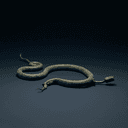
Serpents frequently surround Hecate in iconography, evoking her connection to the earth, the cycles of death and rebirth, and the magic of poisonous herbs. They reflect her chthonic nature and her mastery over venom and poisons.

An attribute of her magical and chthonic dimension, Hecate's knife is associated with nocturnal rites, the cutting of herbs by moonlight, and magical practices in ancient Greece. Sorceresses such as Medea used it in rituals performed in her honor.

Sometimes depicted with a whip, Hecate is portrayed as a driver of souls and the hounds of the Underworld. This object underscores her authority over the spirits and nocturnal demons she leads on her nightly rounds.

Dogs — especially black ones — are Hecate's sacred animals. They would bark as she approached during her nocturnal rounds, and were sacrificed in her honor during crossroads rituals. Their howling at night told the Greeks that the goddess was invisibly near.

A vessel used in offerings and libations to the goddess. The deipna Hekates placed at crossroads included cups of honey, wine, and water poured in her honor to appease the goddess and the spirits she governs.
School Curriculum
Vocabulary & Tags
Key Vocabulary
Daily Life
Morning
Hecate, a nocturnal and chthonic deity, has no place in the daytime cycle of the Olympian gods. Dawn marks the end of her active domain: her hounds retreat into the shadows, her torches go out, and she withdraws to the liminal spaces between worlds — caves, tomb thresholds, the depths of the earth. Morning is the time when her powers fade before those of the solar deities.
Afternoon
During the sunlit hours, Hecate dwells in the chthonic depths, guarding the passages between the world of the living and the realm of the dead. She watches over wandering souls and presides over the underground crossroads of Hades, fulfilling her role as Persephone's constant companion in the kingdom of shadows.
Evening
Twilight is the hour of her awakening and her greatest power. Hecate takes up her torches and begins her nightly rounds at the triodoi, guiding lost souls and receiving ritual offerings. Her devotees place their deipna Hekates — ritual meals of eggs, fish, and honey — at crossroads as soon as night falls.
Food
As a goddess, Hecate receives specific offerings: eggs, fish (especially red mullet), cheese, honey, garlic, and moon-shaped cakes. Animal sacrifices — black dogs in particular — were reserved for the most solemn occasions. Garlic was especially sacred to her and was hung at crossroads in her honor.
Clothing
Hecate is depicted wearing long, flowing robes, often in dark colors — purple, black, or gray — trimmed with silver evoking moonlight. She sometimes wears a crown of stars or a crescent-moon headdress, reflecting her association with Selene in the Hellenistic tradition.
Housing
Hecate dwells neither on Olympus like the great gods, nor in the Underworld like Hades: her domain is the in-between. Crossroads, house thresholds, tombs, cellars, and caves are her abodes. Her most sacred site is the triodoi — the three-way crossroads — a place of passage where the veil between worlds is thinnest.
Historical Timeline
Period Vocabulary
Visual Style
Figure triple et majestueuse à un carrefour nocturne sous la pleine lune, torches flamboyantes, chiens noirs aux yeux brillants, drapés pourpres et argent — style entre fresque grecque et peinture romantique nocturne avec un fort clair-obscur.
Sound Ambience
Sons de la nuit grecque antique au carrefour sacré : chiens hurlants, torches crépitantes, chouette, cliquetis de clés de bronze et murmures rituels évoquant la présence invisible d'Hécate entre les mondes.
Liens externes & ressources
Références
Œuvres
Théogonie — Hésiode
vers 700 av. J.-C.
Hymne homérique à Déméter
VIIe – VIe siècle av. J.-C.
Médée — Euripide
431 av. J.-C.
Les Argonautiques — Apollonios de Rhodes
IIIe siècle av. J.-C.
Les Oracles Chaldaïques
IIe siècle apr. J.-C.
Papyrus Grecs Magiques (PGM)
IIe – IVe siècle apr. J.-C.