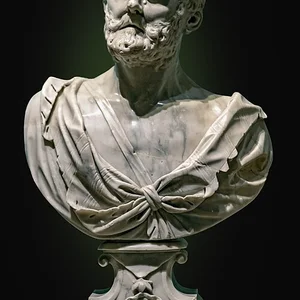

Pre-Socratic Greek philosopher born around 534 BC in Ephesus (present-day Turkey). He is famous for his doctrine of universal flux and fire as the fundamental principle of all things. His work, known under the title "On Nature", has survived only in fragments.
Heraclitus(534 av. J.-C. — 470 av. J.-C.)
Heraclitus
Éphèse
7 min read
Frequently asked questions
Famous Quotes
« You cannot step into the same river twice.»
« Everything flows, nothing stands still.»
« War is the father of all things.»
« The Logos is common to all, yet each person lives as though they had their own private wisdom.»
Key Facts
- Born around 534 BC in Ephesus, in Ionia (present-day Turkey)
- Died around 470 BC, a contemporary of Parmenides
- Developed the doctrine of fire as the arché (the primary principle of all things)
- Introduced the concept of the Logos as the universal reason governing the cosmos
- His work survives only through approximately 130 fragments quoted by later authors
Works & Achievements
Heraclitus's major work, of which only 130 fragments survive, quoted by later authors. It set out his doctrine of the universal Logos, the primordial fire, and perpetual becoming.
A collection of maxims on the universal reason (Logos) that governs the cosmos. Heraclitus argues that the Logos is common to all people, yet most live as though they possessed a reason of their own.
Reflections on the unity of opposites (cold/hot, life/death, waking/sleeping) and on permanent change. These fragments are the source of the famous saying 'Everything flows' (Panta rhei).
Maxims on the city, law, and justice. Heraclitus argues that all human laws are nourished by a single divine law, and criticizes democracy in favor of rule by the best.
Anecdotes
Heraclitus was known for his solitary and contemptuous character. According to Diogenes Laërtius, he refused to draw up laws for the people of Ephesus, preferring to retreat into the mountains to play knucklebones with children rather than govern men he considered fools.
His work was considered so obscure that his contemporaries nicknamed him 'the Obscure' (ho Skoteinós). It is said that Socrates, after reading his book, declared: 'What I understood is excellent; what I did not understand is probably so as well — but it would take a Delian diver to get to the bottom of it.'
Heraclitus harbored a deep contempt for other philosophers. He openly criticized Pythagoras, Xenophanes, and even Homer, claiming that 'much learning does not teach understanding.' In his view, most people were sleepwalking through life, unable to perceive the universal Logos.
According to tradition, Heraclitus died under strange circumstances: suffering from dropsy (an abnormal accumulation of fluid in the body), he reportedly asked physicians to cure him by covering him in cattle dung to draw out the moisture. The treatment failed, and he died in this manner, around the age of sixty.
Primary Sources
Although this Logos exists always, men are unable to understand it, both before hearing it and after they have heard it for the first time.
You cannot step into the same river twice, for new waters are always flowing.
War is the father of all things and the king of all things; some it has shown as gods, others as men; some it has made slaves, others free.
All things are exchanged for fire, and fire for all things, as goods are exchanged for gold and gold for goods.
He deposited his book in the temple of Artemis, and according to some, he deliberately wrote it in an obscure style so that only those of ability could access it, and to avoid being looked down upon by the common people.
Key Places
Heraclitus's hometown, a prosperous Ionian city on the Aegean coast of Asia Minor. It was here that he was born, lived, and died, refusing to leave despite invitations from other cities.
One of the Seven Wonders of the Ancient World, located in Ephesus. Heraclitus deposited his work 'On Nature' there, choosing this sacred site to restrict access to initiates alone.
A major neighboring Ionian city and the birthplace of Greek philosophy, home to Thales, Anaximander, and Anaximenes. Heraclitus was familiar with their theories and set himself apart by making fire the primary principle of all things.
An Ionian island near Ephesus and the homeland of Pythagoras, whom Heraclitus sharply criticized for his vast learning without genuine wisdom. The two philosophers represent two opposing visions of knowledge.
Typical Objects

Fire is the fundamental principle of Heraclitus's philosophy: everything is born from fire and returns to it. The ever-moving flame symbolizes the universal becoming he taught.

The writing medium used by Ionian philosophers to record their thoughts. Heraclitus deposited his work on papyrus in the Temple of Artemis at Ephesus.

A terracotta cup used for drinking wine mixed with water at symposia. Heraclitus rarely attended these gatherings, though they formed the central setting of Greek intellectual life.

A draped wool garment worn by free Greek men. Heraclitus, born into an aristocratic family in Ephesus, likely wore a fine-quality himation.

A timekeeping instrument used in Archaic Greece. For Heraclitus, the flow of time and perpetual motion were at the heart of his understanding of the world.

A game played by Greek children and adults using small bones or shaped stones. According to tradition, Heraclitus preferred playing knucklebones with children rather than taking part in the city's political affairs.
School Curriculum
Vocabulary & Tags
Key Vocabulary
Daily Life
Morning
Heraclitus rose before dawn, accustomed to solitude. He would observe the sunrise from the heights above Ephesus, meditating on celestial fire and the cycles of the cosmos. He recorded his reflections on wax tablets before transcribing them onto papyrus.
Afternoon
Refusing to hold a school like Pythagoras, Heraclitus wandered alone through the streets of Ephesus or sat in public spaces observing his fellow citizens with a mixture of fascination and contempt. He sometimes engaged with visitors who sought his wisdom, answering them in riddles.
Evening
He retired early, far from the banquets and symposia he disdained. His evenings were devoted to contemplating fire — a brazier or an oil lamp — and to crafting his maxims. According to tradition, he eventually withdrew to the mountains, living on wild plants.
Food
Later in life, Heraclitus reportedly adopted a vegetarian diet, subsisting on herbs, roots, and wild fruits after withdrawing from civic life. While in the city, he most likely ate the standard Ionian fare: barley bread, olives, pulses, goat cheese, and fish.
Clothing
He wore a himation (a large draped wool cloak) and a linen chiton, the typical dress of free Greek men. Born into an aristocratic family, he could have afforded fine clothing, but his reputation as an ascetic suggests he preferred simplicity over ostentation.
Housing
Heraclitus lived in Ephesus in a courtyard house (oikos) typical of Ionian cities: walls of rammed earth or mud brick, beaten earth or pebble floors, and sparse furnishings. After withdrawing from public life, he is said to have lived in more rustic conditions outside the city.
Historical Timeline
Period Vocabulary
Visual Style
Style inspiré de la céramique à figures rouges de la Grèce archaïque-classique, avec des teintes chaudes de terracotta et d'orangé évoquant le feu, principe fondamental d'Héraclite.
Sound Ambience
Ambiance sonore d'Éphèse au tournant du Ve siècle av. J.-C. : ville ionienne active mêlant sons portuaires, artisanat et vie religieuse autour du temple d'Artémis.
Liens externes & ressources
Références
Œuvres
De la Nature (Peri Physeos)
vers 500 av. J.-C.
Fragments sur le Logos
vers 500 av. J.-C.
Fragments sur le devenir et les contraires
vers 500 av. J.-C.
Fragments politiques et éthiques
vers 500 av. J.-C.
See also
Related Characters
Alexander II of Macedon
Anaxagoras of Clazomenae
499 av. J.-C. — 427 av. J.-C.
Anaximander
609 av. J.-C. — 545 av. J.-C.
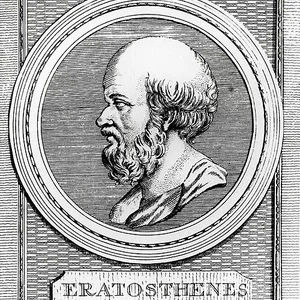
Eratosthenes
275 av. J.-C. — 193 av. J.-C.
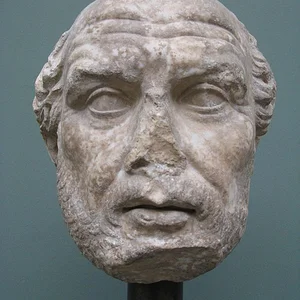
Phidias
499 av. J.-C. — 429 av. J.-C.
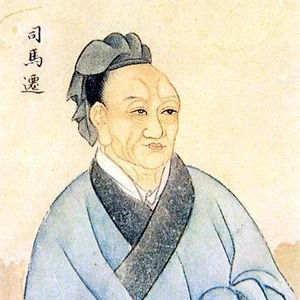
Sima Qian
144 av. J.-C. — 85 av. J.-C.