
Hjalmgunnar is a warrior king from Norse mythology, mentioned in the heroic sagas. He was slain by the valkyrie Brynhildr on Odin's orders, which led to her being punished by the chief god.
Hjalmgunnar
Hjalmgunnar
8 min read
Frequently asked questions
Key Facts
- Hjalmgunnar is an old warrior king mentioned in the Völsunga saga and the Eddas
- He fought Agnar in a battle where both sides sought Odin's favor
- The valkyrie Brynhildr granted him defeat and gave victory to Agnar, against Odin's will
- His death is the cause of Brynhildr's punishment by Odin, who cast her into an enchanted sleep
- He appears as a secondary character who serves as a narrative trigger in the Brynhildr cycle
Works & Achievements
An Eddic poem preserved in the Codex Regius in which Brynhildr-Sigrdrífa explains to Sigurðr why she was punished by Odin, naming Hjalmgunnar explicitly. This is the essential primary source mentioning the warrior king.
The great Icelandic saga recounting the story of the Völsungar, including Sigurðr. Chapter 21 gives a detailed prose account of Brynhildr's punishment following the death of Hjalmgunnar.
A treatise on Norse mythology codifying the role of the valkyries and Odin's system of granting favor to warriors — essential theological context for understanding the significance of Hjalmgunnar's death.
A Germanic epic in Middle High German transmitting a parallel version of the Brynhildr/Brunhilde cycle, a direct heir to the mythological traditions of which Hjalmgunnar is one of the founding milestones.
An Icelandic manuscript regarded as the most precious collection of ancient Norse poetry; it contains the Sigrdrífumál and serves as the primary manuscript source for the entire story of Hjalmgunnar.
Anecdotes
Hjalmgunnar was a warrior king so formidable that Odin himself had promised him victory in his next battle. This divine promise was an exceedingly rare honor, granted only to fighters deemed worthy of entering Valhalla after a glorious death. Yet even the word of the supreme god could not save him from his fate.
The valkyrie Sigrdrífa — identified in the sagas with Brynhildr — had received a formal order from Odin to grant victory to Hjalmgunnar in his final battle. She deliberately chose to ignore this order and gave victory to his opponent Agnar. This act of disobedience earned her an exemplary punishment: Odin pricked her with a sleep thorn and surrounded her with a ring of fire on the rock Hindarfjall.
The very name Hjalmgunnar is telling: in Old Norse, 'hjálmr' means helmet and 'gunnarr' evokes war or combat. He was thus named 'the helmeted warrior' or 'he whose helmet leads the battle,' emphasizing his identity as a great military leader whose renown had crossed the world of men and reached the gods.
The death of Hjalmgunnar is one of the founding episodes of Brynhildr's tragic fate in the Nibelung cycle. Without this battle and the valkyrie's disobedience, Brynhildr would never have been put to sleep on her ring of fire, and Sigurðr the Dragonslayer would never have awakened her — the entire chain of heroic tragedies would never have unfolded.
In Norse cosmology, the death of Hjalmgunnar raised a troubling theological question: if Odin had promised victory to a warrior and that promise was broken by his own valkyrie, it meant that even divine decrees could be overridden. This paradox made Hjalmgunnar not merely a defeated man, but the unwitting catalyst of a crisis in divine authority.
Primary Sources
I struck down Hjálmgunnarr in battle — the old king to whom Odin had promised victory — and granted victory to Auðr, the younger one. For this, Odin pricked me with the sleep-thorn.
Sigrdrífa told him that she had slain Hjálmgunnarr in battle, an old warrior to whom Odin had promised victory, and that for this Odin had pricked her with the sleep-thorn, and that she had slept ever since.
The valkyries ride to battles and choose those who are to die, and they govern victory. Odin sends to every battle those he chooses; they decide the fate of men according to his will.
Grípir foretells to Sigurðr that he will awaken a woman put to sleep by Odin's magic, a valkyrie punished for disobeying the god — a direct allusion to the consequence of Hjálmgunnarr's death.
Key Places
The precise location of Hjalmgunnar's death is not named in the Eddic texts, but lies within the mythical lands of the Germanic heroic kings. It is here that the valkyrie Sigrdrífa disobeyed Odin and brought about the warrior king's downfall.
A mythical rock surrounded by a ring of flames where Odin put Brynhildr to sleep following Hjalmgunnar's death. It is the place most directly tied to the consequences of the warrior king's fate, immortalized in the sagas.
The great golden hall of Ásgarðr where the einherjar — warriors who died gloriously in battle — reside. Hjalmgunnar, slain as a hero on the battlefield, was destined to take his place there, but the valkyrie's disobedience left that fate in limbo.
It was in medieval Iceland that the heroic tales featuring Hjalmgunnar were committed to writing, in the halls of chieftains and in monasteries. This land is the cultural guardian of his memory, passed down orally for centuries.
Typical Objects

The helmet is written into Hjalmgunnar's very name. A symbol of his status as a great warrior king, it embodied his divine protection and battlefield prestige — without a helmet, no king of battles.

In the Norse sagas, great swords bore their own names and were passed between heroes like sacred relics. Hjalmgunnar's sword stood for his martial power and the legitimacy of his reign.

Armor woven from interlocking metal rings, worn by the elite warriors of the Norse heroic age. It conferred both rank and protection, and was the essential gear of a fighting king like Hjalmgunnar.

The essential defensive weapon of the Norse warrior, often painted with protective symbols. On the mythic battlefield where Hjalmgunnar fell, the shield was the last line between life and death.

A magical object used by Odin to punish Brynhildr after she refused to grant victory to Hjalmgunnar. This enchanted talisman, directly bound to the king's death, plunged the valkyrie into an endless sleep.

At the warrior feasts held in Norse halls, the mead horn was passed among fighters to seal alliances and oaths. As king, Hjalmgunnar presided over these rituals, which forged the loyalty of his warriors before each battle.
School Curriculum
Vocabulary & Tags
Key Vocabulary
Daily Life
Morning
At daybreak in his hall of wood and stone, Hjalmgunnar receives reports from his jarls and inspects his troops. He offers ritual sacrifices to Odin — ale poured over the altar, prayers whispered — to secure divine favor before any military campaign.
Afternoon
Afternoons are devoted to sword-and-shield combat training, strategic battle planning, and settling disputes among his warriors. His legitimacy as king depends entirely on his ability to lead his men to victory.
Evening
In the evening, Hjalmgunnar presides over feasts in his mead-hall, lit by the central fire. Skalds sing the deeds of ancestors, horns of mead are passed around, and oaths of loyalty are sworn before all the assembled warriors.
Food
Like any great Norse king, he consumes roasted meats — boar, venison, beef — accompanied by barley bread and aged cheese. Mead (mjöðr) and strong ale are the ritual drinks of the feast, symbols of royal hospitality and the alliances they seal.
Clothing
Hjalmgunnar wears the nasal helmet that gives him his name, a coat of mail (brynja) over a thick wool tunic, laced breeches, and heavy leather boots. Brooches of precious metal and engraved rings display his royal rank before allies and enemies alike.
Housing
His hall (höll) is a longhouse of thick timber walls under a thatched or turf roof, with a central hearth whose fire never goes out. The walls are adorned with captured shields, weapons of war, and tapestries depicting hunting scenes — signs of power and martial glory.
Historical Timeline
Period Vocabulary
Visual Style
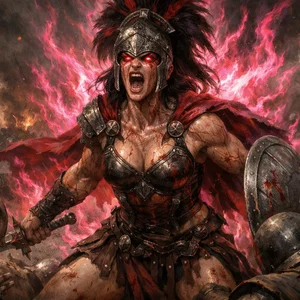
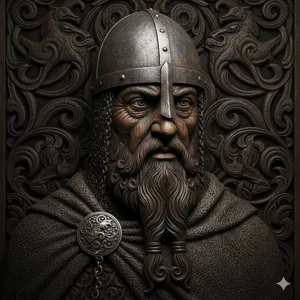
Un style épique et sombre évoquant les sagas nordiques — guerriers en armures de mailles, ciels de plomb orageux, palette de gris ferreux, rouges sang et or terne rehaussée d'entrelacs vikings.
Sound Ambience
Un univers sonore qui mêle le fracas des batailles nordiques à la gravité des halls guerriers — ponctué par les corbeaux d'Odin et le vent des plaines scandinaves.
Liens externes & ressources
Références
Œuvres
Sigrdrífumál (Chant de Sigrdrífa) — Edda poétique
vers 1270 (traditions orales antérieures)
Völsunga saga
vers 1260-1270
Edda en prose (Snorri Sturluson)
vers 1220
Nibelungenlied (Chanson des Nibelungen)
vers 1200
Codex Regius (GKS 2365 4°)
vers 1270