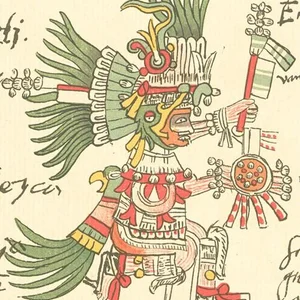

Huitzilopochtli is the god of war and the sun in Aztec mythology. The patron deity of the Mexica people, he guides them from Aztlan to the founding of Tenochtitlan. He lies at the heart of Aztec cosmology and the sacrificial rituals intended to feed the sun.
Huitzilopochtli
Huitzilopochtli
8 min read
Frequently asked questions
Key Facts
- Born fully armed from the womb of his mother Coatlicue, he immediately kills his sister Coyolxauhqui and his brothers the Centzonhuitznahua
- Patron deity of the Mexica, he guides their long migration from Aztlan to Lake Texcoco (14th century)
- The Templo Mayor of Tenochtitlan (founded c. 1325) is co-dedicated to him and the rain god Tlaloc
- Thousands of human sacrifices were offered to him to feed the sun and prevent the end of the world
- His cult is at the heart of the "Flower War
- (xochiyaoyotl)
- a ritualized practice to capture prisoners for sacrifice
Works & Achievements
The armed birth of Huitzilopochtli and his victory over Coyolxauhqui (the Moon) and the Centzon Huitznahua (the stars). This founding myth explains the cycle of day and night and justifies human sacrifice as the means of maintaining cosmic order.
Huitzilopochtli guided his people for two centuries from Aztlan to Lake Texcoco, speaking through his effigy carried by priests. This epic journey is the Aztec equivalent of the biblical Exodus.
Huitzilopochtli designated the site of the future capital through a prophetic sign — an eagle devouring a serpent atop a cactus — which appears on the Mexican flag to this day, remaining one of the most powerful national symbols in the Americas.
In Aztec cosmology, Huitzilopochtli embodies the sun of the fifth and final age of the world. This sun can survive only through human sacrifice — without it, the world would collapse into eternal darkness.
A massive 24-ton basalt disk carved during the reign of Axayacatl, depicting Huitzilopochtli-Tonatiuh at the center of the Aztec cosmos. Discovered in 1790 beneath Mexico City, it is now held at the National Museum of Anthropology.
Anecdotes
Huitzilopochtli was born under extraordinary circumstances: his mother Coatlicue, goddess of the Earth, picked up a ball of feathers that miraculously impregnated her. His siblings, the four hundred gods of the stars, were furious and resolved to kill her. But Huitzilopochtli burst forth from the womb already armed with a fire serpent — the Xiuhcoatl — and routed them in an instant.
The myth of Huitzilopochtli's birth explains the daily cycle of the sun. He defeated his sister Coyolxauhqui (the Moon) by hurling her from the summit of Mount Coatepec and dismembering her. Each morning, the sun triumphs over the night once more — and this cosmic battle can only continue through human sacrifices that restore his strength.
For nearly two hundred years, Huitzilopochtli guided his people on a migration from Aztlan, a mythical island. Priests carried a wooden effigy of the god, which would "speak" and give instructions. This long journey forged the identity of the Mexica people and culminated in the founding of Tenochtitlan in 1325.
According to legend, Huitzilopochtli revealed to the Mexica the sign that would mark the place to found their city: an eagle perched on a nopal cactus, devouring a serpent. Mexica scouts discovered this sign on a small island in Lake Texcoco — there rose Tenochtitlan, which became one of the greatest cities in the world by the 15th century. This symbol appears on the flag of Mexico to this day.
The Templo Mayor of Tenochtitlan was the main temple dedicated to both Huitzilopochtli and Tlaloc, god of rain. At its consecration in 1487, during the reign of Ahuitzotl, thousands of war prisoners were sacrificed over four days. The Aztecs genuinely believed that without these blood offerings, the sun would cease to rise and the world would come to an end.
Primary Sources
Huitzilopochtli was born fully armed: he carried a shield in his left hand, a blue lance, and his limbs were painted blue. On his head, an ornament in the shape of a hummingbird. He emerged fully formed, ready for battle.
And Huitzilopochtli said to them: “I will lead you, I will be your guide and your support, and you will see the place where you must settle — where the eagle devours the serpent upon the cactus, there shall be Tenochtitlan.”
The painting depicts the Mexica migration from Aztlan, step by step, with the effigy of Huitzilopochtli carried by priests as the divine compass of a people on the march.
Captives were brought before the idol of Huitzilopochtli. The high priest would open their chests and tear out their still-beating heart, which he offered to the god by holding it toward the sun.
The main temple of Tenochtitlan is depicted with two shrines at its summit: the left one, adorned with blue feathers, is dedicated to Huitzilopochtli; the right one, with black and white stripes, to Tlaloc.
Key Places
The mythical homeland of the Mexica people, a white island of herons. Huitzilopochtli commanded the Mexicas to leave this paradise and found a new empire, setting off the great founding migration.
The mythical mountain where Huitzilopochtli was born. It was here that he defeated Coyolxauhqui and the four hundred stars of the south, giving rise to the cosmic myth of the eternal struggle between the sun and the night.
Capital founded in 1325 on the site revealed by Huitzilopochtli. At the heart of the city rose the Templo Mayor, the *axis mundi* of the Aztec empire and the center of all rituals held in honor of the god.
The great temple dedicated to Huitzilopochtli (southern shrine, painted red) and to Tlaloc (northern shrine). Expanded seven times over successive reigns, it was the site of all major sacrifices in the Mexica empire.
A refuge for the Mexicas before the founding of Tenochtitlan, and a key waypoint in the migration led by Huitzilopochtli. A great rock there was carved with the likenesses of Mexica leaders to commemorate their passage.
Typical Objects

Mythical weapon of Huitzilopochtli, this fire serpent represents the sun's rays and lightning. With it, he dismembered his sister Coyolxauhqui at his birth and repels the forces of darkness each day.

Circular shield adorned with white heron feathers, a warrior attribute of Huitzilopochtli. It symbolizes his nature as god of war and protects the sun in its daily battle against the forces of night.

A headdress of hummingbird feathers that gave the god his name: Huitzilopochtli means 'Hummingbird of the South.' Warriors who died in battle were believed to be reincarnated as hummingbirds to accompany the sun on its journey.

A ritual knife carved from black volcanic obsidian, used for human sacrifices offered to Huitzilopochtli. The hearts torn from victims represented divine nourishment — the chalchiuhatl, 'precious water' — essential for the god to ensure the sun would continue to rise.

During the migration from Aztlan, Huitzilopochtli was represented by a wooden statue carried by special priests, the tlamacazque. This idol 'spoke' to the Mexica leaders and guided the people by indicating the route and resting places.

A gold disk representing the sun, symbol of Huitzilopochtli's identity as solar god. High priests wielded it during ceremonies to signify that the sun's survival depended on offerings made to the god.
School Curriculum
Vocabulary & Tags
Key Vocabulary
Tags
Daily Life
Morning
Each dawn represents Huitzilopochtli's daily triumph over the forces of night. Priests greeted the rising sun with prayers, auto-sacrifices (pricking themselves with maguey thorns to collect their own blood), and offerings of copal incense. Warriors who had died in battle were believed to accompany the sun in procession from the horizon to its zenith.
Afternoon
The zenith marked a cosmic changing of the guard: fallen warriors — Huitzilopochtli's companions since dawn — handed off to women who had died in childbirth, the Cihuateteo, who escorted the sun toward sunset. In the temples, priests performed rituals according to the 260-day sacred calendar, the *tonalpohualli*.
Evening
Sunset was experienced as a battle temporarily lost — Huitzilopochtli descended into the underworld to face the forces of darkness. Priests lit sacred fires at the summit of the Templo Mayor and recited hymns to ensure the sun's return at the following dawn.
Food
As a god, Huitzilopochtli 'fed' on *chalchiuhatl* ("precious water"), the Aztec term for human blood and the hearts of sacrificial victims. This "divine meal" provided him the energy to cross the sky each day. The god's effigy also received offerings of maize, cacao, and fragrant flowers.
Clothing
Huitzilopochtli is depicted painted turquoise blue (the color of the sky) with black stripes across his face. He wears a headdress of hummingbird feathers, a shield adorned with a white down disk, sandals of sacred paper, and bracelets of yellow feathers. His attire symbolizes war, the sun, and divine kingship all at once.
Housing
Huitzilopochtli's earthly dwelling was the southern shrine of the Templo Mayor, at the top of the great stepped pyramid. The darkened room, decorated with red and black paintings, housed a wooden idol covered in chia seeds and adorned with precious jewels. Only high priests were permitted to enter in order to feed and dress the god each day.
Historical Timeline
Period Vocabulary
Liens externes & ressources
Références
Œuvres
Le combat cosmique de Coatepec
temps mythiques
La guidance de la migration mexica
vers 1111-1325
La révélation du signe de Tenochtitlan
1325
Le Soleil du Cinquième Âge (Nahui Ollin)
temps mythiques
La Pierre du Soleil (Piedra del Sol)
vers 1427-1479