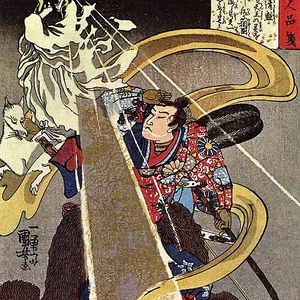

Japanese Shintō deity associated with rice, fertility, foxes, and commerce. Inari is one of the most venerated deities in Japan, with shrines (inari-sha) found throughout the country.
Inari
Inari
8 min read
Frequently asked questions
Key Facts
- Inari is first mentioned in the Nihon Shoki (720 AD)
- The great shrine of Fushimi Inari-taisha in Kyoto dates back to the 8th century
- Inari can be depicted in masculine, feminine, or androgynous form depending on tradition
- Inari's messengers are foxes (kitsune), present as statues in front of shrines
- About one third of Japan's Shintō shrines are dedicated to Inari (more than 30,000)
Works & Achievements
Inari presides over the formation of a network of more than 32,000 shrines across Japan, the densest of the entire Shinto pantheon, structuring the religious and agricultural life of the archipelago for over twelve centuries.
Inari becomes the tutelary deity of blacksmiths. According to the legend staged in the Nō drama 'Kokaji', a kitsune sent by Inari helps the blacksmith Sanjō Munechika forge one of the most celebrated swords in Japan.
The monk Kūkai (Kōbō Daishi) makes Inari the spiritual guardian of Kyoto's Tō-ji temple, merging Shinto worship with esoteric Buddhism and elevating Inari to the rank of protector of the imperial capital.
During the Edo era, Inari establishes itself as the protector of merchants and artisans. Major trading houses had small Inari shrines erected on the rooftops of their warehouses, a practice still found in modern Japanese businesses today.
Thousands of vermilion torii donated by worshippers create at Fushimi one of the most iconic sacred landscapes in Japan, making the shrine a global pilgrimage destination and a living symbol of the Inari cult.
Anecdotes
Foxes (kitsune) are the sacred messengers of Inari. In the Shinto tradition, they are depicted in pairs in front of shrines, guarding the entrance. A nine-tailed kitsune is a particularly powerful messenger, having accumulated centuries of divine wisdom. In Japanese folklore, the kitsune can take human form to carry out Inari's will and reward sincere devotees.
At Fushimi Inari-taisha, in Kyoto, thousands of vermilion torii form tunnels stretching several kilometers along the sacred mountain. These gates are donated by individuals and businesses in gratitude for favors granted by Inari. The tradition intensified during the Edo period (17th–19th centuries), when wealthy merchants sought to honor the deity of commerce and prosperity.
Inari is one of the rare Shinto deities whose gender is fluid: depending on the tradition and region, Inari may be venerated as an elderly man carrying rice, as a beautiful woman, or as a group of three distinct kami. This flexibility reflects Inari's ability to adapt to the needs of all worshippers — a sign of universal power.
The legendary swordsmith Sanjō Munechika, of the Heian period, is said to have been assisted by a kitsune sent by Inari to forge one of Japan's most celebrated swords, nicknamed Ko-Kitsune-Maru (Little Fox). This legend, staged in the Nō drama 'Kokaji', illustrates how the cult of Inari extended well beyond agriculture to become the protector of craftsmen and warriors.
Primary Sources
The shrines of Inari are listed among the important places of worship in Yamashiro Province. Rice offerings are prescribed to appease the deity and ensure good harvests throughout the entire country.
It is reported that the Hata clan built the first shrine on Inariyama Hill, after a mochi (rice cake) transformed into a white bird and flew to the mountain's summit — a sign of divine presence.
The Inari shrine of Yamashiro is classified among the great myōjin-taisha shrines, receiving official state offerings during the major national agricultural ceremonies.
Several stories describe kitsune serving Inari who reward the devout and punish those who lack devotion. A merchant who had offered rice at the shrine saw his shop prosper miraculously from the very next season.
The swordsmith Munechika, unable to find a qualified assistant, prays to Inari. A divine kitsune appears beside him and together they forge the sword Ko-Kitsune-Maru, bearing witness to Inari's protection over metalworkers.
Key Places
The main grand shrine of Inari, founded in 711 at the foot of Mount Inari. Famous for its thousands of vermilion torii gates, it is the most visited pilgrimage site in Japan, welcoming several million visitors each year.
A sacred mountain rising 233 meters, considered to be the physical body of the deity itself. The pilgrimage path winds up to the summit through dozens of smaller secondary shrines dedicated to the various manifestations of Inari.
One of the three great Inari shrines in Japan, founded in the 14th century within a Zen Buddhist temple dedicated to Dakiniten. It exemplifies the *shinbutsu-shūgō* syncretism that is characteristic of the Inari cult.
One of the three great Inari shrines, with a traditional founding date of 651. Located northeast of Tokyo, it draws more than three million pilgrims during its grand spring festival.
The third great Inari shrine in Japan, founded in 1687 on a rocky promontory overlooking a forest in Kyūshū. Nicknamed "the Nikkō of Kyūshū" for the richness of its lacquerwork and gilding.
Typical Objects

The vermilion gates mark the entrance to sacred spaces dedicated to Inari. Offered by worshippers as a sign of gratitude, they form tunnels several kilometers long along the slopes of the sacred mountain at Fushimi Inari.

White ceramic fox statues guard the entrance to Inari shrines. They sometimes hold in their mouths a key (to the rice storehouse), a jewel, or a sheaf of rice — symbols of the blessings granted by the deity.

Abura-agé is the favorite offering of Inari's kitsune. Worshippers place it in front of fox statues to win the deity's favor, a practice still very much alive in contemporary shrines.

Rice is Inari's founding attribute — the very name means 'carrying rice' or 'rice that grows.' Golden rice sheaves adorn depictions of the deity and altars during agricultural ceremonies.

Sake, a fermented rice alcohol, is an essential ritual offering to Inari. Large barrels of sake are placed in shrines during festivals, symbolizing fertility and abundance.

Worshippers write their wishes on wooden plaques, often depicting a fox. These are hung in shrines so that Inari may grant prayers for academic, business, or romantic success.
School Curriculum
Vocabulary & Tags
Key Vocabulary
Daily Life
Morning
At dawn, the shrine priests (kannagi) perform purification rites (misogi) and open the doors of the honden to 'awaken' the deity. Offerings of uncooked rice, sake, and pure water are placed before the inner altar, accompanied by ritual prayers (norito) recited aloud facing the sacred mountain.
Afternoon
Pilgrims flock to the shrine to present their requests to Inari: farmers praying for good harvests, merchants seeking prosperity, artisans looking for protection. Abura-agé (fried tofu) are offered to the guardian kitsune statues, and votive plaques (ema) inscribed with wishes are hung from the shrine gates.
Evening
At dusk, the closing rituals are performed and lanterns are lit along the shrine's pathways. Mount Inari, dotted with small secondary shrines, takes on a mysterious atmosphere said to favor kitsune apparitions according to popular belief. The priests close the honden for the night, concluding the ritual day.
Food
The ritual offerings made to Inari reflect its agrarian nature: cooked and uncooked rice, sake, abura-agé, freshwater fish, and seasonal vegetables. After the ceremonies, these offerings are distributed to priests and pilgrims during a communal meal called naorai, a moment of communion between humans and the deity.
Clothing
The priests serving Inari wear traditional Shintō attire: white and red hakama, an immaculate white kimono, and an eboshi hat. During major seasonal ceremonies, they don silk robes embroidered with rice stalks and fox silhouettes. The kitsune statues often wear small red bibs offered by devotees.
Housing
Inari resides in the honden, the most sacred building of the shrine, inaccessible to the uninitiated. At Fushimi, the sacred complex extends across the entire Mount Inari, with each level of the mountain housing a secondary altar dedicated to a specific manifestation of Inari, creating a layered divine dwelling between heaven and earth.
Historical Timeline
Period Vocabulary
Liens externes & ressources
Références
Œuvres
Fondation du réseau des sanctuaires Inari (稲荷社)
À partir du VIIIe siècle
Protection de la forge des épées — légende de Ko-Kitsune-Maru
Période Heian (794-1185)
Alliance spirituelle avec le temple Tō-ji (東寺)
823 apr. J.-C.
Patronage du commerce et de l'industrie à l'époque Edo
1603-1868
Les 'senbon torii' (千本鳥居) de Fushimi
À partir du XVIIe siècle