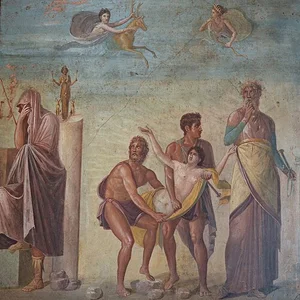

Daughter of Agamemnon and Clytemnestra, Iphigenia was condemned to be sacrificed at Aulis to appease Artemis and allow the Greek fleet to sail for Troy. Saved by the goddess, she was transported to Tauris where she became a priestess. Her fate inspired major tragedies by Euripides.
Iphigenia
Iphigenia
9 min read
Frequently asked questions
Famous Quotes
« I would rather live in misery than die with glory. (Euripides, Iphigenia at Aulis)»
Key Facts
- Daughter of Agamemnon, king of Mycenae, and Clytemnestra
- Condemned to sacrifice at Aulis after an unfavorable omen from Artemis blocked the Greek fleet
- Saved at the last moment by Artemis, who substitutes a doe in her place and transports her to Tauris
- Becomes high priestess of Artemis in Tauris, tasked with sacrificing strangers
- Reunites with her brother Orestes, who came to steal the statue of Artemis, and returns to Greece with him
Works & Achievements
A Greek tragedy recounting Iphigenia's life as a priestess in Tauris and her recognition of her brother Orestes. One of Euripides' most performed plays, celebrated for its recognition scene and its unusually happy ending within the tragic genre.
An unfinished tragedy performed after Euripides' death, retracing the sacrifice at Aulis. The scene in which Iphigenia courageously accepts her fate for the glory of Greece stands as one of the great moments in ancient theatre.
A French classical tragedy premiered at Versailles before Louis XIV. Racine adapts Euripides by introducing the character of Ériphile to preserve Iphigenia's virtue, embodying the ideals of French Classicism — propriety and verisimilitude.
A reforming opera staged in Paris that revolutionized lyric music by placing drama above vocal ornamentation. Gluck made Iphigenia a pathetic and noble heroine, inspiring a sweeping reform of European opera.
Gluck's masterpiece premiered in Paris, regarded as the most accomplished of his operatic reforms. The work triumphed over the Neapolitan operatic style and marked a decisive turning point in the history of dramatic music.
A verse drama by Goethe and a symbol of Weimar Classical humanism. Goethe transforms Iphigenia into a figure of reconciliation and moral truth, rejecting human sacrifice in the name of reason and humanity.
Anecdotes
To allow the Greek fleet to sail for Troy, Agamemnon was forced to sacrifice his own daughter. He lured her to Aulis under the pretense that she was to marry the hero Achilles. This cruel deception reveals the tension between military duty and paternal love that runs through all of Greek mythology.
At the moment of the sacrifice, the goddess Artemis intervened and replaced Iphigenia with a doe on the altar at Aulis. The young woman was mysteriously transported to Tauris (present-day Crimea), where she became high priestess — saved at the last possible moment in one of the most dramatic scenes in the entire Trojan cycle.
In Tauris, Iphigenia held the terrible duty of presiding over the human sacrifice of shipwrecked foreigners washed up on those shores. When her own brother Orestes landed there in disguise with his friend Pylades, she came within moments of sacrificing him before the two siblings recognized each other — a scene of recognition (*anagnorisis*) celebrated throughout all of Antiquity.
The story of Iphigenia illustrates the central conflict of Greek tragedy: divine will against the bonds of blood. Her father had no choice — Artemis had stranded the fleet because of an offense he had committed. This impossible dilemma inspired centuries of reflection on the justice of the gods and the fate of the innocent.
Iphigenia became one of the most admired female figures in world theater. Euripides gave her a human and moving voice in two tragedies, Racine brought her to Versailles before Louis XIV, and Gluck made her the heroine of his landmark reform operas — an exceptional artistic longevity for a mythological character.
Primary Sources
Iphigenia: 'O father, if only I had the voice of Orpheus to move you with my songs, if my words could touch your heart, I would use them. But now I bring only my tears; that is all I have.'
Iphigenia: 'What god or mortal, dwelling in these distant lands, could have brought me back to Greece, to my father's house, to the city where I was born?'
Artemis sent contrary winds and held the fleet at Aulis. The oracle revealed that the goddess demanded the sacrifice of Iphigenia. At the moment of the sacrifice, Artemis replaced her with a deer and carried her off to Tauris to serve as her priestess.
The fleet could not sail from Aulis until Iphigenia, the king's daughter, had been offered to the angered Diana. But the goddess took pity on the maiden and, at the moment of sacrifice, substituted a deer in her place.
Clytemnestra invokes the sacrifice of Iphigenia to justify her murder of Agamemnon: 'He killed what was most precious to me, my own daughter — and not to save Argos, but to gratify the madness of Menelaus.'
Key Places
Boeotian port where the Greek fleet gathered before sailing for Troy. It was here that Iphigenia nearly became a sacrificial victim on Artemis's altar — the place where her fate hung between death and a life of sacred exile.
Royal city of Agamemnon and birthplace of Iphigenia. It was from this citadel with its Cyclopean walls that the young woman left her family, believing she was traveling to Aulis to marry Achilles.
The mythological region at the edge of the known world where Artemis carried Iphigenia after the sacrifice at Aulis. She lived there for years as a priestess, compelled to sacrifice shipwrecked strangers cast upon those barbarous shores.
According to Euripides, Iphigenia settled at Brauron after her return from Tauris, where a real sanctuary of Artemis Brauronia stood. She ended her days there as a priestess, completing the full circle of her bond with the goddess.
Although Iphigenia took no part in the Trojan War itself, her sacrifice at Aulis was its indispensable precondition. The city of Priam stands as the bloody goal toward which her own sacrificial life was directed.
Typical Objects

A sacred instrument of Greek ritual, the curved knife was used to slit the throats of victims on the altar. In Tauris, Iphigenia was required to wield this fearsome object to slaughter foreigners — a cruel role imposed by her fate as an exiled priestess.

A primitive wooden statue (*xoanon*) representing Artemis, kept by Iphigenia in her temple in Tauris. Orestes' mission was to bring it back to Greece; it is around this statue that the recognition scene between brother and sister unfolds.

Used in nocturnal ceremonies honoring Artemis, the torch symbolizes the divine light guiding the priestess. It illuminates the sacred processions over which Iphigenia presided each evening at the temple.

Sacred bands used during sacrifices to adorn the altar and the victim. Iphigenia wove them herself according to Greek rite, perpetuating the cultic gestures of her homeland even in barbarian lands.

A footless cup used to pour liquids (wine, water, oil, milk) as offerings to the gods. Iphigenia poured libations to Artemis from it during daily ceremonies, keeping her bond with the Greek world alive.

In Euripides' tragedy, Iphigenia entrusts a letter to a stranger to deliver to her brother in Greece. It is precisely this letter that triggers the recognition scene: Orestes reveals that he himself is the intended recipient.

The animal Artemis placed in Iphigenia's stead on the altar at Aulis at the moment of sacrifice. The hind becomes the symbol of unexpected divine salvation and of the mercy hidden behind the apparent cruelty of fate.
School Curriculum
Vocabulary & Tags
Key Vocabulary
Tags
Daily Life
Morning
Iphigenia rose at dawn to perform the purifying ritual ablutions required of every priestess. She put on her sacerdotal garments — a white tunic and veil — then solemnly opened the doors of the temple of Artemis to welcome the light of day and recite the morning prayers, facing east.
Afternoon
The afternoon was devoted to managing the temple: overseeing the young cult attendants (neokoros), preparing vegetable offerings (fruits, barley cakes, flowers), and examining foreigners captured along the coastline. She had to determine their fate according to Taurian law — a duty that tormented her inwardly, for she remained deeply Greek at heart.
Evening
In the evening, Iphigenia presided over libation ceremonies and sometimes over nocturnal sacrifices by torchlight. She would then withdraw alone, gazing out to sea, meditating on her distant homeland and the loved ones from whom she had been separated for years — an inner exile as painful as her geographic one.
Food
As priestess of Artemis, goddess of wild nature, Iphigenia followed a simple, austere diet: barley bread (*maza*), boiled vegetables, goat's cheese, olives, and spring water. The meat from sacrifices was burned for the gods or reserved for communal ritual meals, not for the personal consumption of the priestesses.
Clothing
Iphigenia wore a long white tunic (*chiton*) cinched at the waist with a sacred belt, a symbol of her purity and her dedication to Artemis. A veil covered her hair during ceremonies. She wore no ostentatious jewelry, in keeping with the austerity expected of servants of the virgin goddess.
Housing
Iphigenia lived in the outbuildings of the temple of Artemis in Tauris, a cold, austere stone structure open to the Black Sea. Her room — a simple cell adorned with a small statue of Artemis and an oil lamp — was set apart from the main sanctuary. She lived surrounded by temple attendants yet maintained a deep inner solitude born of being a stranger in this barbarian land.
Historical Timeline
Period Vocabulary
Liens externes & ressources
Références
Œuvres
Iphigénie en Tauride — Euripide
vers -414
Iphigénie à Aulis — Euripide
vers -405 (posthume)
Iphigénie — Jean Racine
1674
Iphigenie auf Tauris — Johann Wolfgang von Goethe
1787