
Iris is the Greek goddess of the rainbow and messenger of the Olympian gods, most notably Zeus and Hera. Daughter of Thaumas and Electra, she serves as an intermediary between the divine world and the human world, carrying messages from the immortals to mortals.
Iris
Iris
9 min read
Frequently asked questions
Key Facts
- Iris is mentioned in Homer's Iliad as the messenger of the gods
- She is the daughter of Thaumas (a sea god) and Electra (an Oceanid)
- Her Greek name (Ἶρις) refers to both the goddess and the rainbow
- She is sometimes depicted with golden wings carrying a caduceus
- She primarily serves Hera and Zeus to relay their commands
Works & Achievements
Iris appears in numerous books as the messenger of Zeus and Hera, carrying orders and warnings to both gods and mortals. This foundational text establishes her role, attributes, and personality in Greek mythology.
Hesiod places Iris within the divine genealogy, identifying her as the daughter of Thaumas and Electra, and describes her role as guardian of the waters of the Styx. This cosmogonic poem establishes her place in the Greek world order.
In this Alexandrian epic, Iris plays a decisive role by preventing the Boreads from killing the Harpies, ensuring the balance between divine forces. She appears here as an arbiter of the gods' will in the face of mortal heroes.
Ovid offers one of the most poetic descriptions of Iris: she crosses the sky as an arc of light and enters the palace of Morpheus to deliver Juno's command. This passage inspired many artists of the Renaissance and Neoclassicism.
The marble sculpture depicting Iris in motion is one of the most remarkable ancient representations of the goddess; now held in the British Museum in London, it illustrates her characteristic grace and speed.
This neoclassical painting depicts the messenger of the gods addressing Morpheus as he sleeps in his dark lair. Housed in the Hermitage Museum in Saint Petersburg, it reflects the renewed interest in Iris in 19th-century European art.
Anecdotes
In Homer's *Iliad*, Iris is sent by Zeus to warn Priam, the king of Troy, to go and reclaim the body of his son Hector from the Greek camp. She appears to him in the guise of one of his sons and delivers the divine message gently, giving him the courage to face Achilles. This role as a benevolent messenger illustrates her central place in communication between mortals and immortals.
Iris possesses the unique ability to descend into the Underworld and fill a sacred jug with the waters of the Styx. This water was used to seal the oaths of the gods — should a god break such an oath, they were condemned to lie breathless and speechless for a year. Iris was the only one capable of making this perilous journey and returning alive.
In Apollonius of Rhodes's *Argonautica*, Iris intervenes to stop the Harpies who were tormenting the seer Phineus. She holds back the Boreads — sons of the North Wind — who were about to kill the creatures, and promises in the name of the gods that the Harpies will never return. This episode highlights her role as mediator and guardian of divine order.
In Ovid's *Metamorphoses*, Iris is tasked by Juno with seeking out Morpheus, the god of sleep, to ask him to send a dream to Alcyone. She ventures deep into the land of dreams, a place of absolute silence, and gently rouses the sleeping god to deliver her message. This episode shows just how indispensable Iris is for reaching even the most inaccessible of gods.
Unlike Hermes, the male messenger of the gods, Iris is especially linked to Hera and conveys her commands to goddesses and mortal women alike. Ancient texts describe her speed as surpassing that of the wind, and she can cross in an instant the distance between Olympus and the depths of the sea. Her Greek name, *iris* (ἶρις), denotes both the goddess and the rainbow, underscoring that her very being and her path through the sky are one and the same.
Primary Sources
Wind-footed Iris, the messenger, sped like a storm; she drew near and spoke to him with winged words.
Zeus called golden-footed Iris: “Go, swift Iris, leave Olympus and tell great-hearted Priam to go to the Achaean ships to ransom his beloved son.”
And Thaumas wed Electra, daughter of deep-flowing Ocean; she bore swift Iris and the fair-haired Harpies, Aello and Ocypete.
Iris swept down from the Olympian sky and stretched out her hand toward Zetes: “It is not lawful for mortals to strike the hounds of Zeus; the Harpies shall trouble Phineus no more.”
Iris put on her thousand-colored robes, traced her arching bow across the sky, and sought the cloud-wrapped palace of Sleep, then gently roused Morpheus with her winged voice.
Key Places
Home of the Greek gods and the starting point of all Iris's missions. It is from its summit that she takes flight to carry messages from Zeus and Hera to mortals or other deities.
In the *Iliad*, Iris appears repeatedly on and around the Trojan battlefield to relay the gods' commands. She is notably sent to Priam to allow him to retrieve Hector's body from Achilles.
Iris is the only deity permitted to descend into the Underworld to draw the sacred waters of the Styx. This mythical river marks the boundary of the land of the dead, and its waters are used to seal the most irrevocable divine oaths.
One of the largest sanctuaries of Hera in the Greek world, on the island of Samos. As Hera's messenger, Iris was honored here, and representations of the goddess have been uncovered during archaeological excavations.
Iris appears among the sculptures of the Parthenon's east pediment (5th century BCE), depicted in motion during the birth of Athena. These marble carvings attest to Iris's importance in the official iconography of the Greek city-state.
Typical Objects

The rainbow is both the path and the visible manifestation of Iris herself: she travels along it or transforms into it to pass from the heavens to the earth. In Greek tradition, seeing a rainbow meant that a divine messenger was on her way.

Iris is invariably depicted with large golden or multicolored wings that allow her to fly faster than any wind. These wings symbolize her ability to cross instantly the distances between the divine and human worlds.

Iris is the only deity permitted to descend to the Underworld and draw the sacred water of the Styx in a golden jug. This water is used to seal the irrevocable oaths of the gods: any immortal who breaks such an oath is struck motionless and mute for a year.

The veil and tunic of Iris shimmer with every color of the rainbow, according to Greek and Roman texts. Ovid describes her donning her iridescent garments before each mission, making her an immediately recognizable figure in ancient iconography.

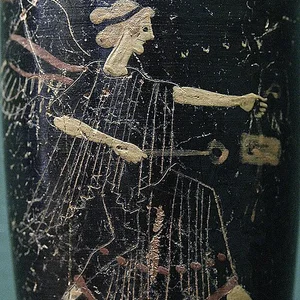
Like Hermes, Iris is sometimes depicted on Greek vases holding a caduceus or herald's staff, the emblem of her divine diplomatic mission. This symbol marks her as an inviolable envoy whose message must be honored.

In certain ceramic representations, Iris carries a cup used for libations — liquid offerings poured to the gods during ceremonies. She attends the banquets of Olympus and may serve as an attendant of honor to the other deities.
School Curriculum
Vocabulary & Tags
Key Vocabulary
Tags
Daily Life
Morning
Iris begins her day on Olympus, ready to receive orders from Zeus or Hera. The moment a message must be delivered, she dons her shimmering himation and spreads her great golden wings. Her mornings can see her cross the Mediterranean sky from end to end in mere instants.
Afternoon
Her afternoons are devoted to the most varied missions: delivering a summons to dissenting gods, warning a hero of divine favor or wrath, or descending to the ocean depths to find a deity. She travels faster than any wind and can cross several worlds in a single day without ever growing tired.
Evening
In the evening, Iris joins the gods' banquet on Olympus, where she may serve nectar and ambrosia to the immortals. She listens to the gods' deliberations and stands ready for any nocturnal mission. Unlike Hermes, she is not tasked with guiding the souls of the dead — her role is that of a messenger of light and life.
Food
Like all Olympian deities, Iris subsists on nectar and ambrosia, the divine foods that bestow immortality. She never consumes mortal food, a distinction that marks the uncrossable boundary between gods and humans. Her role as messenger sometimes brings her to divine feasts, though she takes no active part in them.
Clothing
Iris wears a *himation* and a *peplos* whose colors faithfully reproduce those of the rainbow. Her garments shimmer and sparkle with every movement, instantly betraying her divine nature. Ovid describes her donning her iridescent robes before each mission as a preparatory ritual.
Housing
Iris resides on Olympus in the palace of the gods, where she holds the position of a high-ranking attendant to Hera. She has no fixed home, for her very nature is one of perpetual movement between worlds. Some myths place her dwelling at the foot of the sky, where the rainbow seems to touch the horizon.
Historical Timeline
Period Vocabulary
Liens externes & ressources
Références
Œuvres
Iliade (Homère)
VIIIe siècle av. J.-C.
Théogonie (Hésiode)
VIIe siècle av. J.-C.
Argonautiques (Apollonios de Rhodes)
IIIe siècle av. J.-C.
Métamorphoses, Livre XI (Ovide)
8 apr. J.-C.
Fronton est du Parthénon (atelier de Phidias)
~432 av. J.-C.
Iris et Morphée (Pierre-Narcisse Guérin, peinture)
1811