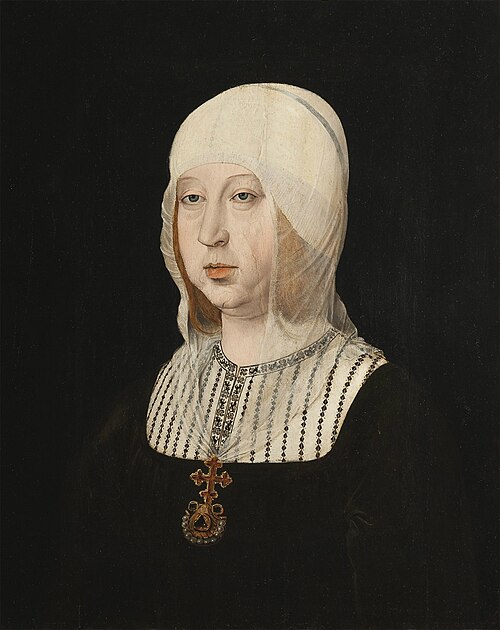
Isabella I of Castile(1451 — 1504)
Isabella the Catholic
couronne de Castille
9 min read
Queen of Castile and León (1474–1504), she unified Spain with her husband Ferdinand II of Aragon. She financed Christopher Columbus's voyage in 1492 and drove the Reconquista to its conclusion with the fall of Granada.
Frequently asked questions
Famous Quotes
« I will pledge my crown to finance this voyage. »
Key Facts
- 1474: crowned Queen of Castile after the death of her brother Alfonso
- 1479: marriage to Ferdinand II of Aragon, uniting the two Spanish crowns
- 1480: establishment of the Spanish Inquisition under royal authority
- 1492: fall of Granada (end of the Reconquista) and financing of Columbus's voyage
- 1492: Alhambra Decree ordering the expulsion of Jews from Spain
Works & Achievements
Through her marriage to Ferdinand of Aragon and their joint rule, Isabella united the kingdoms of Castile, León, and Aragon under a shared authority, laying the foundations of modern Spain. This union was nonetheless personal: both kingdoms retained their own laws and institutions.
The *Capitulaciones de Santa Fe* (April 17, 1492) authorized and funded Columbus's first voyage, opening the way for Spanish colonization of the Americas. This political and economic act is one of the most consequential in world history.
After ten years of military campaigns (1482–1492), Isabella and Ferdinand completed the *Reconquista* by capturing Granada, the last Islamic kingdom on the Iberian Peninsula. This event brought to a close 781 years of Muslim presence in Spain.
Isabella and Ferdinand obtained authorization from Pope Sixtus IV to establish an inquisitorial tribunal under royal control, initially to monitor *conversos* (converted Jews). Led by Tomás de Torquemada, the Inquisition would become one of the most controversial instruments of their reign.
This decree ordered the expulsion of all Jews who refused to convert to Christianity, forcing tens of thousands into exile. A founding act of the project of forced religious unity, it remains one of the most controversial decisions of the reign.
Negotiated with Portugal under papal mediation, this treaty divided the world into two spheres of influence. It illustrates the ambitious diplomacy of Isabella and Ferdinand, who sought to legally codify European dominion over newly discovered lands.
Isabella commissioned Cardinal Francisco Jiménez de Cisneros to reform the Castilian religious orders, combat corruption among the clergy, and strengthen ecclesiastical discipline. This reform partially anticipated and influenced the Protestant Reformation of the following century.
Anecdotes
In 1469, Isabella married Ferdinand of Aragon in secret in Valladolid, defying the opposition of King Henry IV of Castile, her own half-brother. To convince witnesses of the legitimacy of their union, the couple presented a forged papal bull of authorization — a bold diplomatic gambit that marked the beginning of an alliance that would reshape Spain.
On January 2, 1492, Isabella and Ferdinand received the keys to Granada, the last Muslim kingdom on the Iberian Peninsula. According to the chronicles, Boabdil, the defeated sultan, wept as he handed over the keys and took one last look at the Alhambra. That day has remained etched in the Spanish collective memory as the triumph of the Reconquista.
It was Isabella who ultimately convinced Ferdinand to fund Christopher Columbus's expedition in 1492, after the project had been repeatedly rejected by royal commissions. Legend has it that she offered to pledge her own jewels to finance the venture — a symbolic gesture, even if historians today treat this account with some nuance.
Isabella was one of the first European monarchs to receive a full humanist education, learning Latin as an adult so she could read diplomatic and religious texts directly. She assembled a personal library of several hundred volumes — exceptional for the time — and was a patron of scholars and artists at her court.
Isabella died in 1504 in Medina del Campo, worn out by years of war, pregnancies, and successive bereavements — including the death of her heir, Prince Juan, in 1497. Her will, drawn up shortly before her death, reflects an undiminished political resolve: in it she calls for the gentle evangelization of the indigenous peoples of the Americas and reminds the conquistadors of their moral duties.
Primary Sources
Don Fernando e Doña Ysabel [...] dan e otorgan a vos Christóbal Colón [...] el oficio de Almirante en todas aquellas islas e tierras firmes que por su mano e industria se descubrirán o ganarán en las dichas mares Océanas.
Mandamos a todos los judíos y judías de cualquier edad que sean, que viven, moran y están en los dichos nuestros reinos y señoríos [...] que fasta en fin del mes de julio primero que viene deste presente año salgan de todos los dichos nuestros reinos y señoríos.
Suplico al Rey mi señor [...] que se contente e conforme con ellas; e si algo en contrario se ha fecho o intentado, lo mande remediar e enmendar. Otrosí, suplico a Su Alteza que tenga mucho cuidado de las cosas de la Inquisición.
La Reina tenía tanta gracia en el hablar e tanta fuerza en el razonar, que cuantos la oían quedaban maravillados de su saber e de la manera de su gobernar, que parescía más obra divina que humana.
Sepa Vuestras Altezas que yo he hallado muchas islas pobladas con gente sin número, y dellas todas he tomado posesión por Sus Altezas con pregón y bandera real extendida.
Key Places
Isabella's birthplace, born in a royal palace here in 1451. The town still preserves the monastery and medieval ramparts that shaped her earliest years.
The last stronghold of the Nasrid Kingdom of Granada, taken on January 2, 1492. Isabella and Ferdinand established their court there and made the Alhambra a royal residence. Granada was the stage for the final episode of the Reconquista.
The administrative and religious capital of Castile, seat of the Primatial Archbishopric of Spain. Isabella convened several Cortes there and carried out major religious reforms alongside Cardinal Cisneros.
A military camp built by Isabella and Ferdinand during the siege of Granada, which grew into a permanent town. It was here that the Capitulaciones were signed in April 1492, granting Columbus authorization for his voyage.
The town where Isabella died on November 26, 1504, worn down and weakened after years of rule and personal losses. She had also resided there regularly, as the town was an important commercial and political center of Castile.