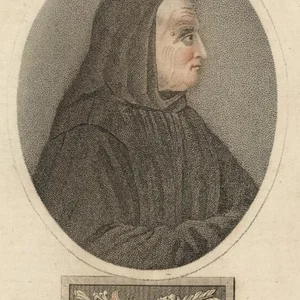

A Benedictine monk of the Congregation of Saint-Maur, Jean Mabillon is the founder of diplomatics, the critical science of authenticating charters and ancient documents. His major work, De re diplomatica (1681), laid the foundations of modern historical method.
Jean Mabillon(1632 — 1707)
Jean Mabillon
France
7 min read
Frequently asked questions
Key Facts
- Born in 1632 in Pierrepont (Aisne), died in Paris in 1707
- Joined the Congregation of Saint-Maur in 1654
- Published De re diplomatica in 1681, establishing diplomatics as a scientific discipline
- Responded to Abbot de Rancé with the Traité des études monastiques (1691), defending the intellectual work of monks
- Undertook a major scholarly journey to Germany and Italy (1683) to collect manuscripts
Works & Achievements
The founding work of diplomatics, this six-volume treatise established for the first time scientific criteria for authenticating medieval charters. It marks the birth of the modern critical historical method.
A vast hagiographic collection in nine volumes gathering the lives of Benedictine saints arranged by century, grounded in rigorous source criticism and long considered a standard reference for the history of Western monasticism.
A measured and scholarly response to Abbot de Rancé, this treatise defends the legitimacy of intellectual study within monastic life and lays the foundations of a humanist Benedictine pedagogy.
A two-volume account of Mabillon's travels in Italy, containing inventories of manuscripts and unpublished documents held in libraries and archives across the peninsula.
A major chronological history of the Benedictine Order from its origins, begun by Mabillon and continued by his Maurist brethren; a standard reference work for European medieval history.
A journal of Mabillon's journey through Germany (1683), published after his death, describing his research in the archives and libraries of Rhenish and Bavarian abbeys.
Anecdotes
In 1681, Mabillon published De re diplomatica, a work of more than 500 pages in which he established scientific criteria for authenticating medieval charters. The book put an end to a dispute with the Bollandist Daniel van Papenbroeck, who had challenged the authenticity of Merovingian documents. Mabillon responded with exemplary rigor and courtesy, demonstrating through analysis of the handwriting, parchment, and seals that the charters were indeed authentic.
The Abbé de Rancé, reformer of the Abbey of La Trappe, publicly attacked Mabillon in 1692, arguing that monks should not devote their lives to intellectual study but solely to prayer and manual labor. Mabillon responded with his Traité des études monastiques, defending with moderation and erudition the compatibility between monastic life and scholarly work. This exchange remains one of the most celebrated debates in seventeenth-century Catholicism.
Between 1683 and 1686, Mabillon undertook lengthy journeys to Germany and Italy to consult directly the archives of the great European abbeys and libraries. He visited dozens of monasteries, transcribed thousands of documents, and brought back to Paris previously unknown information about the medieval written heritage. These travels were funded by Colbert, who supported the scholarly work of the Maurists in service of France's intellectual prestige.
At Mabillon's death in 1707, the Abbey of Saint-Germain-des-Prés went into mourning and scholars from across Europe paid tribute to his memory. Voltaire himself — rarely generous toward men of religion — would later acknowledge that Mabillon had founded a true science. His name remains to this day associated with the critical historical method, far beyond monastic circles.
Primary Sources
Diplomatica est ars dijudicandi antiqua diplomata ac rescripta, chartas et id genus monumenta, tum ab iis quae supposita sunt ac spuria, tum a mendis et interpolationibus.
The study of sacred and secular letters is so necessary for monks that one may say that without it they cannot worthily fulfill the principal duties of their state.
Aggressi sumus opus laboriosum quidem et vires nostras longe superans, sed ad gloriam Dei et Ordinis nostri pertinens: Acta videlicet Sanctorum qui in Ordine Benedictino floruerunt.
Inter praecipua eruditionis subsidia eminent bibliothecae et tabularia, quae ad historiae cognitionem plurimum conferunt; earum copiam Italiae beneficio habuimus.
Sanctissimi Patris nostri Benedicti Annales aggredimur, qui per quindecim saecula in Ecclesia Dei floruerunt, ac praeclara monumenta in omni scientiarum genere reliquerunt.
Key Places
Birthplace of Jean Mabillon, in the Champagne region, where he was born on 23 November 1632 into a peasant family. It is here that he received his earliest education before entering the college at Reims.
The principal intellectual centre of the Congregation of Saint-Maur, where Mabillon spent the greater part of his adult life, wrote all of his works, and died in 1707. Today only the church survives at the heart of Paris.
An ancient Benedictine abbey where Mabillon stayed during his early monastic years and began working on the Merovingian manuscripts held in its celebrated scriptorium.
During his travels to Italy (1686 and 1701), Mabillon consulted the papal archives and Roman libraries, bringing back inventories of previously unpublished documents for his historical research.
The cradle of the Benedictine order, founded by Saint Benedict in the 6th century. Mabillon visited it during his Italian journey and consulted its archives, which hold irreplaceable historical value.
Typical Objects

The everyday tools of the scholarly monk — the trimmed quill and iron-gall ink — allowed Mabillon to transcribe thousands of documents and compose his monumental works through long nightly vigils.

Official documents of the Frankish kings from the 6th–8th centuries, bearing seals and subscriptions, these pieces are the central objects of Mabillon's inquiry as he laid the foundations of diplomatics.

The black cowl with wide sleeves worn by all monks of Saint-Maur symbolizes belonging to the order and monastic poverty; Mabillon wore it without ever setting it aside, even when traveling.

Essential for examining the fine details of scripts, seals, and parchments, the magnifying glass allowed Mabillon to analyze the graphic features that reveal whether a document is authentic or forged.

An impression affixed to charters to authenticate them officially; Mabillon developed a comparative method for studying seals that became one of the cornerstones of diplomatics.

The codices adorned with miniatures held at Saint-Germain-des-Prés served Mabillon both as historical sources and as paleographic references for dating handwriting styles.

The founding text of Western monastic life, read aloud daily in community; Mabillon drew from it the spiritual framework of his existence and devoted part of his work to the history of the order it brought into being.
School Curriculum
Vocabulary & Tags
Key Vocabulary
Daily Life
Morning
Mabillon's day begins well before dawn with Matins and Lauds, offices sung in common in the abbey church. After the morning Mass, he makes his way at first light to the library of Saint-Germain-des-Prés, one of the richest in Europe, to examine charters and manuscripts by candlelight or by the window.
Afternoon
The afternoon is devoted to writing, to correspondence with scholars across Europe, and to receiving learned visitors — bibliophiles and ecclesiastics who come to consult the great man. Mabillon compares scripts, copies extracts from documents, examines seals, and prepares his arguments.
Evening
After Vespers and Compline, the communal meal is held in the refectory while a monk reads a sacred text aloud according to the Rule. In the evening, Mabillon may still read or prepare the next day's work before the monastic Great Silence settles over the entire abbey.
Food
According to the Benedictine Rule, meals consist of vegetables, legumes, wheat bread, and cheese. Meat is forbidden except for the sick; fish, eggs, and milk are permitted. At Saint-Germain-des-Prés, the community benefits from kitchen gardens and more varied resources than those found in rural abbeys.
Clothing
Mabillon wears at all times the black Benedictine cowl, a wide hooded woolen robe worn over a white linen tunic. Simple and functional, the habit expresses belonging to the Order and serves as a reminder of the vow of poverty. For solemn liturgical services, he dons the vestments proper to his rank as a priest.
Housing
Mabillon lives in an individual cell in the abbey of Saint-Germain-des-Prés, furnished with a wooden bed, a writing table, a *prie-Dieu*, and a few shelves. The neighboring abbey library, rich with thousands of manuscripts and charters, is his true intellectual living space.
Historical Timeline
Period Vocabulary
Liens externes & ressources
Références
Œuvres
De re diplomatica libri VI
1681
Acta Sanctorum Ordinis Sancti Benedicti
1668–1702
Traité des études monastiques
1691
Museum Italicum
1687–1689
Annales Ordinis Sancti Benedicti
1703–1739 (6 vol., dont 4 posthumes)
Iter Germanicum
1717 (posthume)