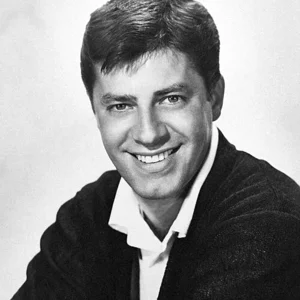

An American actor, filmmaker, and comedian born in 1926, Jerry Lewis is an icon of world comedy cinema. Famous for his duo with Dean Martin, he was particularly revered in France, where he was elevated to the rank of Commander of the Order of Arts and Letters.
Jerry Lewis(1926 — 2017)
Jerry Lewis
États-Unis
9 min read
Frequently asked questions
Famous Quotes
« I am the only genius I know.»
« France taught me to love myself.»
Key Facts
- Born on March 16, 1926, in Newark, New Jersey, under the name Joseph Levitch
- Forms a legendary comedy duo with Dean Martin between 1946 and 1956
- Directs and stars in *The Bellboy* (1960) and *The Nutty Professor* (1963)
- Awarded the Legion of Honor by France in 1984
- Dies on August 20, 2017, in Las Vegas
Works & Achievements
The first film of the Martin & Lewis duo, produced by Paramount, which established the formula behind their success: the smooth charmer opposite the endearing clown. It definitively launched their film careers and made them the most popular comedians in America.
The first film directed by Lewis himself, shot in seventeen days at the Fontainebleau Hotel in Miami. Nearly silent in spirit, it reveals a visionary filmmaker who constructs his gags with an architectural and spatial precision unlike anything seen before.
The film in which Lewis invented the video assist system and designed a unique set — a boarding house filmed in cross-section — considered one of the most inventive in the history of film comedy.
Lewis's undisputed masterpiece, a retelling of the Jekyll and Hyde legend in which he plays both the timid Professor Kelp and the arrogant Buddy Love. The film is regarded by international critics as a landmark work of twentieth-century American comedy.
Martin Scorsese's film in which Lewis took on his first major dramatic role, playing Jerry Langford, an American talk-show star stalked by an obsessive fan. His restrained and unsettling performance revealed a depth as an actor that the general public had never suspected.
An annual charitable television broadcast hosted by Lewis for forty-five years, raising over two billion dollars for research into muscular diseases. The Telethon became an American cultural institution and directly inspired the French AFM Telethon, created in 1987.
Anecdotes
Jerry Lewis revolutionized filmmaking by inventing the "video assist" system on the set of *The Ladies Man* in 1961. He connected a video monitor directly to the camera so he could immediately review takes without waiting for the next day's rushes. This technical innovation, which he never patented, is now used on film sets around the world.
The split of the **Martin & Lewis** duo on **July 24, 1956** was one of the most dramatic breakups in American show business. During their final performance at the **Copacabana** in **New York**, the two comedians parted ways without any prior official announcement, leaving their audience in shock. The curtain fell on ten years of meteoric success and a friendship that would only be briefly rekindled twenty years later, during a Telethon.
In **France**, Jerry Lewis enjoyed a level of admiration that Americans did not always understand. Critics at *Cahiers du Cinéma* regarded him as a genuine auteur on a par with Chaplin or Keaton. He received the **Légion d'honneur** in **1984** and was made a *Commandeur des Arts et des Lettres* — an honor that moved him deeply and that he spoke of with emotion until the end of his life.
For forty-five years, Jerry Lewis hosted the annual Telethon for the **Muscular Dystrophy Association (MDA)**, beginning in **1966**. He would often devote more than twenty consecutive hours to it, raising a total of over two billion dollars. This commitment stemmed from a memorable encounter in the **1950s** with a child suffering from muscular dystrophy, which awakened in him an unwavering philanthropic dedication.
During the filming of *The Nutty Professor* in **1963**, Jerry Lewis played two radically opposite characters: Professor Kelp, clumsy and endearing, and Buddy Love, charming but arrogant. Many saw in the character of Buddy Love a sharp portrait of **Dean Martin**, his former partner. Lewis always denied this interpretation, but the ambiguity has long contributed to the film's enduring mystique.
Primary Sources
The director is the total film-maker. He must be the writer, the actor, the set designer, the costume designer, the cutter — he must be all things to all men on the set.
Dean and I had something that was bigger than either one of us. We were greater than the sum of our parts, and the day we split up, a piece of me died.
Jerry Lewis is the only American director who has succeeded in making mise en scène a comic act in itself.
France gave me something America had not yet given me: respect as an artist. You saw me as a filmmaker, and that changed me.
Key Places
Jerry Lewis's birthplace, born on March 16, 1926, in a neighborhood with a large immigrant Jewish population. His parents, vaudeville performers, introduced him to show business at a very early age, in the heart of working-class America.
The legendary Manhattan nightclub where Martin & Lewis split for good on July 24, 1956, during their final performance together. This venue became part of American show-business legend as the stage for a breakup as sudden as it was sensational.
The heart of the American film industry, where Lewis shot the majority of his movies — first alongside Dean Martin, then as a solo act. Paramount Studios was his artistic playground for more than a decade.
The entertainment capital of America, where Lewis performed regularly from the 1950s onward, notably at the Sands Hotel alongside the Rat Pack. Las Vegas was his primary residence during the last decades of his life and the place where he died in 2017.
The Parisian cultural institution that championed Jerry Lewis as a genuine auteur filmmaker, organizing several major retrospectives of his work. Paris was the city where his genius was recognized earliest and most fully — long before the United States caught on.
Typical Objects

An iconic fixture of cabarets and performance venues in the 1940s–1960s, the gooseneck microphone allowed Lewis to interact with the audience while performing his pantomime routines. He frequently turned it into a comic prop in its own right.

The standard professional camera of Hollywood studios in the 1950s–1970s, used by Lewis as a director on his own productions. He mastered its technical settings with the precision of a perfectionist engineer.

Lewis was the first to connect a video monitor directly to a film camera in order to review takes in real time, thereby inventing the video assist system in 1961. This revolutionary innovation, which he never patented, is now universally used on film sets around the world.

The formal tuxedo look typical of cabarets and Las Vegas shows in the 1950s, the bow-tie ensemble served as the elegant starting point from which Lewis would launch his comic breakdowns. The contrast between the refinement of the outfit and the deliberate clumsiness of his character was at the very heart of his art.

An essential tool for synchronizing picture and sound on a film set, the clapperboard became, for Lewis the actor-director, a symbol of his dual role on his own productions. He personally supervised its use — a sign of his total control over the filmmaking process.

A recurring comic prop in Lewis's sketches and films, the telephone allowed him to exploit mix-ups and absurd situations born from miscommunication. The theme of misunderstanding and crossed wires was central to his brand of humor.
School Curriculum
Vocabulary & Tags
Key Vocabulary
Tags
Daily Life
Morning
In the 1960s, at the height of his career, Lewis began his days very early on his film sets, often as early as five in the morning. He personally supervised the lighting, sets, and camera placement before the crews arrived — a perfectionist's obsession that guaranteed the visual consistency of his films but exhausted his collaborators.
Afternoon
Afternoon shoots were devoted to takes, punctuated by immediate review sessions on his video monitor. After the final cut, he would often stay in the editing room to oversee the day's rushes, combining with uncommon energy the roles of director, actor, and producer.
Evening
In the evenings, Lewis transformed into a stage performer: casino shows or sold-out theater performances, particularly in Las Vegas where he appeared several nights a week. He was known for his long nights with the Rat Pack — Sinatra, Davis Jr., Martin — mixing improvisation, music, and the male camaraderie typical of the American show business world of the 1950s and '60s.
Food
Lewis often ate quickly on set, simple meals prepared by catering crews. His growing dependence on painkillers, tied to chronic back problems aggravated by years of physical comedy, affected his relationship with food and his physical appearance from the 1970s onward.
Clothing
On screen and on stage, Lewis wore carefully calculated costumes: the bow-tie tuxedo for cabaret shows, oversized or too-short clothing to accentuate the awkwardness of his characters. In private life, he was elegant and attached to quality dress, reflecting a taste for luxury acquired through success.
Housing
Lewis lived in luxurious homes in the Hollywood Hills and later in Las Vegas, symbols of his success in postwar America's dream. His Las Vegas residence was renowned for housing an impressive collection of electronic and cinematographic equipment, a testament to his abiding passion for technology.
Historical Timeline
Period Vocabulary
Liens externes & ressources
Références
Œuvres
Téléthon MDA (Muscular Dystrophy Association)
1966—2011