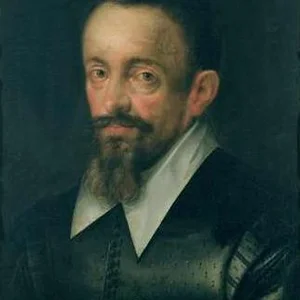

German astronomer and mathematician (1572–1630), Kepler formulated the three laws of planetary motion that revolutionized astronomy. A disciple of Tycho Brahe, he confirmed Copernicus's heliocentric model through precise mathematical calculations.
Johannes Kepler(1572 — 1630)
Johannes Kepler
Saint-Empire romain germanique, duché de Wurtemberg
8 min read
Frequently asked questions
Famous Quotes
« Geometry is unique and eternal, a reflection of the mind of God.»
« I used to measure the heavens, now I measure the shadows of the earth.»
Key Facts
- 1600: joins Tycho Brahe in Prague as his assistant
- 1609: publishes Astronomia Nova, stating his first two laws of planetary motion
- 1619: publishes Harmonices Mundi, containing his third law
- 1627: completes the Rudolphine Tables, a landmark star catalogue
- Discovered that planets follow elliptical orbits rather than circular ones
Works & Achievements
Kepler's first published work, defending Copernicus's heliocentric system. Although his geometric model (Platonic solids) proved incorrect, the work reveals his lifelong quest for a universal mathematical order.
A landmark work stating the first two laws of planetary motion: orbits are elliptical, and planets sweep out equal areas in equal times. A decisive break with the long tradition of perfect circular orbits.
A treatise on optics in which Kepler provides a theoretical explanation of how lenses work and proposes a new telescope design using two convex lenses, known as the 'Keplerian astronomical telescope'.
A major work blending astronomy, geometry, and music, in which Kepler states his third law: the square of a planet's orbital period is proportional to the cube of the semi-major axis of its orbit.
A seven-volume astronomy textbook synthesizing all of Kepler's discoveries. This accessible educational work spread his laws among European scholars, though the Church placed it on the Index in 1619.
Tables of planetary positions based on Brahe's observational data and Kepler's laws. Dedicated to Emperor Rudolf II, they enabled predictions of planetary positions with unprecedented accuracy and remained in use for a century.
An imaginary voyage to the Moon, considered one of the earliest works of science fiction. Kepler describes Earth as seen from the Moon and uses fiction as a vehicle to spread his Copernican ideas.
Anecdotes
Kepler suffered from very poor eyesight from childhood, a lasting effect of smallpox contracted at age 4. This was a cruel irony of fate for a man who would become one of the greatest observers of the sky — he had to rely on Tycho Brahe's extraordinarily precise records rather than his own observations.
In 1600, Kepler joined Tycho Brahe in Prague after fleeing religious persecution. Their collaboration was turbulent: Brahe refused to share all his data, fearing that Kepler would steal his glory. When Brahe died suddenly in 1601, Kepler seized the precious observation records and used them to formulate his laws.
Kepler spent six years defending his mother Katharina before a court from 1615 to 1621: she had been accused of witchcraft. He wrote her defense himself — a 128-page document — and succeeded in having her acquitted. The ordeal consumed him for six years in the midst of his greatest scientific discoveries.
To explain the distances between the planets, Kepler devised an imaginative geometric model in his 1596 Mysterium Cosmographicum: the six known planets were inscribed within the five Platonic solids, nested one inside another. The model was entirely wrong, but the mathematical rigor he applied in developing it ultimately led him toward his true discoveries.
Kepler was among the first to use the word 'satellite' to describe the moons of Jupiter discovered by Galileo in 1610. He corresponded actively with Galileo, and although the two scholars never met in person, they encouraged each other in their defense of the heliocentric system.
Primary Sources
I confess that when Tycho died, I took possession of his observations as an inheritance left for me, with the intention of interpreting them... The orbits of the planets are ellipses with the Sun at one of the foci.
The Earth is the measure of all planetary orbits. Circumscribe a dodecahedron around it; the sphere surrounding it will be that of Mars. Around Mars, circumscribe a tetrahedron; the sphere surrounding it will be that of Jupiter.
The square of the orbital periods of the planets is proportional to the cube of their mean distances from the Sun. I have gathered this treasury of astronomy from Pythagoras and Ptolemy, and purified it of errors.
I believe in Copernicus and not in those who laugh off this hypothesis. I must say that your telescope and your observations have removed all doubt from my mind about the motion of the Earth.
The Sun, source of light and heat, is the driving force of the planetary world. Its power spreads through space and diminishes with distance, carrying the planets along in their courses.
Key Places
Kepler's birthplace, a small imperial city of the Holy Roman Empire. A statue and a museum there honor his memory today.
Tycho Brahe's observatory where the astronomical data that Kepler relied on throughout his life were collected. Although he never worked there himself, the place is inseparable from his work.
Capital of the Empire where Kepler lived from 1600 to 1612 as imperial mathematician at the court of Rudolf II. It was here that he wrote the Astronomia Nova and formulated his first two laws.
The city where Kepler resided from 1612 to 1626 as provincial mathematician. There he wrote the Harmonices Mundi and the Rudolphine Tables despite the upheavals of the Thirty Years' War.
The city where Kepler died in November 1630 while traveling to recover funds owed to him. His tomb, destroyed during the Thirty Years' War, was reconstructed in the 19th century.
Liens externes & ressources
Références
Œuvres
Mysterium Cosmographicum
1596
Astronomia Nova
1609
Dioptrice
1611
Harmonices Mundi
1619
Epitome Astronomiae Copernicanae
1618-1621
Tabulae Rudolphinae (Tables Rudolphines)
1627
Somnium
1634 (posthume)