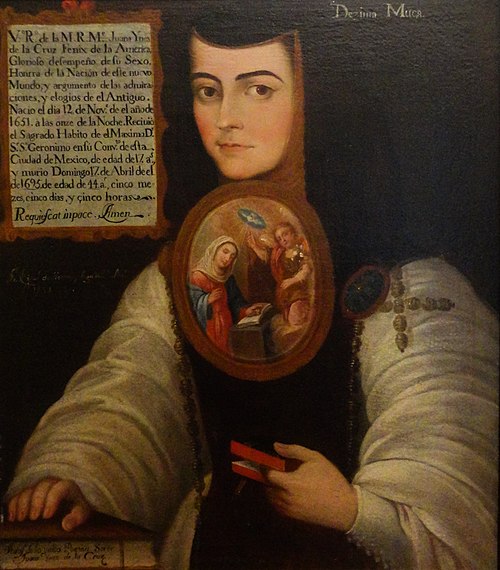
Juana Inés de la Cruz
Juana Inés de la Cruz
1651 — 1695
Empire espagnol
A nun, poet, and playwright from New Spain (colonial Mexico), Juana Inés de la Cruz is considered the first great female writer of Latin America. A brilliant self-taught scholar, she championed women's right to education and knowledge.
Famous Quotes
« ¿En perseguirme, Mundo, qué interesas? / ¿En qué te ofendo, cuando sólo intento / poner bellezas en mi entendimiento / y no mi entendimiento en las bellezas? »
« Hombres necios que acusáis / a la mujer sin razón, / sin ver que sois la ocasión / de lo mismo que culpáis. »
Key Facts
- Born around 1651 in San Miguel Nepantla, in New Spain (present-day Mexico)
- Entered the Hieronymite convent in Mexico City in 1669 in order to pursue her studies freely
- Published her major work 'Primero Sueño' (First Dream), a philosophical poem on the pursuit of knowledge, around 1685
- Wrote the 'Respuesta a Sor Filotea' in 1691, a defense of women's right to education
- Died in 1695 while caring for her fellow sisters during an epidemic
Works & Achievements
A long philosophical poem in silva verse, inspired by Góngora's Soledades, describing the soul's journey through universal knowledge during sleep. It is Juana Inés's most ambitious and personal work, often compared to The Divine Comedy.
An autobiographical letter-essay addressed to the Bishop of Puebla, in which Juana Inés defends women's right to education and intellectual life. Considered one of the earliest feminist texts in the Americas.
A satirical poem in quatrains denouncing the hypocrisy of men who blame women for the very behaviors they themselves encourage. One of the most widely quoted texts in Hispanic literature.
An auto sacramental (allegorical liturgical play) that transposes the myth of Narcissus into a Christian theological context while incorporating elements of Aztec culture. A masterpiece of Hispanic-American Baroque theater.
A three-act comedy of intrigue, inspired by Calderón de la Barca, performed in Mexico City to celebrate the viceroy's birthday. It showcases Juana Inés's mastery of comic and courtly drama.
Her first collection, published in Madrid, bringing together lyric poems, villancicos, and dramatic works. Its publication in the imperial capital established Juana Inés as the greatest Spanish-language poet of her era.
Anecdotes
At the age of three, Juana Inés followed her older sister to school uninvited and learned to read within a few weeks by imitating the lessons. She then begged her mother to let her disguise herself as a boy to attend the University of Mexico, from which women were excluded.
Around the age of eight, she composed a loa (a short dramatic poem) in honor of the Blessed Sacrament, earning her a reputation as a prodigy throughout the viceroyalty. The Viceroy of New Spain, impressed, summoned forty scholars and theologians to question her — the young girl answered every one of their questions with remarkable ease.
After entering the Convent of San Jerónimo in Mexico City in 1669, Juana Inés assembled a personal library of more than four thousand volumes, one of the largest in all of colonial America. Her cell also served as a laboratory where she conducted scientific experiments in physics and music.
In 1690, the Bishop of Puebla published one of her theological critiques without her permission, under the pseudonym 'Sor Filotea.' He attached a letter advising her to devote herself to prayer rather than scholarship. Juana Inés responded with her famous Respuesta, an eloquent defense of women's right to education and one of the earliest feminist texts in the Americas.
Under pressure from her ecclesiastical superiors, Juana Inés ultimately sold her library and scientific instruments in 1693, apparently giving up writing altogether. She died two years later while nursing her fellow sisters during a plague epidemic, at just forty-four years old.
Primary Sources
¿Qué podemos saber las mujeres sino filosofías de cocina? [...] Pues ¿qué os pudiera contar, Señora, de los secretos naturales que he descubierto estando guisando?
Piramidal, funesta, de la tierra nacida sombra, al Cielo encaminaba de vanos obeliscos punta altiva.
Hombres necios que acusáis a la mujer sin razón, sin ver que sois la ocasión de lo mismo que culpáis.
Human Nature, dressed as a Mexican indigenous woman, represents the soul's search for the divine through pre-Hispanic rites.
Key Places
Village in New Spain where Juana Inés was born in 1651. Its Nahuatl name, Nepantla, means "in the middle" — a symbolic coincidence for a woman who lived between two worlds, colonial and indigenous.
The place where Juana Inés spent most of her adult life, from 1669 until her death in 1695. Her cell there served at once as library, scientific laboratory, and literary workshop.
The heart of colonial power where Juana Inés lived as a lady-in-waiting before entering the convent. It was here that she impressed forty scholars and forged connections with the intellectual circles of the capital.
Episcopal city from which Bishop Fernández de Santa Cruz published Juana Inés's Carta atenagórica in 1690, triggering the most serious intellectual and spiritual crisis of her life.
Capital of the Spanish empire where Juana Inés's first collection, Inundación castálida (1689), was published, earning her an international reputation during her own lifetime.
Gallery

Tenorio Sor Juana
Wikimedia Commons, Public domain — Antonio Tenorio

Sor Juana Inés de la Cruz (Juan de Miranda)
Wikimedia Commons, Public domain — Juan de Miranda (c.1667?-1714)
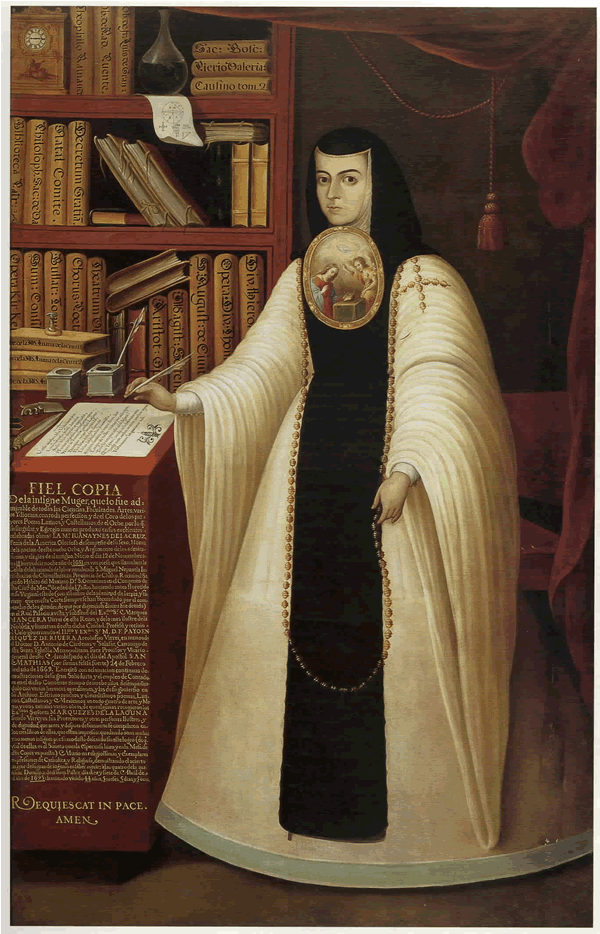
Sor Juana Inés de la Cruz
Wikimedia Commons, CC BY-SA 3.0 — Juan de Miranda

Sor Juana Inés de la Cruz (1772)
Wikimedia Commons, Public domain — Andrés de Islas

Portrait of Sor Juana Inés de la Cruzlabel QS:Len,"Portrait of Sor Juana Inés de la Cruz"
Wikimedia Commons, Public domain — Miguel Cabrera

Universidad del Claustro de Sor Juana
Wikimedia Commons, CC BY-SA 3.0 — Jnaves41

Sor Juana
Wikimedia Commons, CC BY-SA 4.0 — Adrián Cerón

Sor Juana Inés de la Cruz, 1732 - Fray Miguel de Herrera
Wikimedia Commons, Public domain — Fray Miguel de Herrera

Libro de obras poéticas de Sor Juana Inés de la Cruz (1714) en el MIB (1)
Wikimedia Commons, CC BY-SA 4.0 — Luis Alvaz

Cuadro de Sor Juana Inés de la Cruz Miguel Cabrera (1750)
Wikimedia Commons, CC BY 4.0 — OliAzor