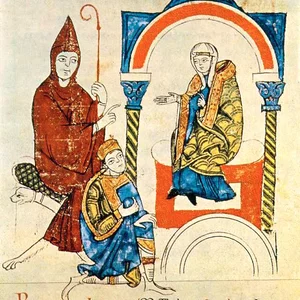

Legendary ruler of the Kingdom of Semien, Gudit led a revolt around 960 CE that overthrew the Aksumite dynasty of Ethiopia. This warrior queen is said to have reigned for several decades over the Ethiopian highlands, leaving a lasting mark on the collective memory of the region.
Judith(950 — ?)
Gudit
8 min read
Frequently asked questions
Key Facts
- Around 960 CE: Gudit led a revolt that overthrew the last Christian Aksumite dynasty of Ethiopia.
- She established her power over the Kingdom of Semien, in the Ethiopian highlands.
- According to tradition, she reigned over the region for approximately 40 years.
- Her origins are debated: some sources associate her with the Beta Israel communities (Ethiopian Jews), others with Agaw-speaking populations.
- Her figure remains legendary and controversial, as few contemporary written sources mention her directly.
Works & Achievements
Gudit brought an end to over a thousand years of Aksumite rule, radically reshaping Ethiopia's political and religious landscape. This foundational — or destructive, depending on one's perspective — act is her primary legendary deed, kept alive in Ethiopian oral tradition to this day.
Gudit is said to have held lasting authority over the Ethiopian highlands for around forty years — an exceptional reign for a woman within the medieval African monarchical tradition. This poorly documented rule remains etched in oral memory as a period of total upheaval.
Tradition credits her with the destruction of numerous stelae, churches, and monasteries, erasing the architectural traces of a thousand-year-old civilization. This act, whether historical or mythologized, earned her in Ethiopian Christian tradition the epithet Esato — 'the Fiery One'.
By overthrowing Aksum, Gudit is thought to have fostered the rise of new centers of power in Ethiopia's central regions, indirectly foreshadowing the ascent of the Zagwe dynasty. Her role as a agent of rupture lastingly reconfigured the country's geopolitical landscape.
Anecdotes
According to Ethiopian traditions, Gudit allegedly set fire to the Cathedral of Saint Mary of Zion in Aksum, the holiest sanctuary of Ethiopian Christianity, believed to house the Ark of the Covenant. This act of symbolic destruction marked, in collective memory, the end of a Christian era and the beginning of a dark period for the Aksumite kingdom.
Ethiopian chronicles recount that Gudit ordered the massacre of the members of the Aksumite royal line, leaving only a young prince alive, hidden by loyal followers. This prince was the sole surviving link between the ancient dynasty and the future Zagwe house that succeeded it generations later.
Gudit is said to have ruled for forty years over the Ethiopian highlands — a number deeply symbolic in both biblical and Ethiopian tradition. During this legendary half-century, monasteries were abandoned and priests forced into exile, according to Christian chroniclers who portray her as an almost demonic figure.
The Beta Israel community (Ethiopian Jews) sees Gudit not as an evil figure but as a heroic queen who defended her people against Aksumite oppression. To them, she is a liberating warrior — her image shifts dramatically depending on which community passes down her story, illustrating the power of competing memories in history.
Certain 10th-century Arab accounts, notably those of the geographer Ibn Hawqal, mention a powerful female ruler reigning in Ethiopia without naming her explicitly. These outside sources are invaluable: they confirm that an exceptional form of female power did exist in the region at that time, lending a kernel of historical reality to the legend of Gudit.
Primary Sources
A woman who worshipped the devil seized the kingdom of Ethiopia, inflicted great harm upon the Christians, and destroyed their churches.
The kingdom of Habesha is dominated by a sovereign woman who has ruled these lands for many years and has subjugated its king.
In those days great tribulations came upon the Church, and the queen of the enemies burned holy Aksum and made the servants of Christ suffer.
Gudit the accursed reigned over Ethiopia and put an end to the lineage of kings until God permitted the return of light with the kings of Zagwe.
Key Places
The historical and religious capital of the Aksumite kingdom, Aksum was the central stage of the legend of Gudit. Its capture and the destruction of its sanctuaries symbolically marked the end of sub-Saharan Africa's first Christian civilization.
A rugged mountain range in northern Ethiopia, the Simien Mountains form the legendary power base of Gudit. This remote highland kingdom is said to have served as her stronghold and launching point for the conquest of the Ethiopian plateau.
According to Ethiopian Christian tradition, this sanctuary — the holiest in Ethiopia, believed to house the Ark of the Covenant — was burned down by Gudit. Its symbolic destruction lies at the heart of the dark legend surrounding the warrior queen.
The source of the Blue Nile and the birthplace of monasteries built on its islands, Lake Tana is linked to Christian resistance against Gudit's conquests. Several traditions hold that monks took refuge there, carrying sacred relics to protect them from destruction.
Although its famous rock-hewn churches were carved after Gudit's era, Lalibela represents the Ethiopian Christian renaissance that arose directly in response to the destruction she embodies in legend. This site is inseparable from the memory of that pivotal period of rupture.
Typical Objects

The torch is Gudit's defining symbolic attribute in Ethiopian tradition, embodying her legend as the queen who set fire to the Christian sanctuaries of Aksum. This symbol of destructive fire gave her the epithet Esato ('the Blazing One') in oral accounts.

The rulers of the Ethiopian highlands carried short double-edged swords inherited from the Aksumite military tradition. For Gudit, this weapon symbolizes her conquest by force and the overthrow of one of Africa's oldest Christian dynasties.

After her victory, Gudit is said to have donned the royal Aksumite regalia, claiming for herself the very symbol of the Christian power she had just destroyed. This crown captures the ambivalence of her figure: at once heir to and destroyer of an ancient royal tradition spanning millennia.

In the military traditions of the Horn of Africa, the great liturgical and war drum set the rhythm of battle and embodied the authority of the commander. As a leader of armies, Gudit would have used these sacred instruments to rally her troops and mark her victories.

Parchment scrolls covered in protective texts, worn around the neck, were common across all religious communities in Ethiopia. For Gudit — a figure at the crossroads of several spiritual traditions — these amulets symbolize, in legendary accounts, her supernatural power and invincibility.
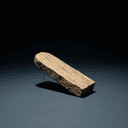
According to tradition, the great monolithic stelae of Aksum — symbols of royal power — were desecrated during Gudit's conquest. The broken stele has become an icon in Ethiopian iconography of the radical dynastic rupture she represents in collective memory.
School Curriculum
Vocabulary & Tags
Key Vocabulary
Tags
Daily Life
Morning
In legendary accounts, Gudit begins her day with propitiatory rites rooted in the spiritual traditions of her people — whether Beta Israel practices or pre-Islamic highland cults. She then reviews her warriors at dawn along the wind-swept ridges of the Simien Mountains, organizing the day's military operations before the mist lifts from the valleys below.
Afternoon
Her afternoons are devoted to governing the conquered kingdom: audiences with subjugated clan chiefs, distribution of war spoils, and negotiations with local populations. In legendary retellings, she presides over war councils where her word is law, surrounded by loyal commanders and messengers who ride across the plateau in every direction.
Evening
In the evening, Gudit withdraws to her fortified camp on the rocky heights. Oral traditions evoke warrior feasts around great fires, marked by the songs and dances of her court. She listens to reports from travelers and scouts to keep watch over pockets of Christian resistance still active in remote regions.
Food
On the Ethiopian highlands of the 10th century, the diet was built around injera (a large fermented flatbread made from teff), served with stews of legumes and dried meat. For a warrior queen, meals would have included roasted beef or mutton, wild honey, and teff beer (tella) — a festive drink reserved for the powerful and honored warriors.
Clothing
In traditional representations, Gudit is imagined wearing dark-dyed linen garments and tanned hides, with a leather breastplate decorated with bronze plates. She wears bronze and silver jewelry, protective amulets, and her brow is crowned with a royal headband or a metal war helmet — all attributes of an authority that is at once martial and sacred.
Housing
Gudit's legendary residence is set within the natural fortresses of the Simien Mountains — rocky pinnacles with sheer cliff faces transformed into entrenched camps. These dry-stone bastions, impenetrable to enemy armies, lend her in popular tradition an aura of invincibility and reinforce her image as queen of the highlands.
Historical Timeline
Period Vocabulary
Visual Style
Esthétique des manuscrits éthiopiens médiévaux : contours noirs appuyés, pigments terreux et or, figures hiératiques sur fond de plateau volcanique sous un ciel d'orage et de feu.
Sound Ambience
Vents des hauts plateaux éthiopiens, tambours de guerre, crépitement des incendies sur les sanctuaires d'Aksum, et chants de moines cherchant refuge dans la nuit.
Liens externes & ressources
Références
Œuvres
Renversement de la dynastique aksumite
vers 960
Règne de quarante ans sur le plateau éthiopien
vers 960–1000
Destruction des monuments et sanctuaires d'Aksum
vers 960
Reconfigurations géopolitiques de l'Éthiopie médiévale
vers 960–1137