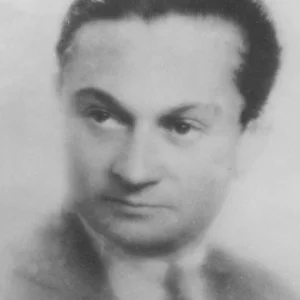

Julien Duvivier (1896-1967) is one of the greatest French filmmakers of the 20th century. A prolific director, he left his mark on the golden age of French cinema with films such as Pépé le Moko and La Belle Équipe.
Julien Duvivier(1896 — 1967)
Julien Duvivier
France
8 min read
Frequently asked questions
Key Facts
- Born on October 8, 1896, in Lille; died on October 29, 1967, in Paris
- Directed Pépé le Moko in 1937, a masterpiece of poetic realism starring Jean Gabin
- Made La Belle Équipe in 1936, a symbol of the Popular Front and working-class solidarity
- Worked in Hollywood during World War II (1941-1945)
- Directed more than 60 films over five decades of career
Works & Achievements
An iconic film of the Popular Front era starring Jean Gabin, about five unemployed men who try to open a riverside dance hall after winning the lottery. Famous for its two opposing endings, it embodies both collective hope and tragic disillusionment.
A masterpiece of poetic realism with Jean Gabin as a gangster hiding in the Casbah of Algiers. Considered one of the greatest French films of all time, it had a lasting influence on American film noir.
A melancholic anthology film about a woman who tracks down the men she danced with in her twenties, featuring an exceptional cast of French stars. Winner of the Grand Prix at the Venice Film Festival, it secured Duvivier's international reputation.
A drama about aging actors living in a retirement home for performers, starring Michel Simon and Louis Jouvet. A valedictory film made on the eve of war, reflecting on old age, past glory, and oblivion.
Adapted from a Simenon novel, this film noir starring Michel Simon portrays a man singled out as a scapegoat by a vengeful mob. Shot in post-Liberation Paris, it probes collective violence and injustice.
An adaptation of Zola's novel about the hypocritical and greedy Parisian bourgeoisie of the 19th century, starring Gérard Philipe. One of Duvivier's last major films, it demonstrates his ability to renew his vision across several decades.
Anecdotes
During the filming of *La Belle Équipe* (1936), Julien Duvivier shot two entirely different endings: a happy one, in which the friends survive and open their guinguette, and a tragic one, in which Jean Gabin kills his friend out of jealousy. It is this second version — dark and disillusioned — that Duvivier himself preferred. It is now considered the most faithful to the spirit of poetic realism.
The success of *Pépé le Moko* (1937) was so great that the Hollywood studio United Artists purchased the film's rights to block its distribution in the United States, clearing the way for its own remake titled *Algiers* (1938) with Charles Boyer. Duvivier received no additional compensation from the deal, which stands as a striking illustration of Hollywood's commercial dominance over European cinema.
Fleeing the German Occupation, Duvivier went into exile in Hollywood in 1940. There he directed stars such as Charles Boyer, Rita Hayworth, and Henry Fonda in *Tales of Manhattan* (1942). His naturalistic style and sense of European tragedy set him apart from American productions, yet he managed to carve out a place for himself in the Hollywood industry for the entire duration of the war.
His film *Un carnet de bal* (1937), a melancholic portrait of a woman tracking down the dance partners of her youth, won the Coppa Mussolini — Grand Prix — at the Venice Film Festival, cementing Duvivier's reputation as one of the most important filmmakers in Europe. He had assembled an exceptional cast of French stars, a rare achievement at the time.
Duvivier died on October 29, 1967, in Paris in a car accident, just days after his seventy-first birthday. He left behind more than fifty films made over a forty-five-year career, embodying in himself nearly the entire history of French cinema, from the silent era to color.
Primary Sources
"I am not trying to make optimistic or pessimistic films. I am trying to make true films. And the truth, more often than not, lies in the shadows."
The film was shot on location along the banks of the Marne and in the Billancourt studios. The production chose to release two distinct endings depending on the market, with the director championing the tragic version as the one most consistent with his intentions.
"Duvivier pulls off the remarkable feat of making the studio-reconstructed Casbah feel more real than reality itself, a space in which Pépé's fate unfolds as both a geographical and a social inevitability."
"Duvivier is the only director who ever gave me the impression of controlling everything without once reining me in. He could see the entire film before he even began shooting."
Key Places
Birthplace of Julien Duvivier, born on October 8, 1896, in this major industrial city in northern France. He left his home region for Paris to break into the world of entertainment.
The main Parisian filming location where Duvivier made his greatest films of the 1930s and 1940s. The Algiers Casbah featured in *Pépé le Moko* was entirely reconstructed on set there by production designer Jacques Krauss.
Duvivier's place of exile during the Second World War (1940–1944), where he directed several films for major American studios. He moved in the community of refugee European filmmakers, including René Clair and Jean Renoir.
The historic fortified quarter of Algiers whose labyrinthine atmosphere inspired the setting of *Pépé le Moko*. Photographic location scouting was carried out there to enable a faithful reconstruction on the Billancourt soundstages.
The city where Duvivier spent most of his professional life and where he died in a car accident on October 29, 1967. Paris is also the implicit backdrop of many of his films, even when the action takes place elsewhere.
Typical Objects

A French reference cinema camera used in studios during the 1920s–1940s, relatively lightweight and precise. Duvivier used it to frame the expressive atmospheres of his great poetic realism films.

A hinged black-and-white board that an assistant claps in front of the camera at the start of each take to synchronize sound and image during editing. A universal symbol of filmmaking since the advent of sound cinema.

A cellulose nitrate film medium, flammable and fragile, on which images and the soundtrack are recorded. Many copies of Duvivier's films were lost in archive fires before acetate film became widespread.

The film's text typed on a typewriter and covered with the director's handwritten annotations, detailing dialogue, shot breakdowns, and performance notes. For Duvivier, the screenplay was a highly developed preparation document before any shoot began.

A powerful studio light powered by an electric arc between two carbon electrodes, producing an intense, hard light. The expressionist, high-contrast atmosphere of Duvivier's films owes much to this equipment.

A large, brightly colored poster printed by lithography to advertise films in cinemas and on Parisian billboards. The posters for *Pépé le Moko* and *La Belle Équipe* have become icons of 1930s graphic art.
School Curriculum
Vocabulary & Tags
Key Vocabulary
Daily Life
Morning
Duvivier was known for his extreme rigor and arrived among the first on set. He devoted his mornings to meticulous preparation of the day's sequences, discussing framing and lighting with his director of photography well before the actors arrived.
Afternoon
Afternoons were entirely dedicated to shooting, often long and demanding. A perfectionist, Duvivier could run take after take until he achieved exactly the dramatic atmosphere he wanted, earning him a reputation as a tough but supremely precise director.
Evening
In the evenings, Duvivier reviewed the day's rushes with his team and prepared the next day's work. He frequented the brasseries of Montparnasse and the Boulevard du Temple, staying close to the artistic and intellectual world of Parisian life in his era.
Food
Like many Frenchmen of his generation, Duvivier appreciated traditional bourgeois cuisine. During intensive studio shoots, set meals — simple dishes served during breaks — punctuated his long working days.
Clothing
On set, Duvivier wore a dark suit and tie, sometimes a gabardine coat, embodying the image of the professional European-style director. His understated appearance reflected his authority and seriousness, the very opposite of any eccentricity.
Housing
In Paris, Duvivier lived in bourgeois apartments in the upscale neighborhoods of the Right Bank. During his Hollywood exile, he rented villas in the hills of Los Angeles, within the community of refugee European filmmakers.