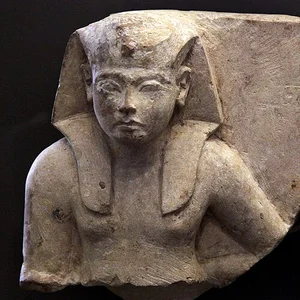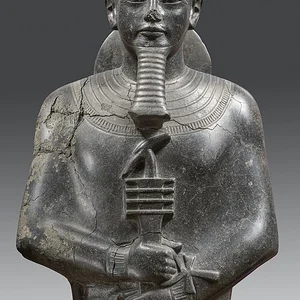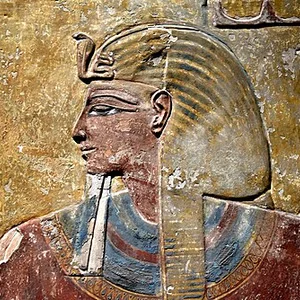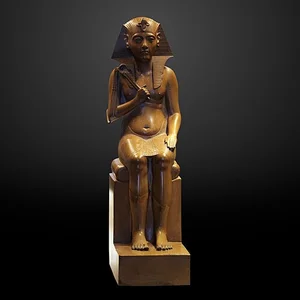

Pharaoh of the 4th Dynasty of ancient Egypt (c. 2589–2566 BC), Khufu is famous for commissioning the Great Pyramid of Giza, one of the Seven Wonders of the Ancient World. His reign stands as a symbol of the absolute power of pharaonic rule.
Khufu(2700 av. J.-C. — 2565 av. J.-C.)
Khufu
Égypte antique, Ancien Empire de l'Égypte
9 min read
Frequently asked questions
Key Facts
- Reigned c. 2589–2566 BC, 4th Dynasty of the Old Kingdom
- Commissioned the Great Pyramid of Giza, the tallest human-built structure for nearly 3,800 years (146 m)
- The pyramid required approximately 2.3 million stone blocks and tens of thousands of workers
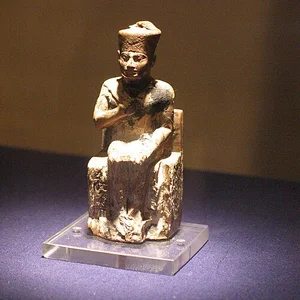
- Only one small ivory statuette (9 cm) depicting him survives, now held at the Cairo Museum
- His reign is known largely through Herodotus, who portrays him as a tyrannical ruler
Works & Achievements
The absolute masterpiece of ancient architecture, the Great Pyramid was the tallest human-built structure for 3,800 years. It remains the only one of the Seven Wonders of the Ancient World still standing today.
Beyond the main pyramid, Khufu had a funerary temple, a processional causeway, a valley temple, and three smaller pyramids built for his queens. This unified architectural complex was designed for the pharaoh's eternal cult.
Two ritual boats made of cedar wood, disassembled and buried in pits at the base of the pyramid, were meant to allow Khufu's soul to sail alongside the god Ra. One of them, restored, is on display at the Solar Boat Museum on the site.
The logistics system devised for the pyramid is itself a remarkable achievement: planned workers' cities, a network of canals, a supply port on the Red Sea, and teams paid in kind. The Merer Papyrus provides the oldest written account of this work ever discovered.
Anecdotes
Herodotus, the Greek historian of the 5th century BC, describes Khufu as a fearsome tyrant who supposedly closed all of Egypt's temples and forced his people to labor ceaselessly on his pyramid. According to him, Khufu even sent his own daughter to a brothel to finance the construction — a legend that speaks volumes about the terrifying reputation the pharaoh had acquired in the collective memory of Antiquity.
The Westcar Papyrus, written during the Middle Kingdom but recounting stories said to date back to Khufu's reign, presents the pharaoh surrounded by extraordinary magicians. In one story, a magician named Djedi was supposedly able to reattach a severed head — Khufu wanted him to demonstrate this on a prisoner, but the wise man refused, choosing to use an animal instead. This text shows how the figure of Khufu had already become, even in Antiquity, a near-supernatural legendary character.
The only certain representation of Khufu to have survived is a tiny ivory statuette just 7.5 centimeters tall, discovered at Abydos in 1903. A striking paradox: the man who commissioned the largest structure ever built by humanity is known to us only through this very small object. The statuette is now held at the Egyptian Museum in Cairo.
In 2013, an exceptional papyrus discovered at the site of Wadi al-Jarf — the Merer Papyrus — revealed the logbook of a foreman who participated in the construction of the Great Pyramid around 2560 BC. This unique document, the oldest papyrus in the world, sheds light on the colossal logistical organization of the construction site: thousands of workers organized into specialized teams, fed and paid by the state, far removed from the image of abused slaves that legend sought to impose.
In 2017, physicists from the ScanPyramids project detected, using cosmic muons, a large unknown void inside the Great Pyramid — a chamber at least 30 meters long whose purpose remains mysterious. This unresolved secret, buried for 4,500 years within the mass of stone, continues to fuel the supernatural aura of the pharaoh who sought to rival the gods.
Primary Sources
Khufu reduced the Egyptians to all manner of misery. He closed the temples and forbade them to offer sacrifices; then he forced them all to labor in his service.
His Majesty King Khufu, true of voice, said: 'Let Djedi the magician be brought to me — he who knows how to restore a severed head, who can make a lion follow behind him with its leash trailing on the ground.'
Inspector Merer records his team's journeys transporting limestone blocks from the Tura quarries to the construction site of the Great Pyramid of Akhet Khufu, via a network of canals.
The king ascends to the sky, he crosses the firmament, he traverses the waters. The king is a god who lives forever; he takes his place among the imperishable stars.
Key Places
The Great Pyramid, named 'Akhet Khufu' (the Horizon of Khufu), is the only one of the Seven Wonders of the Ancient World still standing. Standing 138 meters tall today (147 originally), it required around 2.3 million stone blocks and remained the tallest structure ever built by humans for 3,800 years.
The administrative and religious capital of the Old Kingdom, Memphis was the seat of pharaonic power under Khufu. It was from this city that he governed Egypt and coordinated the colossal construction of his pyramid through his vizier.
A great religious center dedicated to the solar cult of Ra, whose son Khufu claimed to be. The theologians of Heliopolis developed the royal doctrine that made the pharaoh a divine intermediary between humanity and the sun god.
A pharaonic Red Sea harbor where the Merer Papyrus and storehouses linked to the construction of the Great Pyramid were discovered in 2013. This site reveals the extraordinary reach of the logistical network put in place by Khufu.
A sacred city dedicated to Osiris, god of the dead and resurrection, where the only known statuette of Khufu was discovered in 1903. A major site of royal worship, Abydos was associated with passage into the afterlife and the dynastic legitimacy of the pharaohs.
Typical Objects

A royal headdress combining the white crown of Upper Egypt and the red crown of Lower Egypt, symbolizing the unity of the land. Khufu wore it during major ceremonies to assert his divine dominion over the entire kingdom.

The shepherd's crook and the small three-tailed flail together formed the most iconic insignia of pharaonic power. Held crossed over the chest, they symbolized the pharaoh's absolute authority over his people and his dual role as provider and ruler.

The only confirmed likeness of the pharaoh, this 7.5 cm figurine discovered at Abydos shows him seated on his throne, wearing the red crown. A striking paradox: the man behind the greatest construction in human history is known to us only through this tiny object.

An elongated oval ring enclosing the name of Khufu written in hieroglyphs, granting him eternal magical protection. Cartouches bearing his name were found in the relieving chambers of the pyramid, providing definitive proof of its builder's identity.

Two large dismantled ritual boats were discovered in pits at the foot of the Great Pyramid. Intended to carry the pharaoh's soul across the sky alongside the god Ra in the afterlife, they illustrate the ancient Egyptian belief in royal immortality.

Copper chisels, saws, and picks used by craftsmen and stonemasons during the building of the pyramid. Thousands of tools recovered from storage deposits bear witness to the enormous coordinated effort carried out under Khufu's direct authority.
School Curriculum
Vocabulary & Tags
Key Vocabulary
Tags
Daily Life
Morning
Khufu rose before dawn to attend the sunrise rituals, a sacred moment when the pharaoh, son of Ra, symbolically welcomed his divine father. Priests anointed him with scented oils and recited hymns during his ritual bathing, performed according to an unchanging protocol inherited from previous dynasties. The day then began with an audience with the vizier, his closest administrative collaborator.
Afternoon
Afternoons were devoted to affairs of state: receiving reports from the provinces, overseeing the tributes sent by the nomes, and regularly inspecting the construction site of the Great Pyramid. Scribes recorded every decision on papyrus scrolls kept in the royal archives. The pharaoh might also hold religious ceremonies or receive foreign dignitaries bearing gifts.
Evening
In the evening, Khufu took part in ritual banquets where food offered to the gods was then consumed by the king and his court — a practice known as the 'reversion of offerings.' Musicians played the harp and flute, and acrobats enlivened the royal festivities. The night ended with prayers to ensure the sun's victory over darkness and the renewal of the cosmic cycle at the following dawn.
Food
The pharaoh enjoyed an abundant and varied diet: finely milled white bread, high-quality beer (the everyday drink of all Egyptians), roasted meats (beef, duck, and fish from the Nile), vegetables (lentils, onions, leeks, cucumbers), and fruits (figs, grapes, dates). Wine imported from Canaan was a luxury reserved for the elite. Certain foods held a ritual dimension connected to offerings to the gods.
Clothing
Khufu wore an immaculately white linen kilt of exceptional fineness, reserved for royalty. During ceremonies, he donned ritual headdresses (the gold-striped Nemes cloth, the Double Crown, the blue Khepresh crown), a gold and lapis-lazuli pectoral, and bracelets inlaid with precious stones. His ceremonial false beard — a braided and curved royal attribute — signaled his divine nature.
Housing
Khufu resided in a palace at Memphis adorned with painted columns and irrigated gardens — no palace from the Old Kingdom has survived, as they were built from mud brick rather than stone like the temples. The palace comprised audience halls, private apartments, kitchens, granaries, and quarters for the court. A valley palace also existed at the foot of the Giza plateau, connected to the funerary complex by a processional causeway.
Historical Timeline
Period Vocabulary
Visual Style
Art égyptien de l'Ancien Empire : hiéroglyphes gravés dans le calcaire blanc éblouissant, figures royales rigides et éternelles, géométrie sacrée des pyramides dorées dominant le désert sous un ciel de feu.
Sound Ambience
Le fracas sourd de milliers d'ouvriers sur le chantier monumental, les incantations des prêtres solaires à l'aube et le silence sacré, minéral, des chambres funéraires creusées au cœur de la pierre.
Liens externes & ressources
Références
Œuvres
La Grande Pyramide de Gizeh (Akhet Khoufou)
vers 2589-2566 av. J.-C.
Le complexe funéraire de Gizeh
vers 2589-2566 av. J.-C.
Les barques solaires de Gizeh
vers 2566 av. J.-C.
L'organisation du chantier de la Grande Pyramide
vers 2589-2566 av. J.-C.