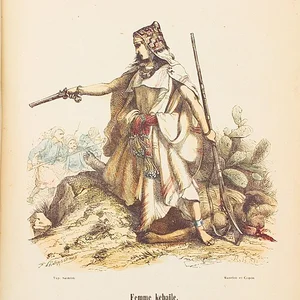

A Kabyle resistance fighter from the Amazigh people, Lalla Fatma N'Soumer led the armed struggle against the French conquest of Algeria in the mid-19th century. Both a spiritual and military figure, she is passed down through Berber oral tradition as a symbol of dignity and resistance.
Lalla Fatma N'Soumer(1830 — 1863)
Lalla Fatma N'Soumer
8 min read
Frequently asked questions
Famous Quotes
« "We shall die free rather than live as slaves." (words attributed by Kabyle oral tradition, unverifiable through written sources)»
Key Facts
- Born around 1830 in the village of Aït Sidi Braham, in Kabylia — date drawn from oral traditions and French colonial sources, approximate in nature
- From 1854 onward, she led the armed Kabyle resistance against the forces of Marshal Randon
- In 1857, following the fall of the Bordj de Tachkirt, she was captured and exiled to Tablat (Médéa)
- She died in captivity around 1863 — the exact circumstances remain uncertain depending on the source
- Her memory is preserved primarily through Amazigh oral tradition; she was recognized as an Algerian national heroine in the 20th century
Works & Achievements
Lalla Fatma N'Soumer united several Kabyle tribes — historically hostile to one another — around a common resistance project. This inter-tribal coalition stands as her most significant political and military achievement.
Personally leading the Kabyle fighters, she inflicted a crushing defeat on French troops in the mountains of Beni Yenni, proving that armed resistance was viable in rugged mountain terrain.
Songs in the Kabyle language composed or inspired by Lalla Fatma N'Soumer, passed down orally and forming one of the earliest bodies of anti-colonial resistance poetry in North Africa.
Lalla Fatma N'Soumer established a system of alliances and messengers enabling military coordination between villages scattered across difficult, hard-to-reach mountain territory.
Anecdotes
Lalla Fatma N'Soumer had been promised in a traditional marriage, but she refused the arranged union and withdrew into a spiritual life under the guidance of her brother Si Tayeb, the religious leader of the village of Aït Sidi Braham. This break from the ordinary fate of Kabyle women of her time granted her an extraordinary moral authority in the eyes of her community.
In 1854, at the Battle of Beni Yenni, Lalla Fatma N'Soumer fought alongside the men, dressed in white and carrying a banner. Eyewitness accounts report that her mere presence galvanized the Kabyle fighters, who regarded her as a saintly and protective figure capable of interceding with God on behalf of their victory.
Captured in 1857 by Marshal Randon following the Battle of Tachkirt, Lalla Fatma N'Soumer was placed under house arrest in Tablat, in the Mitidja plain, far from her Kabyle mountains. She never saw her homeland again and died in captivity at the age of 33. Her final years were those of a silent exile, far from the people for whom she had sacrificed everything.
The French soldiers who faced her described in their letters a surprise mingled with respect: they had not expected to find a woman at the head of such an organized resistance. General Randon himself noted in his memoirs that she exercised a 'fanatical' influence over the Kabyle population — a word that inadvertently reveals the depth of her spiritual hold over them.
In Kabyle oral tradition, Lalla Fatma N'Soumer is compared to Joan of Arc — not by borrowing from French culture, but because Amazigh griots and bards saw in her the same fusion of divine mission and political struggle. Her songs of resistance, known as izlan, continue to be passed down in the villages of Kabylia.
Primary Sources
The marabout woman Fatma N'Soumer held considerable influence over the local populations; her religious zeal and personal courage had made her a formidable figure for our troops.
She wore the white of holiness and carried the fire of the land. Wherever she passed, the mountain rose up. Wherever she spoke, men found their souls again.
The resistance of the Kabyles in the Beni Yenni region is driven by a marabout woman whose moral authority over the insurgents is absolute, and whose capture would have a decisive effect on pacification.
The light of the mountain was extinguished by foreign sabers. Fatma, daughter of the free land, was carried away to where cedars no longer grow.
Key Places
Birthplace of Lalla Fatma N'Soumer, nestled in the mountains of Greater Kabylia. It was here that she grew up, developed her spiritual authority, and organized the first resistance against French incursions.
The site of the 1854 battle in which Lalla Fatma N'Soumer commanded the Kabyle forces and inflicted heavy losses on French troops. This landmark of resistance is today a memorial site for the Kabyle people.
Site of the decisive 1857 battle in which the Kabyle forces were defeated despite fierce resistance. It was here that Lalla Fatma N'Soumer was captured by the soldiers of Marshal Randon.
A town in the Algerian plain where Lalla Fatma N'Soumer was placed under house arrest after her capture. Exiled far from her Kabyle mountains, she died there in 1863, far from her people and her homeland.
A Quranic school and spiritual retreat led by Lalla Fatma N'Soumer's family. It was in this religious center that she received her spiritual education and built her authority as a marabout.
Typical Objects

A large white wool veil worn by Kabyle women of high spiritual standing. Lalla Fatma N'Soumer wore it into battle, making white — the color of holiness in Sufi Islam — a banner visible from afar across the battlefield.

A Sufi devotional object used to count divine invocations. As a female marabout, Lalla Fatma N'Soumer used it during spiritual rituals before battle, reinforcing her religious authority among the warriors.

A banner carried into battle by Kabyle war leaders. Lalla Fatma N'Soumer's standard marked her presence at the front and served as a rallying point for fighters from the various allied tribes.

A weapon of war used by the Kabyle resistance in the mid-19th century, often decorated with copper and silver. The fighters under her command were equipped with these rifles, making their mountain guerrilla warfare a formidable challenge for French columns.

A woven wool piece featuring Amazigh geometric patterns, used for daily prayer. It symbolizes the spiritual grounding of Lalla Fatma N'Soumer, whose authority rested as much on piety as on military courage.

Silver ornaments adorned with coral and enamel, worn by high-ranking women in Kabyle society. These pieces identified Lalla Fatma N'Soumer as a woman of elevated status and maraboutic lineage, reinforcing her legitimacy in the eyes of her community.
School Curriculum
Vocabulary & Tags
Key Vocabulary
Daily Life
Morning
Lalla Fatma N'Soumer began her day before dawn with the fajr prayer, followed by lengthy Sufi invocations (dhikr) in the family zawiya. She would then receive the village men and women who came seeking counsel, blessing, or spiritual intercession — the central role of the marabout in Kabyle society.
Afternoon
Afternoons were devoted to the affairs of resistance: receiving messengers from allied tribes, organizing supplies of weapons and provisions, and tactical planning with the warrior chiefs. She also took part in tribal councils, a traditionally male space she entered by virtue of her spiritual authority.
Evening
Evenings brought the community together around stories and songs. Lalla Fatma N'Soumer led collective prayer sessions and passed on the izlan — sung poems in Tamazight — that fueled the spirit of resistance. She slept little, spending part of the night in meditation.
Food
The Kabyle diet of the 19th century centered on barley flatbread (aghrum), cornmeal porridge (assida), olive oil from terraced fields, dried figs, and goat cheese. Meat was reserved for feast days and ritual sacrifices. Mint tea accompanied moments of counsel.
Clothing
Lalla Fatma N'Soumer wore the white haik, the long woolen veil characteristic of the female marabout's status. Beneath it, a Berber dress (taqendurt) embroidered with geometric patterns in indigo and red. Her silver jewelry — necklaces, bracelets, and fibulae (tizabi) — signaled her rank and lineage. In battle, the white remained her visible standard.
Housing
She lived in the family home adjoining the zawiya of Aït Sidi Braham, a dry-stone building with a tiled roof typical of mountain Kabyle architecture. The house included a separate space for receiving visitors, a prayer room, and food stores. The walls were decorated with geometric patterns painted in whitewash.
Historical Timeline
Period Vocabulary
Visual Style
Peinture dramatique mêlant réalisme ethnographique et motifs géométriques amazighs, palette terracotta-indigo-argent, lumière chiaroscuro sur les montagnes kabyles.
Sound Ambience
Sonorités des montagnes kabyles du XIXe siècle : vent sur les cèdres, tambours de guerre, zaghareet féminines, prières soufies et bruits de la vie villageoise berbère.
Liens externes & ressources
Références
Œuvres
Organisation de la résistance armée kabyle (1852-1857)
1852-1857
Bataille des Beni Yenni — victoire kabyle
1854
Corpus d'izlan (chants de résistance en tamazight)
milieu XIXe siècle
Réseau de communications entre tribus kabyles
1853-1857