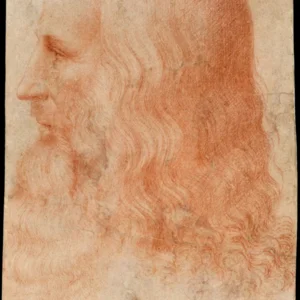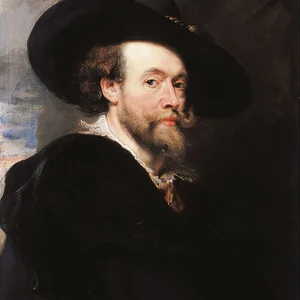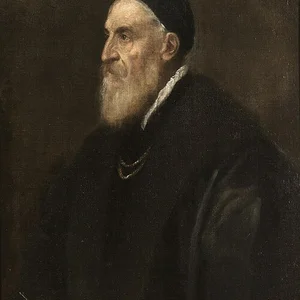

Titian, whose real name is Tiziano Vecellio, is the undisputed master of the Venetian school of the Renaissance. A prolific painter famous for his revolutionary use of color, he dominated the art scene for over sixty years and was the official portraitist of the greatest sovereigns of Europe.
Titian(1490 — 1576)
Titian
république de Venise
9 min read
Frequently asked questions
Key Facts
- Born around 1490 in Pieve di Cadore, in the Republic of Venice
- Painted the *Assumption of the Virgin* for the Frari church in Venice (1516–1518)
- Became official painter to Emperor Charles V, who knighted him (around 1533)
- Painted the *Venus of Urbino*, a masterpiece of the Venetian nude (1538)
- Died in Venice in 1576, probably during a plague epidemic
Works & Achievements
Commissioned for the high altar of Santa Maria dei Frari in Venice, this monumental canvas nearly seven meters high revolutionized Venetian painting with its dynamism and ardent colorism. It is considered Titian's first great mature work.
An allegorical painting whose meaning is still debated by historians, probably commissioned for a Venetian patrician wedding. It brilliantly illustrates Titian's mastery of idealized female nudes and luminous Venetian landscapes.
A reclining nude commissioned by Duke Guidobaldo II della Rovere, it redefined the canon of the female nude in Western painting. Its decidedly sensual character and domestic setting broke with earlier mythological allegories, inspiring Manet and Goya.
Commissioned to celebrate the Emperor's victory over the Protestant princes, this portrait is one of the earliest and most influential of the equestrian genre. It served as a direct model for Velázquez and Rubens in their own royal portraits.
Painted for Alfonso I d'Este, Duke of Ferrara, it illustrates the moment when Bacchus catches sight of Ariadne on the island of Naxos. The extraordinary intensity of the ultramarine blue sky — exceptionally rare and costly — testifies to the prestige and wealth of the patron.
One of the great "poesie" sent to Philip II of Spain, it testifies to Titian's spiritual and pictorial maturity. The freedom of the brushwork, almost dematerialized, prefigures the explorations of modern painting.
Titian's last work, unfinished at his death and completed by Palma il Giovane, it was painted for his own tomb in the Frari. The kneeling old man at Christ's feet is a self-portrait of the master — an artistic and spiritual testament to a life wholly devoted to painting.
Anecdotes
During a sitting in Augsburg in 1548, Titian's brush fell to the floor. Emperor Charles V — master of half the known world — stooped down himself to pick it up, astonishing his court. No sovereign had ever paid such an honor to an artist, a gesture that illustrates the new status of the artist in the Renaissance.
Titian died in August 1576, probably at over eighty-five years of age, carried off by the great plague that ravaged Venice. The very day after his death, brigands looted his workshop — a tragic irony for a man whom the most powerful monarchs of Europe had heaped with honors all his life.
The artist was in the habit of turning his canvases to face the wall for several weeks, sometimes several months. He 'put them in quarantine,' in his own words reported by his pupil Palma il Giovane, to later look at them with fresh eyes and correct them layer after layer until perfection.
The Venus of Urbino (1538), commissioned by Duke Guidobaldo II della Rovere, was so daring that it could only be shown in a private circle. The duke transported it hidden in a dispatch case during his travels. Yet this female nude became one of the most copied paintings of the entire Renaissance.
Knighted with the Golden Spur and made a Count Palatine by Charles V in 1533, Titian obtained hereditary nobility for himself and his descendants. A painter ennobled by the most powerful monarch in Europe: an unprecedented event, testifying to the upheaval of the artist's social status in the 16th century.
Primary Sources
Titian of Cadore, an exceedingly excellent painter, was born in the town of Cadore, a small territory in Friuli, to Gregorio Vezelli and his mother Lucia, honorable gentlefolk of that place. Before reaching the age of twenty, he painted the portrait of Doge Grimani with such likeness and vividness that it seemed alive.
Sacred Catholic Royal Majesty, I send to Your Majesty the *Poesia* of Andromeda and Perseus, a work in which I have placed all my study and effort, hoping that it may be worthy to appear before Your Majesty, whose hands I humbly kiss.
His friendship with Titian is a thing that honors me as much as him; because the virtue of his brush has placed my name where envy cannot take it away. He is the first among living painters, and no one can ever take this primacy from him.
Titian would sketch his paintings with a mass of colors, which served as a bed or base for the expressions he intended to add on top. Then he would turn them to face the wall and leave them for weeks and months without looking at them. When he later resumed them, he examined them with rigorous severity.
Titian was the greatest colorist that painting has ever had, and so it was confessed by those of his time, and after him the most distinguished masters have said it. His manner of painting was always frank, bold, and well understood.
Key Places
The heart of Titian's entire life: he settled there as a teenager, built his large workshop at Biri Grande in the Cannaregio district, and died there during the plague of 1576. Venice was then the world capital of the pigment and painted canvas trade.
Titian's birthplace in the mountains of Friuli, where his family enjoyed a status of local minor nobility. He returned occasionally and maintained family ties throughout his life, owning a house there.
A decisive stay from 1545 to 1546 at the invitation of Pope Paul III Farnese. The encounter with Michelangelo — admiring but committed to the primacy of drawing — embodied the great debate between Venetian *colorito* and Florentine *disegno*.
Titian went there twice (1548 and 1551) to paint Charles V during the Imperial Diets. It was there that he created the *Equestrian Portrait of Charles V at the Battle of Mühlberg*, which revolutionized the genre of official portraiture and inspired Velázquez and Rubens.
Titian painted several monumental works there for the Great Council Hall, affirming his status as official painter of the Serenissima. These frescoes, lost in the fire of 1577, were considered among his greatest masterpieces.
Typical Objects

Central tool of Titian's practice, where he mixed his colors with incomparable mastery. His virtuosity as a colorist reinvented the use of oil painting as a medium in Venice.

Costly pigments imported from the East were at the heart of the workshop economy. Lapis lazuli produced ultramarine blue, a color reserved for the wealthiest patrons — its use in a painting signaled the prestige of the sponsor.

Titian helped popularize the *tela* (stretched canvas) instead of the wood panel, better suited for large dimensions. This lightweight, portable support facilitated the spread of his works in Spain, at the court of Philip II.

In his late works, Titian worked with wide brushes — even with his fingertips — to create vibrant, dematerialized touches. This free technique foreshadowed the Impressionists by several centuries.

Used to evaluate compositions from a distance and in reverse, it allowed Titian to detect imbalances invisible from the front. It was also essential for portraits from life.

Titian's correspondence with Philip II of Spain was accompanied by drawings describing ongoing projects. These illustrated letters today constitute a valuable source on his working method and artistic intentions.
School Curriculum
Vocabulary & Tags
Key Vocabulary
Daily Life
Morning
Titian rose early to take advantage of the northern morning light entering his large studio at Biri Grande. He began by inspecting the canvases drying, correcting a few details, then gathered his pupils to assign the day's tasks.
Afternoon
Afternoons were devoted to posing sessions with his models or patrons, and to the major compositions in progress. In his later years, he often worked on several paintings simultaneously, moving from one to another to let layers dry and gain fresh perspective.
Evening
In the evening, Titian frequented the learned circles of Venice—especially the salon of his friend Pietro Aretino and the librarian Jacopo Sansovino. These conversations among painters, poets, and humanists nurtured the mythological and literary culture essential to his great compositions.
Food
Titian's Venetian table reflected the city's prosperity: lagoon fish (branzino, sardines in saor, clams), risotto rice, polenta, roasted meats on feast days, wines from the Veneto. Spices imported from the East—cinnamon, pepper, saffron—enlivened dishes in a cuisine influenced by trade.
Clothing
As an ennobled artist mingling with the aristocracy, Titian wore fine clothes: doublets of dark velvet, fur-lined coats in winter, gold chains given by his royal patrons. In the studio, a long linen apron protected him from pigment splatters.
Housing
At the end of his life, Titian lived in a spacious house at Biri Grande (Cannaregio district), with a garden rare in Venice overlooking the lagoon. The house included several studios, storerooms for canvases and pigments, and housed the many pupils and assistants living under his roof.
Historical Timeline
Period Vocabulary
Visual Style
Le style du Titien allie lumière dorée et chaude, couleurs somptueuses (rouge vénitien, bleu outremer), et une touche de plus en plus libre dans ses œuvres tardives — révolutionnaire pour l'époque, annonciatrice de la modernité picturale.
Sound Ambience
L'atelier vénitien du Titien mêlait le frottement des pinceaux sur la toile, le broyage des pigments et les rumeurs de la lagune — cloches de Saint-Marc, gondoliers en dialecte vénitien, animation du marché du Rialto.
Liens externes & ressources
Références
Œuvres
Portrait équestre de Charles Quint à la bataille de Mühlberg
1548
Bacchus et Ariane
1520–1523