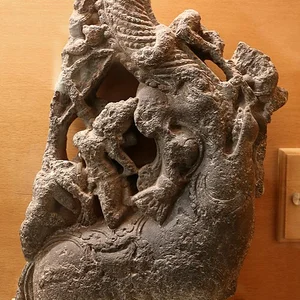

Louhi is the powerful witch-queen of Pohjola in Finnish mythology, a central figure of the Kalevala. Mistress of magic and dark forces, she opposes the heroes Väinämöinen and Ilmarinen. She holds the Sampo, a mysterious object that brings prosperity.
Louhi
Louhi
9 min read
Frequently asked questions
Key Facts
- Louhi rules over Pohjola, the Land of the North, realm of darkness in Finnish mythology
- She is the guardian of the Sampo, a magical artifact forged by Ilmarinen in exchange for her daughter
- She faces Väinämöinen, Ilmarinen, and Lemminkäinen, the three heroes of the Kalevala
- She can transform into a giant eagle to fight her enemies
- The Kalevala, in which she appears, was compiled by Elias Lönnrot in 1835 from ancient oral traditions
Works & Achievements
The Finnish national epic in 50 cantos, in which Louhi is the main antagonist and one of the few female figures endowed with genuine autonomous power. She embodies the strength of the North against the masculine heroism of the Kalevala.
The first compiled version of the Kalevala in 32 cantos; Louhi already appears as queen of Pohjola and a formidable adversary of the heroes, laying the groundwork for her definitive portrait.
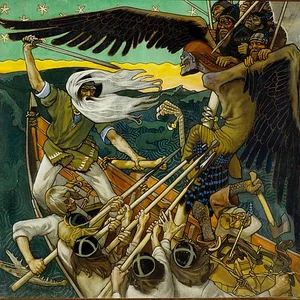
A masterpiece of Finnish painting depicting the final battle for the Sampo, with Louhi in the form of a giant eagle confronting the heroes. This canvas fixed the visual image of Louhi for the entire world.
Sibelius's first major symphonic work inspired by the Kalevala. It inaugurates a series of musical compositions born from Kalevalaic mythology, in which the figure of Louhi resonates as an archetype of the dark power of the North.
The definitive scholarly English translation, which spread knowledge of Louhi throughout the English-speaking world and influenced fantasy authors such as Tolkien in their reception of Finnish mythology.
Anecdotes
Louhi offers her daughters to heroes as a reward, but under impossible conditions. She asks Ilmarinen, the divine smith, to forge the Sampo in exchange for one of them. This mysterious Sampo — a magical mill or talisman of prosperity — becomes the central stake in the conflict between Pohjola and Kalevala, and Louhi guards it jealously at the heart of her frozen kingdom.
When the heroes steal the Sampo and flee across the sea, Louhi transforms into a gigantic eagle whose wings span the entire sky, and pursues their ship through a raging storm. This epic scene from the Kalevala illustrates her total mastery of animal transformations and the natural forces of the Far North.
Louhi possesses a sack in which she imprisons diseases and plagues that she can unleash upon her enemies. In the Kalevala, she releases nine diseases upon the land of Kalevala, forcing the hero Väinämöinen to seek magical remedies to save his people — a figure reminiscent of Pandora's box in Greek mythology.
In an act of ultimate revenge, Louhi steals the sun and moon by locking them inside a mountain of rock. The world plunges into total darkness, forcing Ilmarinen to forge false celestial bodies, until Väinämöinen negotiates the return of light through the power of his magical song.
Louhi is not merely an antagonist: she is also a mother who negotiates to protect her daughters and her kingdom. She sets trials for suitors — plowing a field of serpents, capturing the sacred elk — revealing a complex figure who blends political power, maternal attachment, and formidable diplomatic cunning.
Primary Sources
Louhi, the gap-toothed old woman of Pohjola, answered from the threshold of her hall: "I will give you my daughter, the fairest of my daughters, if you forge for me the Sampo, with its many-colored lid."
The mistress of Pohjola raised her voice and said to Väinämöinen: "You shall not return home, you shall not see your land again, until I have decided to let you go."
I have gathered from the mouths of Karelian singers these runes in which Louhi of Pohjola appears as the great adversary of heroes, guardian of the North and mistress of all the magic known to the ancients.
The variants of the Louhi figure depict a northern sorceress whose power extends over animals, diseases, celestial bodies, and the spirits of the dead, according to the singers of eastern Karelia.
Key Places
Dark and icy mythological kingdom that Louhi governs with absolute authority. In the Kalevala, Pohjola is described as a distant, cold, and mysterious land — the polar opposite of the sunny homeland of the Kalevala heroes.
Mythological sea that Louhi crosses in the form of a giant eagle while pursuing the heroes. The final battle for the Sampo takes place there amid a devastating storm that shatters the magical object into a thousand pieces.
Historical region straddling present-day Finland and Russia, the true birthplace of the oral tradition from which Louhi originates. It is there that Elias Lönnrot collected from the rune-singers the stories that bring the queen of Pohjola to life.
Mythical place where Louhi imprisons the sun and moon to plunge the world into total darkness. This cosmic site symbolizes the furthest reach of Louhi's power over celestial forces and her ambition to dominate the very order of the universe.
The museum houses collections and artistic representations of the Kalevala, including works by Akseli Gallen-Kallela depicting Louhi. It is the primary site of living memory for Kalevala mythology in Finland.
Typical Objects

A mysterious magical object — cosmic mill or talisman of prosperity — that Louhi jealously guards in her kingdom. Possession of it is the central stake in the conflict with the heroes, and its loss unleashes the vengeful fury of the queen of Pohjola.

Louhi possesses a bag in which she imprisons the plagues and epidemics of the world. By unleashing it upon her enemies, she can decimate entire populations, making her a figure of terror comparable to Pandora's box in Greek mythology.

Louhi controls the natural elements of the Far North: polar winds, blizzards, and thick fogs. She wields them as weapons to protect Pohjola and hinder the heroes' navigation across the Arctic sea.

A magical musical instrument at the heart of the *Kalevala*; although the kantele belongs to Väinämöinen, Louhi fears its power and constantly seeks to counter her adversary's musical magic with her own incantations.

Louhi rules from her vast, dark dwelling in the North, the seat of her political and magical power. It is here that she receives the heroes, negotiates impossible bargains, and orchestrates her vengeance with cold determination.

Louhi wears amulets of bone, sacred wood, and northern stones at her belt, engraved with protective runes. These objects amplify her magical powers and connect her to the ancestral spirits of Pohjola.
School Curriculum
Vocabulary & Tags
Key Vocabulary
Tags
Daily Life
Morning
Louhi begins her day by scrutinizing the omens sent by the spirits of the North. From her great dark hall wrapped in Arctic mist, she studies the flight of ravens and the entrails of animals, deciding which alliances to forge and which challenges to set before the heroes of Kalevala.
Afternoon
In the afternoon, Louhi receives suitors and emissaries in her Pohjola dwelling with cold, calculating majesty. She negotiates the impossible conditions she imposes: a daughter's hand in marriage in exchange for a superhuman feat, peace in exchange for the surrender of the Sampo. Every contract is a cleverly laid trap.
Evening
In the evening, Louhi performs her most powerful spells by the light of the northern lights. She weaves *loitsus* (incantations) in the polar darkness, commands the winds of the North, and communes with the dead and spirits, making her ancestral chants resonate through the frozen night of Pohjola.
Food
At Pohjola, Louhi's table is that of a Nordic queen: game from the Arctic forests, reindeer, fish from icy waters, wild berries, and mead brewed according to secret recipes passed down from generation to generation. Her feasts also serve as diplomatic occasions to test and weaken her guests.
Clothing
Louhi wears thick furs of bear, wolf, and reindeer — symbols of her power over the wild animals of the Far North. Her garments are embroidered with protective runes woven with silver thread; she wears amulets of bone and sacred wood at her belt that amplify her shamanic powers.
Housing
Louhi's dwelling is a vast Nordic hall of dark wood, always enveloped in fog and biting cold. The walls are adorned with hunting trophies and magical objects; the Sampo stands at the center, radiating the prosperity that makes Pohjola wealthy and powerful.
Historical Timeline
Period Vocabulary
Liens externes & ressources
Références
Œuvres
Kalevala — Édition définitive (Élias Lönnrot)
1849
Vanha Kalevala (Ancien Kalevala) — Élias Lönnrot
1835
La Défense du Sampo — Akseli Gallen-Kallela (peinture)
1896
Kullervo — Jean Sibelius (symphonie)
1892
The Kalevala — traduction en prose de Francis Peabody Magoun
1963