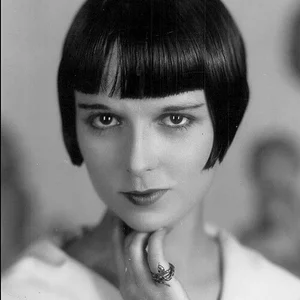

An American actress of the 1920s and 1930s, Louise Brooks is celebrated for her role in Pandora's Box (1929) by G.W. Pabst. An icon of silent cinema, she is recognized for her bob haircut and her naturalistic acting style that was ahead of its time.
Louise Brooks(1906 — 1985)
Louise Brooks
États-Unis
9 min read
Frequently asked questions
Key Facts
- Born on November 14, 1906, in Cherryvale, Kansas
- Played the role of Lulu in Pandora's Box (Die Büchse der Pandora) by G.W. Pabst in 1929
- Her bob haircut becomes a worldwide symbol of the 1920s
- Abandoned Hollywood in the early 1930s and fell into obscurity
- Rediscovered in the 1950s–1960s by cinephiles and critics, most notably Henri Langlois
Works & Achievements
American silent film by Howard Hawks in which Louise Brooks plays an irresistible femme fatale. The role helped cement her international reputation before her departure for Germany.
Masterpiece of silent cinema directed by G.W. Pabst, adapted from the expressionist plays of Frank Wedekind. Louise Brooks plays Lulu, a character who is both liberated and tragic, in a performance universally regarded as one of the greatest in the history of cinema.
Her second film made with G.W. Pabst in Germany, adapted from the novel by Margarete Böhme. Louise Brooks plays a young woman confronting social injustice, in a poignant story with a gritty, realistic edge.
A Franco-Italian film directed by Augusto Genina, and one of Louise Brooks's last. She plays a young typist who becomes Miss France, in a production that captures the transition between silent and sound cinema.
A collection of autobiographical and critical essays in which Louise Brooks reflects on her own career and those of her contemporaries. Acclaimed by critics worldwide, it reveals a gifted writer and a clear-eyed analyst of the Hollywood system.
Anecdotes
Louise Brooks's bobbed haircut, adopted for her role in *Pandora's Box* in 1929, became a worldwide phenomenon. Millions of women across Europe and the United States imitated this daring style, a symbol of the modern, liberated woman of the Roaring Twenties. In the eyes of her contemporaries, her hairstyle alone embodied the spirit of freedom of an entire era.
In 1928, Paramount Pictures demanded that Louise Brooks return from Europe to dub her films for sound. She refused, and the studio terminated her contract, unofficially placing her on a blacklist. Upon her return to Hollywood, she was offered only extra roles, bringing a premature end to a career that had just reached its peak.
In 1956, Henri Langlois, founder of the Cinémathèque française, organized a full retrospective in Paris dedicated to Louise Brooks, who had been forgotten for twenty years. His phrase became celebrated: “There is no Garbo, there is no Dietrich, there is only Louise Brooks.” This rediscovery earned her belated international recognition and inspired an entire generation of cinephiles.
Retired in Rochester, New York in near-poverty, Louise Brooks began writing critical essays of remarkable quality on silent cinema. Her texts, collected in *Lulu in Hollywood* (1982), revealed a lucid and sharp intellectual whose view of Hollywood was at once tender and merciless. Critics unanimously praised this second literary life.
G.W. Pabst confided that Louise Brooks was the most natural actress he had ever directed. Unlike the actresses of her era who overacted to compensate for the absence of sound, Brooks performed as if the camera didn't exist — an approach so modern that it was not truly understood and appreciated until thirty years after the release of *Pandora's Box*.
Primary Sources
I was never afraid of anything, except mediocrity. Hollywood offers you glory on one side and demands absolute obedience on the other. I chose freedom and I paid the price.
Louise Brooks possesses the unique ability to transfigure any film into a work of art. She is the first genuinely modern vision of femininity that cinema has ever offered.
There is no Garbo, there is no Dietrich, there is only Louise Brooks.
Louise understands a character from the inside. She doesn't perform, she lives it. It is a natural gift that the cinematographic technique of the time had not yet learned to measure.
Silent cinema demanded total physical truth. You could not cheat with your body, your gaze, your presence. That is what made it more honest than the talkies.
Key Places
A small Midwestern town where Louise Brooks was born in 1906. Her childhood in the American heartland stands in sharp contrast to the glamorous world of Hollywood studios and Berlin cabarets she would later inhabit.
The global center of film production in the 1920s, where Louise Brooks signed with Paramount Pictures and appeared in numerous silent films before departing for Europe.
The vibrant cultural capital of the Weimar Republic, where Louise Brooks collaborated with G.W. Pabst on *Pandora's Box* (1929) and *Diary of a Lost Girl* (1929). Berlin in the 1920s was the cradle of Expressionism and home to a legendary nightlife offering a degree of freedom unmatched anywhere else in Europe.
The institution founded by Henri Langlois that organized the landmark 1956 retrospective devoted to Louise Brooks. This belated rediscovery brought her international recognition and secured her a permanent place in the history of world cinema.
The city where Louise Brooks spent her final decades in relative seclusion. It was here that she wrote the critical essays collected in *Lulu in Hollywood* (1982), and where she died in 1985.
Typical Objects

A 35 mm camera cranked by hand by an operator on set during the 1920s. A central instrument in Louise Brooks's career, it captured her natural performance under voltaic arc lights, whose intense heat quickly exhausted the actors.

A boyish hairstyle with black hair cut straight at jaw level with a smooth fringe. Adopted by Louise Brooks in the 1920s, it became the worldwide symbol of the modern, liberated woman of the Roaring Twenties.

A short dress with fringes falling below the knee, worn for dancing the charleston in the cabarets and clubs of the 1920s. It embodies the carefree spirit of the Roaring Twenties and the rejection of Victorian dress codes that Louise Brooks helped shatter.

A typewritten document describing scenes, intertitles, and acting directions, with no spoken dialogue. The screenplay for *Pandora's Box* was adapted from Frank Wedekind's Expressionist plays, bringing a rare literary depth to popular cinema of the era.

A legal document binding an actress to a studio such as Paramount Pictures for a set period and fee. Louise Brooks's refusal to comply with the terms of her contract marked the end of her Hollywood career and illustrates the all-encompassing power of the studio system.

An elegant accessory made of Bakelite or ivory, favored by the liberated women of the 1920s. A symbol of the flapper movement and female freedom, it was ubiquitous in films of the era and is a defining part of the iconography of the Roaring Twenties.
School Curriculum
Vocabulary & Tags
Key Vocabulary
Daily Life
Morning
Louise Brooks's mornings on set began before dawn, whether on the Paramount lots in Hollywood or in the UFA studios in Berlin. Makeup artists, hairdressers, and costume assistants would bustle around her to perfect her appearance before the first takes under the blinding arc-light projectors, whose intense heat quickly exhausted both cast and crew.
Afternoon
Afternoons were devoted to filming, sometimes for ten hours straight, under the demanding direction of the film's director. On Pabst's Berlin shoots, Louise Brooks described an atmosphere of intense yet creative work, very different from Hollywood's industrial logic. Between scenes, she would read or watch the technicians assemble the massive Expressionist sets.
Evening
Evenings in Berlin or Hollywood often stretched late into the night at cabarets, jazz clubs, or glamorous social gatherings. Louise Brooks, who loved to dance and go out, immersed herself in the nightlife of the Weimar Republic, celebrated for its freedom and its artistic and literary vitality. These outings gave her an intimate understanding of the outsider characters she brought to life on screen.
Food
The diet of Hollywood actresses in the 1920s was governed by strict body-image standards imposed by the studios. Louise Brooks had to maintain a slender figure to fit the form-fitting costumes of the era. In Berlin, she discovered the cuisine of the Weimar Republic — rye breads, cured meats, soups — while also dining at the upscale restaurants of the city's bourgeois neighborhoods.
Clothing
Off set, Louise Brooks wore the fashions of the interwar years: fringe dresses, fitted waist-length jackets, silk stockings, and cloche hats. Her bob cut, which had become her worldwide signature, stood in sharp contrast to the waved or permed hairstyles of her contemporaries. She wore her clothes with an effortless nonchalance that struck stylists and photographers of the time.
Housing
In Hollywood, Louise Brooks lived in rented apartments in the city's desirable neighborhoods, like many actresses under contract with the major studios. In Berlin, she stayed in comfortable hotels funded by UFA for the duration of the shoot. After retiring from film, she lived in a modest apartment in Rochester, far removed from the Hollywood glamour of her years of fame.
Historical Timeline
Period Vocabulary
Liens externes & ressources
Références
Œuvres
Lulu in Hollywood
1982