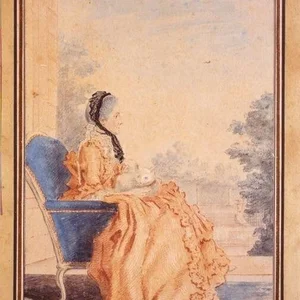

An eighteenth-century French salonnière, the Marquise du Deffand hosted one of the most influential salons of the Enlightenment in Paris. A correspondent of Voltaire and d'Alembert, she embodied the critical spirit and intellectual sociability of her age.
Madame du Deffand
Marie Anne de Vichy-Chamrond, marquise du Deffand
7 min read
Frequently asked questions
Famous Quotes
« The distance is nothing; it is only the first step that is difficult.»
« I am not at all surprised that God created the world, but I am very surprised that He should be pleased with His work.»
Key Facts
- 1697: born at Chamrond, in Burgundy
- c. 1730: opens her salon on the Rue Saint-Dominique in Paris, frequented by Voltaire, Montesquieu, and d'Alembert
- 1753: loses her sight, which does not prevent her from continuing to run her salon
- 1766–1780: passionate correspondence with Horace Walpole, a landmark of European epistolary literature
- 1780: dies in Paris, leaving a vast body of correspondence published posthumously
Works & Achievements
An exchange of letters spanning more than thirty years, bearing witness to a deep intellectual friendship. Voltaire acknowledged in Madame du Deffand an interlocutor fully equal to his own critical mind.
A passionate correspondence with the English writer, published in 1810. These letters reveal the intellectual and emotional life of the salon hostess in her final years and constitute a precious document on Enlightenment society.
Exchanges with the co-editor of the *Encyclopédie*, attesting to the central role of the du Deffand salon in the dissemination of new ideas, even as Madame du Deffand kept her distance from philosophical dogmatism.
Her salon itself constitutes her principal work: a space of intellectual sociability active for more than thirty years, bringing together the most brilliant minds of Enlightenment Europe.
Anecdotes
Blind from 1754, Madame du Deffand never gave up her salon. She continued to animate conversations with a sharp wit, recognizing her guests by voice and dictating her correspondence to her secretaries. Her blindness only refined her reputation as an incomparable woman of wit.
When the Cardinal de Polignac told her about the miracle of Saint Denis, who allegedly walked six leagues carrying his severed head, Madame du Deffand replied with her characteristic impertinence: “The distance is nothing; it is only the first step that is difficult.” This quip became one of the most celebrated phrases of the Enlightenment, illustrating her taste for irony and scepticism.
At 69, Madame du Deffand met the English writer Horace Walpole during his stay in Paris and fell desperately in love with him. She wrote him hundreds of passionate letters in French, which he received with discomfort but kept with great care. This correspondence, published after her death, reveals an unexpected depth of feeling in the salonnière.
In 1754, Madame du Deffand took in the young Julie de Lespinasse as her reader and lady's companion. For ten years, she trusted her completely. But in 1764 she discovered that Julie had been secretly receiving her own guests one hour before the salon officially opened. This betrayal crushed her, and Julie went on to found a rival salon that drew d'Alembert and the Encyclopédistes.
Sceptical to the end, Madame du Deffand declared she believed neither in God nor in the immortality of the soul, while confessing a fear of nothingness. She refused the comfort of philosophical or religious certainty, earning a reputation as a woman of desperate sincerity. Voltaire himself admired this intellectual honesty in his lifelong friend.
Primary Sources
“I have no wish to live; I only wish not to be dead.” She thus expresses her painful relationship with existence, caught between profound boredom and a refusal of nothingness.
“You are the only one who has ever interested me. I do not know why; perhaps because you do not seek to please me and you tell me the truth.”
“You are, madame, one of the finest souls I know, precisely because you have no love of illusions.” Voltaire thus expresses admiration mingled with brotherly affection for her.
“Her salon was the gathering place of all the distinguished minds Paris had to offer. She suffered neither foolishness nor pretension, and one could only enter on the condition of shining there.”
Key Places
Residence of Madame du Deffand from 1747 until her death. It was here that she held her famous salon, welcoming philosophers, aristocrats, and men of letters every week for over thirty years.
Birthplace of Marie Anne de Vichy-Chamrond in 1696, born into the provincial Burgundian nobility from which she took her maiden name.
Madame du Deffand frequented the court of Versailles in her youth and maintained close ties with the aristocracy gravitating around King Louis XV.
The aristocratic district on the Left Bank where the Parisian high nobility resided. The du Deffand salon was one of its most active and sought-after intellectual hubs.
Typical Objects

Before losing her sight, Madame du Deffand wrote her many letters herself. Once blind, she dictated them to a secretary while jealously maintaining her stylistic control.

Brelan and card games were at the heart of the salon's evenings. The card table brought guests together in easy sociability, before or after the great philosophical conversations.

Candlelight was indispensable for the salon's evening gatherings, even if Madame du Deffand, being blind, no longer benefited from it directly. The candelabra created an atmosphere conducive to intimate exchange.

A cup of hot chocolate was the aristocratic refreshment par excellence in the 18th century. Madame du Deffand served it to her guests during her salon evenings.

This official newspaper, read aloud by her secretaries, allowed Madame du Deffand to stay informed of political and cultural news despite her total blindness.

An indispensable accessory for a woman of society in the 18th century, the fan served as much to cool oneself as to punctuate conversation with an elegant gesture or a discreet sign of shared understanding.
School Curriculum
Vocabulary & Tags
Key Vocabulary
Daily Life
Morning
Madame du Deffand, a dedicated night owl, spent her mornings in bed. A secretary would read her the gazettes and correspondence aloud, and she would dictate her replies from her apartments at the Convent of Saint-Joseph, keeping meticulous control over the style of each letter.
Afternoon
Afternoons were devoted to private visits and one-on-one conversations with her closest friends. She sometimes received distinguished visitors — ambassadors or foreign men of letters passing through Paris — in a more intimate setting than the evening gatherings.
Evening
The salon opened late in the evening, around nine or ten o'clock. Madame du Deffand presided over the conversations with natural authority, recognizing her guests by their voices and guiding the discussions with subtle skill. Card games often brought the evening to a close.
Food
The salon table was simple but refined: hot chocolate, lemonades, biscuits, and small cakes were passed among the guests. Madame du Deffand, little given to food, preferred light sweets over the copious meals typical of aristocratic tradition.
Clothing
Dressed according to the standards of eighteenth-century Parisian aristocracy, she wore silk or velvet gowns in muted colors, powdered wigs, and discreet jewelry. Her carefully considered appearance reflected her social standing and her taste for elegance without ostentation.
Housing
From 1747 onward, she occupied an apartment at the Convent of the Filles Saint-Joseph, on the rue Saint-Dominique in the Faubourg Saint-Germain. These comfortable rooms, adorned with portraits and bookshelves, formed an ideal setting for her salon, sheltered from the noise of the city.
Historical Timeline
Period Vocabulary
Liens externes & ressources
Références
Œuvres
Correspondance avec Voltaire
1745-1778
Lettres à Horace Walpole
1766-1780
Lettres à d'Alembert
1750-1780
Le salon du couvent Saint-Joseph (1747-1780)
1747-1780