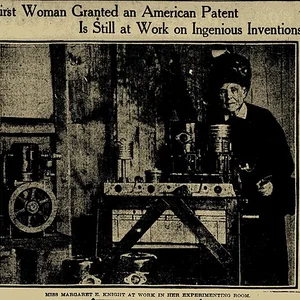

Margaret Knight (1838–1914) was a prolific American inventor who revolutionized the packaging industry by developing the machine that produces flat-bottomed paper bags. Over the course of her life she filed more than 27 patents across fields as varied as textiles, mechanics, and automotive engineering.
Margaret Knight(1838 — 1914)
Margaret E. Knight
États-Unis
8 min read
Frequently asked questions
Key Facts
- 1838: born in York, Maine (United States)
- 1867: invention of a machine to cut and fold flat-bottomed paper bags
- 1871: awarded US Patent No. 116,842 after successfully defending her authorship against a male rival
- More than 27 patents filed across various industrial fields throughout her lifetime
- 1914: died in Framingham, Massachusetts, recognized during her lifetime as one of America's great inventors
Works & Achievements
Knight's first invention, designed at age 12 to automatically stop a power loom when a shuttle came loose; never patented, it was nonetheless adopted in many New England textile mills.
Knight's mechanical masterpiece, this machine automated the production of square-bottomed paper bags, replacing dozens of women working by hand and establishing the global standard for paper packaging still in use today.
A series of refinements to her own packaging machines, filed to strengthen her commercial position following the founding of the Eastern Paper Bag Company.
Knight designed several mechanisms to improve industrial shoe manufacturing — a major sector of the New England economy — earning her new patents in a field far removed from packaging.
In the final years of her life, Knight turned to engine mechanics and patented a rotary engine system, a testament to an intellectual curiosity that was never confined to any single technical domain.
Anecdotes
At just 12 years old, Margaret Knight was working in a cotton mill in Manchester, New Hampshire, when she saw a loom shuttle come loose and seriously injure a worker. Within days, she designed an automatic safety device that would stop the machine if an incident occurred. No one paid her a penny for this invention, as patents were then out of reach for women and children.
In 1870, while Margaret Knight was perfecting her flat-bottomed bag-making machine in a Boston workshop, a man named Charles Annan spied on her work and filed the patent in his own name, arguing that a woman was incapable of designing such a complex mechanism. Knight took him to court, presenting her dated sketch notebooks and the testimonies of workers who had seen her at work. The court ruled in her favor in 1871: this trial became a symbolic victory for women inventors.
Margaret Knight was a tireless worker who filled entire notebooks with plans, calculations, and observations. When she set out to protect her bag-making machine invention, she produced dozens of carefully dated pages of notes before the court. These notebooks, now preserved in historical archives, bear witness to a remarkable scientific rigor for a self-taught woman of the Victorian era.
Her contemporaries nicknamed her the “Lady Edison,” in reference to Thomas Edison, whose lifetime almost exactly paralleled her own. Yet unlike Edison, Knight died nearly penniless in 1914, at the age of 76, having devoted her entire life to inventing. She had filed more than 27 patents in fields as varied as mechanics, footwear, and the rotary engine, but had never managed to turn her inventions into personal wealth.
Margaret Knight’s flat-bottomed bag machine permanently changed commercial habits: before her invention, paper bags had a pointed bottom and could not stand upright. Her invention made it possible to create stable bags that could stand on their own on a counter — the model we still know today in supermarkets. By filing her patent in 1871, Knight unknowingly helped revolutionize modern packaging.
Primary Sources
Be it known that I, Margaret E. Knight, of Boston, in the county of Suffolk and State of Massachusetts, have invented a new and useful Improvement in Paper-Bag Machines, of which the following is a specification.
The testimony shows conclusively that Miss Knight conceived the invention and reduced it to practice prior to any date claimed by Annan. Her notebooks and the sworn depositions of workmen at the machine-shop establish priority beyond reasonable doubt.
Margaret E. Knight, of Boston, Massachusetts, assignor to herself, has invented certain new and useful improvements in bag-machine attachments, fully described in the following specification.
Working notes, dimensioned sketches, and descriptions of mechanisms written between 1867 and 1870, preserved as evidence during the dispute with Annan, then transferred to American historical archives.
To all whom it may concern: Be it known that I, Margaret E. Knight, a citizen of the United States, residing at Framingham, in the county of Middlesex and State of Massachusetts, have invented certain new and useful improvements in rotary engines.
Key Places
Birthplace of Margaret Knight, born on February 14, 1838 in this coastal New England town, into a working-class family of modest means.
Industrial city where Knight worked in cotton mills as a teenager and devised around 1850 her first safety device for looms, without ever receiving any compensation for it.
Home of the Columbia Paper Bag Company, where Knight developed her flat-bottomed bag-making machine between 1867 and 1870, conducting all her experiments on the factory floor.
The city where Knight had her first bag-making machine prototype built at a precision engineering workshop — and where Annan spied on her work before stealing her designs.
Home of the USPTO (United States Patent and Trademark Office), where Knight filed more than 27 patents over her lifetime and won her landmark legal battle against Annan in 1871.
The city where Margaret Knight died on October 12, 1914, nearly penniless despite a lifetime devoted to invention.
Typical Objects

Knight's landmark invention, patented in 1871, this machine automatically folded and glued the square bottom of paper bags, replacing entirely manual labor and creating the bag design we still use today.

Knight filled entire notebooks with dimensioned sketches, calculations, and dated notes to document her research; these notebooks proved decisive during the 1871 lawsuit against Annan, establishing her priority of invention.

A self-taught engineer, Knight built metal prototypes herself in machine shops, operating lathes, files, and precision tools at a time when such practices were considered the exclusive domain of men.

A moving part of an industrial loom that Knight sought to make safer at the age of 12, after witnessing a serious accident at a textile mill in New Hampshire.

A patent, issued by the USPTO (United States Patent and Trademark Office), was the legal document protecting an invention; Knight obtained more than twenty of them, in a context where women often had to fight to have their intellectual authorship recognized.

Among her many patents, Knight improved shoe manufacturing machinery, helping to mechanize an industry that employed large numbers of female workers in late nineteenth-century New England.
School Curriculum
Vocabulary & Tags
Key Vocabulary
Tags
Daily Life
Morning
Margaret Knight rose early and began her days in the workshops or factories where she worked, often before dawn in winter to make the most of daylight. She would record in her notebooks the mechanical problems observed the previous day and sketch solutions even before the machines were restarted.
Afternoon
Afternoons were devoted to practical testing: Knight handled the prototypes herself, adjusted parts on the lathe or with a file, and conferred with the mechanical workers who built her models. During periods of litigation or administrative proceedings, she visited lawyers or drafted letters to the USPTO in Washington.
Evening
In the evenings, Knight returned to her notebooks to record the day's test results and draw the modifications to be made. A woman of strong character but not particularly sociable, she lived modestly, devoting her evenings to technical reflection rather than the social diversions of the Victorian era.
Food
Like the majority of working-class and lower-middle-class women in New England in the 19th century, Knight ate simple, nourishing food: soup, cornbread, baked beans, salt-cured meats, and seasonal vegetables. Meals were frugal, eaten quickly between work sessions.
Clothing
Knight wore the plain and practical clothing of Victorian working-class women: a long cotton or dark wool dress, a sturdy apron to protect her clothes in the workshop, and hair pinned up in a bun. She did not wear the elaborate corsets and crinolines of bourgeois women, which were incompatible with physical work at machinery.
Housing
Knight lodged successively in boarding houses or rented rooms near the factories where she worked, a common form of accommodation for unmarried working women in New England. She never owned a home of her own and died in modest lodgings in Framingham, despite decades of productive work.
Historical Timeline
Period Vocabulary
Liens externes & ressources
Références
Œuvres
Dispositif de sécurité pour métiers à tisser
vers 1850
Machine à fabriquer des sacs en papier à fond plat (brevet n° 116 842)
1871
Améliorations des machines à relier et à coller le papier (brevets complémentaires)
1879–1883
Machines de découpe et d'assemblage pour l'industrie de la chaussure
1880–1895
Moteur rotatif à gaz et à vapeur (brevet n° 688 647)
1901