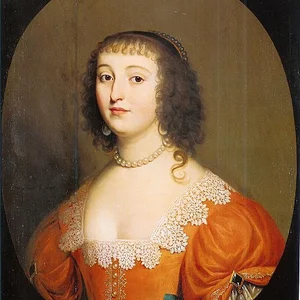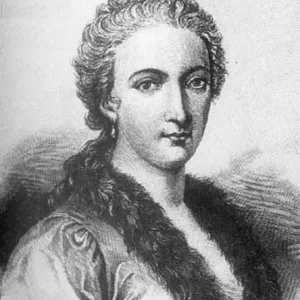

An Italian mathematician and philosopher of the 18th century, Maria Gaetana Agnesi is celebrated for her treatise Instituzioni analitiche (1748), a pioneering pedagogical synthesis of differential and integral calculus. The first woman appointed as a professor of mathematics at the University of Bologna, she later devoted her life to charity and spirituality.
Maria Gaetana Agnesi(1718 — 1799)
Maria Gaetana Agnesi
Monarchie de Habsbourg
8 min read
Frequently asked questions
Key Facts
- 1718: born in Milan into a noble and cultured family
- 1748: publication of Instituzioni analitiche ad uso della gioventù italiana, a landmark treatise on calculus
- 1750: appointed honorary professor of mathematics at the University of Bologna by Pope Benedict XIV
- Around 1752: abandons mathematics to devote herself to theology and charitable works
- 1799: dies in Milan after decades of religious and philanthropic life
Works & Achievements
A Latin oration delivered and published at the age of nine, arguing for women's right to education. The first public testament to Agnesi's prodigious genius and humanist convictions.
A collection of 191 philosophical and scientific theses defended during her father's private academies. The work demonstrates the encyclopedic breadth of her knowledge in physics, logic, and mathematics.
A two-volume pedagogical masterpiece synthesizing algebra, differential calculus, and integral calculus. The first complete mathematical treatise written by a woman, it was translated into French and English and adopted by several European universities.
An algebraic curve analyzed and popularized in the Instituzioni analitiche, nicknamed the 'Witch of Agnesi' due to a mistranslation into English. It still bears her name in mathematics textbooks around the world.
Anecdotes
A remarkable child prodigy, Maria Gaetana Agnesi had mastered five languages by the age of nine, including Latin and Greek. Her father, a wealthy Milanese merchant, hosted scholarly gatherings where she debated natural philosophy in Latin before Milan's greatest minds — a miniature academic salon in every sense.
The mathematical curve known as the 'Witch of Agnesi' owes its strange name to a translation error. Agnesi called the curve 'versiera' (from the Latin 'vertere', to turn); but the English translator John Colson, in 1801, confused the word with 'avversiera', meaning 'witch' or 'female devil' in Italian. And so a simple algebraic curve ended up saddled with a mysterious nickname for centuries to come.
In 1750, Pope Benedict XIV, impressed by the Instituzioni analitiche, officially appointed Maria Gaetana Agnesi as professor of mathematics and natural physics at the University of Bologna. It was an unprecedented honor for a woman. Yet Agnesi, already drawn toward religious life, never actually taught in Bologna and continued to live in Milan.
After her father's death in 1752, Agnesi permanently set aside mathematics to devote herself entirely to the poor and the sick. She founded a hospice in Milan, the Pio Albergo Trivulzio, where she worked until her death in 1799. She died in poverty, having given away all her resources to those in need.
At just nine years old, in 1727, Agnesi publicly delivered a lengthy oration in Latin that she had composed herself, arguing for women's right to access higher education. The text, known as the Oratio, so astonished Milanese scholars that it was printed and circulated throughout Europe as a remarkable intellectual curiosity.
Primary Sources
I have tried to make the path that must be followed in the study of Analysis easy and clear... bringing together the methods of the most celebrated modern Analysts.
A collection of 191 philosophical and scientific theses publicly defended by Agnesi at scholarly gatherings organized by her father, covering physics, natural philosophy, and mathematics.
Agnesi eloquently argues that women possess the same intellectual capacities as men and should have equal access to the liberal arts and sciences.
The Holy Father, having taken note of the excellence of Madame Agnesi's analytical work, confers upon her the chair of mathematics and natural physics at the University of Bologna — an honor rarely granted to a person of her sex.
Key Places
The family residence where Pietro Agnesi hosted his famous academic gatherings, bringing together the leading scholars of Milan. It was in this setting that Maria displayed her talents as a polyglot and philosopher from an early age.
The oldest university in Europe, where Pope Benedict XIV appointed Agnesi as professor of mathematics in 1750. Although she never taught there, the title made her a worldwide symbol of women's access to academic knowledge.
A large Milanese hospice where Agnesi devoted the final decades of her life to caring for the poor and the sick. She died there in 1799, having given up everything for this charitable mission.
Pope Benedict XIV, from Rome, actively supported Agnesi's work and sent her a personal letter of congratulations following the publication of the Instituzioni analitiche, before appointing her to Bologna.
Typical Objects

Agnesi wrote out her proofs with a quill pen on large sheets of vellum paper, covered in formulas and geometric figures. The preparatory manuscripts for the Instituzioni analitiche bear witness to her meticulous corrections and pedagogical rigor.

Essential tools of the era for drawing the curves and geometric figures that accompanied mathematical demonstrations. Agnesi used them to illustrate her lessons and construct the diagrams in her treatises.

A deeply devout woman, Agnesi carried a rosary and meditated daily. These devotional objects grew increasingly central to her life as she gradually stepped back from mathematics and devoted herself more fully to the Catholic faith.

Agnesi carefully studied the works of Leibniz, Newton, and the Bernoullis in preparing her synthesis. These treatises, annotated in her own hand, formed her working library and reflected her ability to read mathematics in several languages.

Unlike other women of her social standing, Agnesi rejected luxurious clothing and the fine adornments of Milanese nobility from an early age. From her youth, she wore simple garments, preferring to give her resources to the poor.

Late-night study sessions by the light of an oil lamp were common among eighteenth-century scholars. Agnesi, who often worked at night, is said to have solved certain problems while sleepwalking, according to her biographer.
School Curriculum
Vocabulary & Tags
Key Vocabulary
Daily Life
Morning
Maria Gaetana rose at dawn to attend Mass, a practice she kept throughout her entire life. She would then spend several hours studying and corresponding with scholars, answering letters from European mathematicians who sent her problems to solve. Her father expected her to be available to preside over his evening academic gatherings, but each morning she negotiated time for her own personal research.
Afternoon
Afternoons were often devoted to the private lessons her father had her give to her brothers and sisters — there were twenty-one children in the family. She also oversaw the drafting of the Instituzioni analitiche, working with copyists to transcribe her proofs into clean form. Occasionally, philosophers and scientists passing through Milan would visit her to debate calculus or natural philosophy.
Evening
In the evenings, the family home transformed into a private academy: Milan's finest minds would gather there, and Maria was expected to present her work, answer objections in Latin or French, and demonstrate her command of both languages and sciences. After these exhausting sessions, she would retire to her rooms to pray and meditate, longing for a more contemplative life.
Food
The Agnesi family was wealthy and kept a generous Milanese table: risotto, polenta, roasted meats, Lombard cheeses, and seasonal pastries. Maria, deeply devout, nonetheless observed regular fasting days, and as she aged she adopted an increasingly simple diet, in keeping with her growing detachment from worldly comforts.
Clothing
In her youth, Agnesi wore the elegant dresses of the Milanese upper-middle class — boned bodices, pannier skirts, and lace trim — as her father required, mindful of the family's social standing. But she found such attire uncomfortable, and gradually won permission to dress more plainly. In her later years, she wore the dark, unadorned habit of a tertiary religious.
Housing
She spent her entire life in Milan — first in the grand family palazzo where her father held his academies, with its libraries, reception rooms, and private studies. After her father's death, she moved to a more modest house, and later joined the Trivulzio hospice, where she lived in a cell like those of the poor residents she cared for.
Historical Timeline
Period Vocabulary
Visual Style
Style baroque tardif et lumières italiennes : clair-obscur chaleureux sur des manuscrits mathématiques, instruments scientifiques en laiton, intérieur patricien milanais sobre et érudit.
Sound Ambience
L'univers sonore d'Agnesi mêle le silence studieux de son cabinet de travail milanais aux échos de la ville baroque : cloches d'église, discussions savantes en latin et en français, grattement de la plume sur le papier.
Liens externes & ressources
Références
Œuvres
Oratio qua ostenditur artium liberalium studia a femineo sexu neutiquam abhorrere
1727
Propositiones philosophicae
1738
Instituzioni analitiche ad uso della gioventù italiana
1748
Courbe de la versiera (sorcière d'Agnesi)
1748