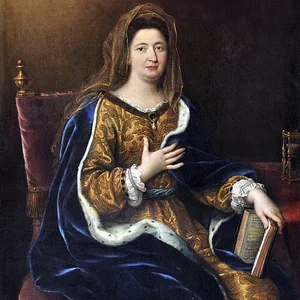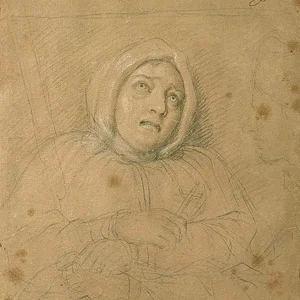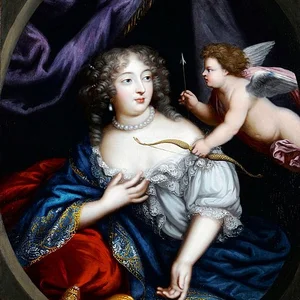

Official favorite of Louis XIV from 1667 to 1681, she reigned over the court of Versailles and had seven legitimized children with the Sun King. Implicated in the Affair of the Poisons, she subsequently fell from grace.
Marquise de Montespan(1640 — 1707)
Madame de Montespan
France
8 min read
Frequently asked questions
Key Facts
- Born in 1640, from the prestigious House of Mortemart
- Became the official mistress of Louis XIV around 1667, supplanting Louise de La Vallière
- Gave the king seven children, all legitimized by letters patent, including the Duke of Maine and the Count of Toulouse
- Implicated in the Affair of the Poisons (1679–1682), which hastened her disgrace
- Withdrew from court and then retired to the Convent of Saint-Joseph in Paris, where she died in 1707
Works & Achievements
Mme de Montespan exercised decisive patronage over the arts at court: she championed Molière, Racine, La Fontaine, Boileau, and Lulli, whose major works were often created under her direct influence.
She oversaw the construction of this masterpiece of French classical architecture, commissioning Jules Hardouin-Mansart and André Le Nôtre for the gardens. Madame de Sévigné described it as a "wonder."
As the leading lady of the court, Mme de Montespan presided over royal entertainments: ballets, comedies, operas, and carousels that contributed to the cultural influence of the French monarchy across Europe.
After her fall from favor, Athénaïs devoted a large part of her fortune to hospitals and relief for the poor, seeking to atone through charity for the scandals that had marked her life as a royal mistress.
Anecdotes
Françoise-Athénaïs de Rochechouart became the official mistress of Louis XIV in 1667, to the great scandal of the Church: both were married. To circumvent the rules, the king had her husband, Louis-Henri de Gondrin, marquis de Montespan, sent into exile — he long refused to be bought off and even organized a symbolic funeral for his wife, whom he considered “dead to virtue.”
Between 1669 and 1678, Athénaïs bore the king seven children, four of whom survived to adulthood. Louis XIV officially legitimized them in 1673. To raise them, Athénaïs herself chose the widow Scarron — who would become Madame de Maintenon — never suspecting she was thereby grooming her own rival, the very woman who would ultimately steal the royal favor away from her.
In 1679, the Affair of the Poisons rocked the court of Versailles. The police of Lieutenant La Reynie dismantled a network of fortune-tellers and poisoners. The name of Athénaïs de Montespan surfaced in confessions: she was accused of having resorted to black masses and special concoctions to maintain her hold on the king. Louis XIV had the affair sealed, but trust was broken forever.
Athénaïs was renowned for her razor-sharp wit and unrivaled taste for luxury. Louis XIV had the Château de Clagny built for her — a residence Madame de Sévigné called “a marvel.” Her patronage extended to Molière, Racine, La Fontaine, and Lully, who brought the grand court festivities to life and helped define the cultural brilliance of the reign.
After her final disgrace in 1681, Athénaïs refused to fade into obscurity. She continued to appear at court for a few more years, then gradually devoted herself to piety and charitable works, founding hospitals and distributing her fortune to the poor. She died at Bourbon-l'Archambault in 1707, far from the splendor of Versailles that had once made her its queen.
Primary Sources
Mme de Montespan has a beauty that astonishes and dazzles; she is tall, well-proportioned, fair-skinned; she has beautiful blonde hair and large blue eyes. There is something so noble and so agreeable in her whole person that one cannot look away.
Mme de Montespan, who had reigned so long and so absolutely over the king and the court, fell at last into a disgrace from which she never recovered. She had wit, haughtiness, and a magnificence that extended to everything.
She had wit, haughtiness, magnificence, and a natural gallantry that was the source of her charm and her power. Her conversation was brilliant and sharp; she knew how to please and displease with equal brilliance.
The Marquise de Montespan then governed the court and the king's favor with an absolute authority that few ministers have ever exercised over their master. She dispensed favor and disgrace with a power that belonged to her alone.
In the depositions of La Voisin and her accomplices, the name of the Marquise de Montespan recurs several times in connection with black masses and preparations intended to secure the continued favor of the king.
Key Places
The king's primary residence and the seat of the court from 1682 onward, Versailles was the stage for Athénaïs's dominance over the kingdom's political and social life for nearly fifteen years. Her apartments, located on the first floor of the central wing, were among the most magnificent in the palace.
Built by Jules Hardouin-Mansart from 1670 onward for Mme de Montespan, just a few hundred metres from Versailles, it was considered one of the finest private residences in Europe. Demolished in the nineteenth century, it survives today only through engravings and enthusiastic written accounts.
The Paris townhouse of the Rochechouart-Mortemart family, from which Athénaïs descended. This place embodies the provincial high nobility's ambition to assert itself at court, and it was from here that several family members rose to the highest distinctions.
A spa town in the Bourbonnais region where Mme de Montespan frequently stayed to take the waters, and where she died on 27 May 1707 at the age of 66, surrounded by her ladies-in-waiting and far from the court that had long forgotten her.
Typical Objects

An indispensable accessory for great ladies of the court, it served both to cool oneself and to communicate through discreet signals. Athénaïs, known for her vanity, owned many such fans adorned with precious stones.

Perfumes were a tool of seduction at the court of Versailles. Mme de Montespan was renowned for her precious essences, sourcing her fragrances from the finest craftsmen of Provence.

Venetian mirrors, rare and costly, adorned the apartments of royal favourites. The fashion for mirrors took hold at Versailles, culminating in the Hall of Mirrors, whose construction Mme de Montespan witnessed.

An absolute symbol of status, Mme de Montespan's carriage was richly decorated. Travelling by carriage at Versailles set those close to the king apart from ordinary courtiers, and Athénaïs made ostentatious use of hers.

Louis XIV gave Mme de Montespan jewels of considerable value, visible tokens of royal favour. These ornaments graced her public appearances and proclaimed the king's affection in the eyes of the entire court.

After her fall from favour, Athénaïs turned to piety. A richly adorned book of hours was the instrument of aristocratic devotion, and she made daily use of one during her final years at Bourbon-l'Archambault.
School Curriculum
Vocabulary & Tags
Key Vocabulary
Daily Life
Morning
Athénaïs rose around nine o'clock and sometimes attended the king's *lever*, a ceremony reserved for the great lords of the realm. Her toilette was a meticulous ritual: dressing in silks and laces, an elaborate coiffure, the application of perfumes and white powders — all accomplished with the help of several ladies' maids.
Afternoon
Afternoons were devoted to strolls through the gardens of Versailles or Clagny, audiences with the poets and artists she patronized, and card games with the king. She also received courtiers in her apartments, dispensing favors and disgrace according to her whim.
Evening
Evenings at Versailles were true spectacles: comedies by Molière, operas by Lully, balls and elegant suppers where Athénaïs presided at the king's side. She was renowned for her brilliant wit and sharp conversation, which animated the royal tables well past midnight.
Food
The royal table was sumptuous: roasted meats, *pâtés en croûte*, fish brought by relay from Paris, candied fruits, sweet courses and fine Burgundy wines. It is said that Athénaïs had a fondness for rich dishes and sweets, which contributed to her fuller figure as the years went by.
Clothing
Athénaïs wore court gowns of silk, velvet and gold or silver brocade, with sleeves adorned with Flemish lace. The fashion of Versailles demanded tight bodices, wide skirts, towering coiffures and jewels of diamonds and pearls gifted by the king.
Housing
Her apartments at Versailles occupied the first floor of the central wing, richly decorated with tapestries from the royal manufacture, Boulle marquetry furniture and paintings by Le Brun. At the château de Clagny, she had an independent residence with formal French gardens designed by Le Nôtre.
Historical Timeline
Period Vocabulary
Visual Style
Style baroque français, fastueux et solennel : ors de Versailles, soieries brodées, portraits d'apparat dans la tradition de Pierre Mignard, palette chaude de bleus royaux, ors et pourpres profonds.
Sound Ambience
Ambiance sonore de la cour de Versailles sous Louis XIV : musique baroque de Lulli au clavecin, froissement de soieries, fontaines royales et murmures feutrés de courtisans dans les salons dorés.
Liens externes & ressources
Références
Œuvres
Mécénat des artistes et écrivains de Versailles
1667-1681
Fondation et aménagement du château de Clagny
1670-1680
Fondation d'œuvres de charité
1691-1707