
Roman god of war and protector of agriculture, Mars is one of the most venerated deities in the Roman pantheon. Legendary father of Romulus and Remus, he embodies Rome's military power and its destiny of conquest.
Mars
Mars
10 min read
Frequently asked questions
Key Facts
- Mars was the second most important god in the Roman pantheon, after Jupiter
- He is identified with the Greek god Ares, god of war
- The month of March (Martius) takes its name from Mars, marking the beginning of the military season
- According to legend, Mars is the father of Romulus and Remus, the mythical founders of Rome (753 BC)
- Augustus had the Temple of Mars Ultor (Mars the Avenger) built in the Forum of Augustus, inaugurated in 2 BC
Works & Achievements
Commissioned by Augustus in fulfillment of a solemn vow, this temple with its 18-meter Corinthian columns is the most iconic monument of the cult of Mars. Its columns survive in part and stand as testimony to the splendor of Roman martial worship.
A poem in six books commenting on the Roman calendar. Ovid devotes Book III to the month of March, recounting the god's myths, his union with Rhea Silvia, the origin of the ancilia, and the rites of the Salii.
Rome's national epic casts Mars as a constant protective presence in the destiny of the Roman people. The god of war intervenes in battles and embodies the conquering vocation of Rome.
An ancient ritual hymn sung by the warrior-priest dancers known as the Salii during their armed processions in March and October. Considered so archaic that classical Romans could no longer understand it, it represents one of the oldest surviving traces of the cult of Mars.
Its spiral bas-reliefs depict Roman legions fighting under divine protection, within the martial iconographic tradition inherited from the cult of Mars. The column illustrates the enduring link between divine favor and imperial military power.
Anecdotes
Mars is considered the father of Romulus and Remus, the legendary founders of Rome. According to tradition, he united with the Vestal Virgin Rhea Silvia, condemned to celibacy by her tyrannical uncle Amulius. This divine act gave birth to the twins who would go on to found the greatest city of antiquity, making the entire Roman people descendants of the god of war.
The month of March (martius) takes its name directly from the god Mars. In the early Roman calendar, it was the first month of the year — the ideal time to resume military campaigns after winter. This name endured through the centuries and survives today in all Romance languages.
In Rome, the priests of Mars known as the Salii performed an annual ritual war dance through the city streets each March, striking their sacred shields with spears while chanting a hymn so archaic that the Romans themselves could no longer understand it. These shields, the ancilia, were believed to guarantee Rome's divine protection as long as they remained within the city.
The emperor Augustus built the Temple of Mars Ultor — Mars the Avenger — to honor the god following his victory over the assassins of Julius Caesar. He had made this vow before the Battle of Philippi in 42 BC. The temple was inaugurated in 2 BC and became one of the most magnificent sanctuaries in Rome, serving as the departure point for all major military expeditions.
Mars's sacred animals were the wolf and the woodpecker. The wolf symbolized martial ferocity and the founding of Rome, while the woodpecker, according to legend, fed and guided the abandoned Romulus and Remus in the forest. Both animals appeared frequently in artistic depictions of the god and in the military omens interpreted by the augurs.
Primary Sources
"First month of the ancient year, Mars, it is you who received it, and the first place in the calendar belongs to you. Remus and the founder of your city both celebrate you." Ovid traces the myths of the god and the origin of the rites held in his honor throughout the month.
"Whether in truth, or because it seemed more honorable to attribute so great an origin to a god, she declared that Mars was the father of the children she had borne." Livy thus records the divine birth of Romulus and Remus.
"From that stock shall arise a race of Trojan blood, who shall extend their dominion over the whole earth. Mars and his warlike might shall watch over this lineage." Virgil places Mars at the heart of Rome's imperial destiny.
"It is said that Mars appeared to Rhea Silvia and lay with her; and that when she had given birth to twins of beauty and stature beyond the ordinary, Amulius, struck with fear, ordered the children to be exposed."
"Numa instituted the Salii in honor of Mars, entrusted them with the ancilia, and taught them a war dance accompanied by chants, so that the god would protect Rome for eternity. These rites are among the most venerable in the Roman religion."
Key Places
A large plain along the banks of the Tiber, sacred to Mars, where Roman soldiers trained and citizens gathered to vote. It was here that military drills, troop reviews, and grand ceremonies in honor of the god took place.
Built by Augustus in fulfillment of a vow made before the Battle of Philippi, this monumental temple was the heart of the imperial cult of Mars. It was here that recaptured military standards were housed and where generals symbolically set out on campaign.
The official residence of the pontifex maximus and the place where the sacred spears and shields of Mars were kept. When the spears vibrated on their own, it was taken as an omen of war — one of the most dreaded divine signs in all of Roman religion.
The mythical peak where the Greco-Roman gods dwelled. Mars held his place among the twelve Olympians there, though he was often scorned by his peers for his brutality — Homer tells us that Zeus himself called him the most hateful of all gods.
Typical Objects

Mars's most emblematic weapon, the spear is his symbol above all else. In Rome, sacred spears kept in the Regia were said to vibrate and rattle on their own to warn of imminent danger — Julius Caesar himself is said to have witnessed this omen on the eve of his assassination.

The ancile is an oval shield with scalloped edges, said to have fallen from the sky during the reign of Numa. To prevent it from being stolen, Numa had eleven identical copies made: the twelve ancilia became Rome's most sacred object, kept by the Salii priests.

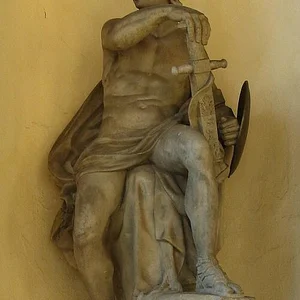
Mars is almost always depicted wearing a Corinthian helmet adorned with a red horsehair crest. This helmet, the quintessential symbol of the warrior, immediately identifies the god throughout Roman and Hellenistic iconography.

Clad in a polished bronze muscled cuirass, greaves, and a great scarlet cloak, Mars embodies the ideal Roman warrior. His gleaming armor symbolizes the invincible power of Rome and strikes terror into her enemies.

The sacred animal of Mars, the wolf represents martial ferocity and the spirit of Rome. The she-wolf who suckled Romulus and Remus was the living embodiment of the god's protection over his divine sons and their nascent city.

Another sacred animal of Mars, the woodpecker was said to have guided and fed the abandoned twins in the forest. In military augury, the sighting of a woodpecker was interpreted as a favorable sign from the god of war.

The solemn sacrifice of a boar, a ram, and a bull — the suovetaurilia — was the most important offering made to Mars. These animals were led in procession around an army or a field to purify it and secure divine favor before any military campaign.
School Curriculum
Vocabulary & Tags
Key Vocabulary
Tags
Daily Life
Morning
At dawn, Mars receives the homage of soldiers preparing for battle. In his temples, priests light sacred fires and offer libations of wine and spelt. During the month of March, the Salii priests chant their ancestral hymn while marching through the streets of Rome in bronze armor, striking their shields to awaken the god's martial power.
Afternoon
In the heart of the day, Mars presides over battles and watches the legions maneuver from the heights of Olympus. He grants his favor to the most courageous and guides generals in their tactical decisions. Augurs interpret the flight of birds — particularly the sacred woodpecker — to divine the god's will before any military action.
Evening
In the evening, Mars takes his seat among the gods of Olympus. According to myth, he often meets Venus, goddess of love and his divine consort — a symbolic union of war and beauty that the Romans saw as a creative force. Victorious generals burn torches in his honor after battle.
Food
Offerings to Mars consist of animals sacrificed during the suovetaurilia: a boar, a ram, and a bull led in procession and solemnly slaughtered. Quality wine, spelt, and mola salsa — a mixture of spelt flour and sacred salt — are placed on his altars. These rites symbolically nourish the god and renew his protective covenant with Rome.
Clothing
Mars is depicted in full armor: a polished bronze muscle cuirass, greaves, a red-crested helmet, and a great scarlet cloak — the paludamentum — the color of blood and of Roman generals. He is always armed with his spear and shield, never at rest, always ready for battle.
Housing
In mythology, Mars dwells on Mount Olympus among the great immortal gods. On earth, his homes are the temples dedicated to him, including the majestic Temple of Mars Ultor in the Forum of Augustus. The Regia, at the heart of the Roman Forum, houses his sacred spears and shields — true palladiums of the eternal city.
Historical Timeline
Period Vocabulary
Visual Style
Mars est représenté comme un guerrier olympien idéalisé, vêtu d'une armure de bronze étincelante et d'un manteau écarlate, dans un style sculptural gréco-romain majestueux aux tons de rouge sang et d'or impérial.
Sound Ambience
L'univers sonore de Mars mêle le fracas des armes et le grondement sourd des légions en marche aux chants rituels archaïques des prêtres Salii, dans une atmosphère de puissance militaire et de solennité religieuse.
Liens externes & ressources
Références
Œuvres
Temple de Mars Ultor (Forum d'Auguste, Rome)
2 av. J.-C.
Ovide, Fastes (Fasti)
vers 8 ap. J.-C.
Virgile, Énéide
29-19 av. J.-C.
Carmen Saliare (Hymne des Salii)
VIIe siècle av. J.-C. (attribué à Numa)
Colonne Trajane, Rome
113 ap. J.-C.