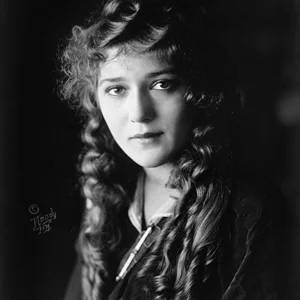

A Canadian-American actress nicknamed “America's Sweetheart,” she was one of the greatest stars of silent cinema. A pioneer of the Hollywood industry, she co-founded the United Artists studio in 1919.
Mary Pickford(1892 — 1979)
Mary Pickford
Canada
6 min read
Frequently asked questions
Key Facts
- Born in 1892 in Toronto (Canada), she began on the stage and then in film from 1909 with D.W. Griffith
- Became one of the highest-paid actresses in the world in the 1910s
- Co-founded United Artists in 1919 with Charlie Chaplin, Douglas Fairbanks, and D.W. Griffith
- Won the Academy Award for Best Actress in 1930 for “Coquette,” one of her first talking pictures
- Received an Honorary Academy Award in 1976 for her lifetime achievement; died in 1979
Works & Achievements
The film that secured her international fame and lastingly established her persona as a working-class young woman.
One of her great successes, emblematic of her roles as spirited and endearing young girls.
An adaptation of the famous novel, the first film she produced for United Artists, and a major commercial hit.
A technical feat in which she plays two roles, including that of a little boy, thanks to elaborate special effects.
Pickford's first talking picture, which earned her the Academy Award for Best Actress and marked her transition to sound cinema.
The creation of a studio by the artists themselves: a revolutionary model of independence from the major studios.
The last film of her career, after which she retired permanently from the screen to devote herself to producing.
Anecdotes
Nicknamed “America's Sweetheart,” Mary Pickford kept her long blonde curls long after she had outgrown the little-girl roles she continued to play. When she finally decided to cut them off in 1928, at the age of 36, the event made front-page news as a genuine national event.
In 1919, tired of being dependent on the major studios, Mary Pickford joined forces with Charlie Chaplin, Douglas Fairbanks, and director D.W. Griffith to found United Artists. A studio executive reportedly quipped, “The lunatics have taken over the asylum” — because actors were becoming their own bosses.
Mary Pickford was one of the first actresses to become a “millionaire” thanks to the movies: as early as 1916, she negotiated a contract guaranteeing her 10,000 dollars a week, a colossal sum for the time. A formidable businesswoman, she controlled the choice of her films and her crews.
Her 1920 marriage to actor Douglas Fairbanks made them Hollywood's first star couple. Their mansion, nicknamed “Pickfair,” became the most famous reception venue in the world, where one might rub shoulders with kings, writers, and scholars who had come to see “Hollywood royalty.”
In 1929, Mary Pickford won the Academy Award for Best Actress for “Coquette,” her first talking film. Much later, in 1976, the Academy presented her with an Honorary Oscar for her entire career and her role as a pioneer of the industry.
Primary Sources
“I never liked any of my performances. If I had my life to live over, I think I would do it differently.”
Artists Mary Pickford, Charlie Chaplin, Douglas Fairbanks, and D.W. Griffith announce the creation of a company to distribute their own productions, free from studio control.
“The public made me what I am, and I owe everything to it. But an actress must also learn the business side of things if she wants to survive.”
The Academy honors Mary Pickford for her unique contribution to the film industry and to the development of film as an art form.
Key Places
Mary Pickford's birthplace, where she was born in 1892 as Gladys Smith and took to the stage at a very young age.
The heart of the film industry where Mary Pickford built her career and her power as a producer. It was there that she shot most of her films.
The mansion she shared with Douglas Fairbanks, which became Hollywood's most prestigious salon, where the world's elite gathered.
The company where she made her film debut in 1909 under the direction of D.W. Griffith, learning the craft of screen acting.
The town where Mary Pickford spent her final years and died in 1979, withdrawn from public life.
Typical Objects

A camera operated by hand, with the cameraman turning the crank at a steady speed to expose the film. It was the central tool of silent film shoots in the 1910s and 1920s.

Her long, curly hair was her trademark, a sign of the innocent young-girl image she embodied. Once it became a symbol, it fueled her popularity with audiences.

Cellulose nitrate film was used to record and project silent movies. Highly flammable, it caused the loss of many works in archive fires.

A text panel inserted between shots to provide dialogue or explain the action in a silent film. It stood in for the actors' absent voices.

A trophy awarded by the Academy of Motion Picture Arts and Sciences, which Pickford co-founded. She received one in 1929 and then an Honorary Oscar in 1976.

A device that projected the film onto a large screen in darkened theaters, often accompanied by a pianist or an orchestra. It made the public screening of films possible.
School Curriculum
Vocabulary & Tags
Key Vocabulary
Tags
Daily Life
Morning
On filming days, Mary Pickford rose before dawn to reach the studio, where her makeup and the curling of her hair took a long while. A businesswoman, she also devoted her mornings to reviewing contracts and scripts.
Afternoon
Afternoons were spent on the sets, under intense light, rehearsing and shooting scenes shot by shot. As a producer, she personally oversaw the choice of sets, costumes, and editing.
Evening
In the evening, at Pickfair, she hosted the Hollywood elite and distinguished visitors from around the world. Dinners and private screenings extended the workday into socializing.
Food
Like the American high society of the day, her meals blended refined cuisine served by staff with simple dishes. The dinners at Pickfair were renowned for their elegance rather than their abundance.
Clothing
On screen, she often wore the modest dresses of a young girl, in keeping with her roles. About town, she sported the elegant outfits and furs of the stars of Hollywood's golden age.
Housing
She lived in the luxury of Pickfair, a vast Beverly Hills mansion surrounded by gardens, with a swimming pool and reception halls, a symbol of the lifestyle of the kings of cinema.
Historical Timeline
Period Vocabulary
Liens externes & ressources
Références
Œuvres
Rebecca of Sunnybrook Farm
1917
Little Lord Fauntleroy
1921
Cofondation de United Artists
1919