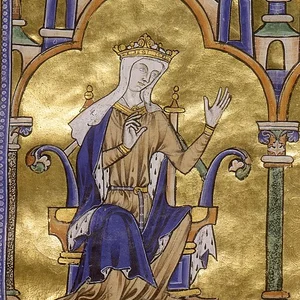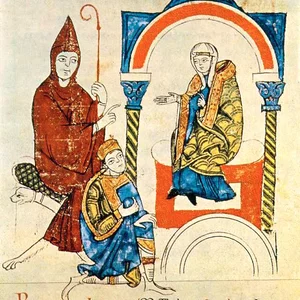

Countess of Tuscany (1046–1115), Matilda was one of the most powerful women of the medieval Western world. An unwavering ally of the papacy, she played a decisive role in the Investiture Controversy, hosting at her Castle of Canossa the famous penance of Henry IV before Gregory VII in 1077.
Matilda of Tuscany(1040 — 1115)
Matilda of Tuscany
8 min read
Frequently asked questions
Key Facts
- 1046: born in Mantua, heir to the Tuscan and Lombard lands
- 1077: the Castle of Canossa (which she owns) is the site of Henry IV's penance before Gregory VII
- She personally commands her armies against imperial troops, notably at the Battle of Volta Mantovana (1080)
- 1102: she donates her lands to the papacy (the Donation of Matilda), a gesture with lasting political consequences
- 1115: dies at Bondeno; Henry V (emperor) attempts to seize her lands upon her death
Works & Achievements
Matilda played a decisive diplomatic role during the meeting between Henry IV and Gregory VII: her castle, her influence, and her efforts made possible the episode of imperial penance — a pivotal moment in the Investiture Controversy.
Matilda solemnly bequeathed all her territories (Tuscany, Lombardy, Emilia) to the papacy, one of the most significant territorial donations in medieval history. This act was disputed for centuries between the Church and the Holy Roman Empire.
Leading her own armies, Matilda won several victories against imperial forces, most notably at Sorbara (1084), securing the defense of papal territories and making her one of the rare female military commanders in Western medieval history.
Matilda funded the restoration of numerous abbeys and churches across her domains, including Polirone. Her material support for the Gregorian Reform took the form of an active policy of monastic foundations and protection of reforming clergy.
The letters exchanged between Matilda and the pope bear witness to an exceptional political and spiritual relationship. This correspondence illustrates Matilda's role as armed defender, financial backer, and intellectual ally of the Church reform movement.
Anecdotes
In January 1077, in the heart of winter, Emperor Henry IV crossed the Alps through cold and snow to reach Canossa Castle. Mathilde, who was hosting Pope Gregory VII, witnessed the astonishing scene in which the most powerful man in Europe appeared barefoot and dressed in penitent's clothing, waiting three days in the cold before being absolved. This episode, which has passed into history as the “Walk of Canossa,” remains one of the most striking moments of the entire Middle Ages.
Mathilde was not content to be a great lady standing back: she personally led her armies during several military campaigns in Northern Italy. In 1084, she won the Battle of Sorbara against imperial forces — a remarkable victory for a woman at a time when warfare was an exclusively male domain.
In 1102, Mathilde made an unprecedented gesture by solemnly donating all her lands to the papacy — thousands of square kilometers stretching between Tuscany and Lombardy. This donation, known as the “Mathildine Donation,” was contested for centuries between the Church and the Empire, and its legal repercussions were felt well into the 19th century.
Widowed at 23 and childless, Mathilde long refused to remarry in order to preserve her political freedom of action. In 1089, at the age of 49, she finally agreed to marry Welf V of Bavaria, who was only 17 — a purely strategic union to strengthen the alliance against the Empire, which remained childless and was quickly dissolved.
Mathilde was exceptionally well-educated for her time: she read Latin fluently and maintained regular correspondence with Gregory VII. She was one of the first great lay figures to actively support the Gregorian Reform through her actions, her money, and her swords.
Primary Sources
Donizo, a monk at the abbey of Canossa, describes Matilda: "She surpassed in wisdom the most learned of men, and governed her lands with a firmness that compelled the admiration of all her contemporaries, defending the Roman Church as an unshakeable bulwark."
In a letter to Matilda, Gregory VII writes: "We commend you to divine mercy, you who have defended with such zeal the cause of Saint Peter and the Roman Church, exposing your possessions and your life for the sake of justice."
Bernold, a contemporary of the events, recounts the penance at Canossa: "Henry, the king, stripped of his royal regalia, waited for three days at the gate of Countess Matilda's castle, barefoot and clad in penitent's wool, in the depths of a harsh winter."
Arnulf of Milan notes Matilda's power during the events of 1077, recording the humiliation of the emperor, who was forced to seek the countess's intercession with the pope in order to recover his crown.
Key Places
Fortress in the Apennines (Reggio Emilia) where Henry IV performed his penance before Gregory VII in January 1077. This site has become the world symbol of the humiliation of temporal power before spiritual authority.
Matilda's birthplace and capital of part of her domains in Lombardy. There she exercised her comital authority and maintained a cultivated court open to reforming clerics.
Tuscan city and important episcopal seat within Matilda's domains. There she exercised her authority as countess and actively championed the Gregorian Reform among the local clergy.
Center of the papacy that Matilda defended throughout her life with her armies and finances. Her troops helped protect the city during conflicts with Henry IV, and Pope Urban VIII had her remains transferred to Saint Peter's Basilica in 1634.
Benedictine abbey founded by Matilda's family near Mantua, which she protected and enriched throughout her life. She was buried there in 1115, before her remains were transferred to Saint Peter's Basilica in Rome in 1634 by Pope Urban VIII.
Typical Objects

As a great feudal lord, Matilda had a wax seal bearing her arms to authenticate her charters, donations, and treaties. This seal symbolized her sovereign authority and her right to rule her vast domains in her own name.

Matilda personally led her troops into battle, clad in armor. Medieval chroniclers depict her riding at the head of her armies during engagements such as the Battle of Sorbara in 1084, which made her legendary in her own lifetime.

A learned woman, Matilda owned liturgical and patristic manuscripts that she had copied for her chapels. She exchanged texts and letters in Latin with Gregory VII as part of their theological and political correspondence.

An impregnable fortress perched on a rocky spur of the Apennines, Canossa was the symbol of Matilda's power. Its keys represented the mistress of the place who, in 1077, hosted the most dramatic encounter of the conflict between the Church and the Empire.

In 1102 and again at her death, Matilda signed charters by which she ceded her lands to the papacy. These parchment documents, written in Latin, were the subject of legal disputes for centuries and remain essential legal records of medieval history.

Deeply devout, Matilda wore a gold or silver pectoral cross as a sign of her piety and support for Church reform. This object of personal faith illustrates the spiritual dimension of her political commitment.
School Curriculum
Vocabulary & Tags
Key Vocabulary
Daily Life
Morning
Mathilde began her day with matins prayers and Mass in her castle chapel, accompanied by her clerics and chaplains. She then devoted the early morning to receiving reports from her stewards and castellans on the state of her many domains scattered across Tuscany and Lombardy.
Afternoon
The afternoon was dedicated to political and military affairs: receiving vassals, signing charters in Latin, and sometimes inspecting her troops or fortifications. Mathilde personally oversaw the defense of her castles, which set her radically apart from the great ladies of her era.
Evening
In the evening, Mathilde gathered clerics and scholars for readings of sacred texts or diplomatic correspondence. She also dictated letters to Rome and maintained relations with the great families of Italy and Germany, sustaining a dense political network.
Food
Like the medieval nobility, Mathilde ate two meals a day: a light meal in the morning and a main dinner in the evening. Her table was well supplied with bread, meat (game, pork, poultry), fish on the fast days prescribed by the Church, garden vegetables, and Tuscan wine.
Clothing
In ordinary times, Mathilde wore long robes of fine wool or silk, with a veil over her head in the aristocratic fashion of the 11th century. For war or riding, she donned a short tunic, leggings, and a coat of mail — attire that chroniclers mention with admiration and sometimes astonishment.
Housing
Mathilde resided in her many fortified castles scattered across Tuscany and Lombardy, of which Canossa was the most symbolic. These medieval fortresses combined grand reception halls for audiences, private chapels, watchtowers, and inner courtyards, offering both relative comfort and military security.
Historical Timeline
Period Vocabulary
Liens externes & ressources
Références
Œuvres
Médiation de Canossa
janvier 1077
Donation mathildine à la papauté
1102 et 1115
Campagnes militaires en Italie du Nord
1080-1092
Mécénat abbatial et religieux
1070-1115
Correspondance avec Grégoire VII
1073-1085