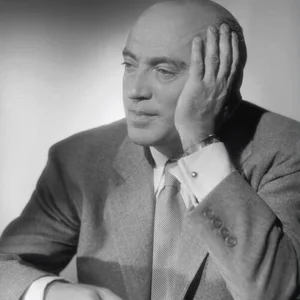

Max Ophüls (1902-1957) was a German-French filmmaker renowned for his virtuoso visual style, marked by long tracking shots and a fluid camera. He directed major works such as *La Ronde*, *Lola Montès*, and *Madame de…*, which explore love and melancholy.
Max Ophüls(1902 — 1957)
Max Ophüls
France, Allemagne
9 min read
Frequently asked questions
Famous Quotes
« Cinema is a form of modern writing whose ink is light.»
Key Facts
- Born on May 6, 1902, in Saarbrücken, Germany
- Fled Nazism in 1933 and went into exile, first in France and then in the United States
- Directed *La Ronde* (1950), adapted from Arthur Schnitzler, which won the Best Screenplay prize at Cannes
- Directed *Lola Montès* (1955), the first French film shot in CinemaScope, now considered a masterpiece
- Died on March 26, 1957, in Hamburg, shortly after returning to Europe
Works & Achievements
Ophüls's first major film, adapted from Schnitzler's play and shot in Germany just before his exile. This Viennese romantic drama foreshadows all of the director's future themes: impossible love, the passage of time, and the waltz as a metaphor for life.
Shot in Hollywood with Joan Fontaine, this film adapted from Stefan Zweig is considered one of the finest melodramas in the history of American cinema. It perfectly showcases Ophüls's mastery of flashback, tracking shots, and subjective narration.
Adapted from Arthur Schnitzler's play *Reigen*, this film structured as a carousel of love affairs in Vienna was a triumph in France and earned Ophüls the Prix Louis Delluc. It marked his return to Europe and his rise to the status of master of French cinema.
A triptych adapted from three short stories by Guy de Maupassant, exploring pleasure, the mask, and illusion. The film's stylistic and literary richness confirmed Ophüls's place in the pantheon of European auteur cinema.
Starring Danielle Darrieux, Charles Boyer, and Vittorio De Sica, this film about a pair of earrings and a fatal love affair is universally hailed as one of the pinnacles of world cinema, both for its direction and its emotional depth.
Ophüls's final film and cinematic testament, the first French feature shot in CinemaScope and color. Misunderstood on release and mutilated by producers, it is today ranked among the absolute masterpieces of world cinema by filmmakers such as Jean-Luc Godard and Stanley Kubrick.
Anecdotes
Max Ophüls was born Max Oppenheimer, but he changed his name to 'Ophüls' at the very start of his theater career to shield his respectable, bourgeois family in Saarbrücken from the scandal that an acting career represented at the time. This pen name, chosen out of filial respect, would become one of the most admired in world cinema.
When Hitler came to power in January 1933, Ophüls was in Berlin directing a film. Warned by friends that his life was in danger as a Jew, he hastily left Germany with his wife and son Marcel, leaving behind a flourishing career in both theater and film. He then began a long wandering through France, the Netherlands, Italy, and finally the United States.
Ophüls is celebrated for his long, sinuous tracking shots and his perpetually moving camera, to the point that his crew joked he had "rails instead of feet." During the shoot of *Lola Montès*, he had an enormous circus tent built on a studio set in Paris, and the complexity of the camera movements required weeks of meticulous preparation.
*Lola Montès* (1955), his final film and most ambitious work, was a crushing commercial failure upon release: the producers mutilated it by re-editing it without the director's consent, even adding an explanatory commentary widely considered condescending. Ophüls died two years later without witnessing its rehabilitation. Today, the film is universally recognized as a masterpiece of world cinema.
His son Marcel Ophüls also became a renowned filmmaker
best known for *The Sorrow and the Pity* (1969)
a devastating documentary about French collaboration during the Occupation. Max
before dying at 54
reportedly told Marcel:
If you make films, make them for yourself." This artistic father-son lineage is one of the most celebrated in the history of cinema.
Primary Sources
I never sought to escape reality in my films. I wanted to look it in the face, but through the eyes of a man who still believes in the beauty of movement, in the fragile charm of fleeting moments.
The camera must never be still when characters are in motion within their souls. The tracking shot is not a stylistic effect — it is a moral necessity: it speaks of time's flight, of the impossibility of holding on to what we love.
We left Germany with a suitcase and hope. France welcomed us with its customary generosity. I don't know what the future holds, but I know I will keep making films for as long as I can hold a camera.
Arthur Schnitzler wrote about Vienna what every city conceals: desire going round in circles, the human comedy that forever begins again. My film is not nostalgic — it is clear-eyed.
Hollywood taught me technical rigor. France gave me back freedom. These are two gifts I carry together, sometimes wondering which of the two weighs more.
Key Places
Birthplace of Max Ophüls (born Max Oppenheimer), then part of the German Empire, close to the French border. His childhood in this Franco-German borderland shaped his dual cultural identity.
His chosen place of exile from 1933, and later the scene of a triumphant return after 1950. It was in Paris that Ophüls shot *La Ronde*, *Madame de…*, and *Lola Montès*, and where he was finally fully recognized as one of the masters of European cinema.
Ophüls lived and worked here from 1941 to 1950, a period during which he directed *Letter from an Unknown Woman* and *Caught*, among others. Despite critical successes, he never felt truly at home there and sought to return to Europe.
Although Ophüls never lived there for any length of time, Vienna is the imaginary city at the heart of his world: the Vienna of Schnitzler, of waltzes and fleeting love affairs that his films recreate with a lucid sense of nostalgia.
The city where Max Ophüls died on **March 26, 1957**, at the age of 54, from heart disease, while preparing new projects. He was buried in France, at the Père-Lachaise Cemetery in Paris.
Typical Objects

Ophüls was the first filmmaker to systematically use long, fluid tracking shots as an artistic signature. His camera, mounted on rails or a dolly, followed the characters' movements with choreographic grace, becoming a fully-fledged narrative tool in its own right.

A recurring object throughout Ophüls's films, the mirror symbolizes illusion, the double, vanity, and the passage of time. In *Madame de…*, mirrors multiply the reflections of characters trapped by their own lies.

In *Lola Montès*, the carousel inside the circus tent becomes the film's central metaphor: the heroine's life is reduced to a spinning spectacle staged for the audience's entertainment. It is at once a real object and a powerful symbol.

In *Letter from an Unknown Woman*, the letter is the engine of the narrative: a woman writes to the man she has loved her entire life — a man who does not remember her. The letter embodies unrequited feeling, lost time, and failing memory.

In *Madame de…*, a pair of earrings secretly sold by an aristocratic woman forms the red thread running through the entire plot. What begins as a frivolous trinket becomes the revealer of a fatal love and social deception.

An everyday tool on Hollywood and French studio sets, the clapperboard synchronized sound and image and marked each new take. For Ophüls — known for his many retakes and meticulous attention to detail — it kept the rhythm through long, demanding days on set.
School Curriculum
Vocabulary & Tags
Key Vocabulary
Daily Life
Morning
Ophüls began his shooting days very early, often before dawn for scenes filmed on location or to meticulously prepare camera movements with his technical crew. He arrived on set with precise hand-drawn plans and notes on every actor's movement.
Afternoon
Afternoons were consumed by filming: Ophüls was known for shooting take after take — sometimes twenty or thirty — until he achieved the exact fluidity he was after. He worked in constant dialogue with his director of photography, discussing at length the angle of light and the axis of the tracking shot.
Evening
Evenings were devoted to preparing the next day's shoot, reviewing rushes, and often to animated conversations with collaborators in Parisian cafés or Hollywood restaurants. A cultured man with a passion for literature, he read voraciously — Schnitzler, Zweig, Maupassant — the very authors he brought to the screen.
Food
Ophüls had adopted French culinary habits during his years of exile in Paris: he enjoyed classic bourgeois cuisine, lively brasseries, and meals taken in good company. In Hollywood, he gravitated toward the European restaurants of Los Angeles frequented by fellow émigré filmmakers.
Clothing
Mindful of his appearance, Ophüls favored elegant suits — a reflection of his bourgeois upbringing and a pronounced taste for aesthetics. On set he remained impeccably dressed, in sharp contrast to the image of the bohemian director; for him, elegance was a form of respect toward his crew and actors.
Housing
In Paris, Ophüls lived in apartments in the Opéra and Montparnasse neighborhoods, at the heart of Parisian intellectual and artistic life. In Hollywood, he rented houses in Beverly Hills or West Hollywood, as did most of the exiled European filmmakers who formed a close-knit community.