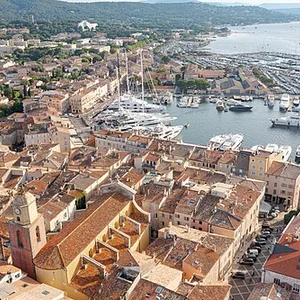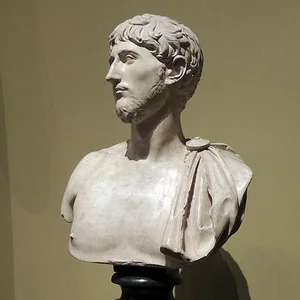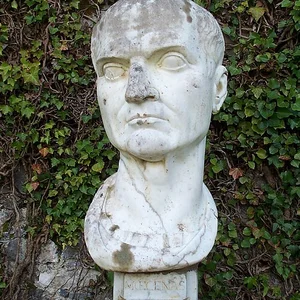

A close advisor to Augustus and great patron of the arts in Rome, Maecenas supported poets such as Virgil and Horace. His name has become synonymous with support for artists and men of letters.
Maecenas(69 av. J.-C. — 7 av. J.-C.)
Maecenas
Rome antique
8 min read
Frequently asked questions
Key Facts
- Around 70 BC: born in Arretium (present-day Arezzo), into an Etruscan family
- From 43 BC onward: became one of the closest advisors to Octavian (the future Augustus)
- He protected and financed major poets such as Virgil, Horace, and Propertius
- Played a crucial diplomatic role in pacifying Italy after the civil wars
- 8 BC: died in Rome, bequeathing his estate to Augustus
Works & Achievements
Maecenas gathered around him the greatest poets of his age — Virgil, Horace, Propertius, Varius Rufus — offering them material support and creative freedom. This literary circle is his most significant and lasting achievement.
Maecenas is mentioned as the author of a philosophical dialogue of which only fragments survive, quoted by other writers. His style was judged overly ornate and precious by Seneca, making it an indirect testimony to the aesthetic sensibilities of the era.
Maecenas wrote poems in Latin, a few fragments of which are preserved in quotations by later authors. They reveal a taste for elaborate forms and a confident aesthetic sensibility, consistent with his role as a patron of the arts.
Maecenas composed memoirs on his political and diplomatic activities, now entirely lost. These texts would have been an invaluable source on the inner workings of the Augustan regime and his own role as a diplomat.
The creation of these monumental gardens on the Esquiline Hill is one of Maecenas's major material achievements. Bequeathed to Augustus upon his death, they transformed a working-class district of Rome into a space of cultural prestige.
Anecdotes
Maecenas was renowned for his chronic insomnia and physical ailments. According to Pliny the Elder, he would spend his nights searching for sleep despite the city's noise, yet refusing to leave Rome. Augustus himself is said to have sent him soothing messages to help him find rest.
When Augustus presided over capital trials and the number of condemned men mounted
Maecenas would sometimes intervene discreetly to temper the prince
s severity. It is reported that he once slipped him a note in the middle of court bearing the words: "Rise at last
executioner!
— an audacity no other adviser would have dared.
To thank Horace for his poems, Maecenas gave him a villa in the Sabine Hills, near Tivoli. This estate, which the poet called his "little Sabine farm
became for him a refuge of peace far from Rome, and he wrote of it in many poems with sincere and heartfelt gratitude.
Maecenas was himself a writer, the author of dialogues, poems, and memoirs now lost. His style was judged excessively convoluted and flowery by his contemporaries: Seneca criticized him harshly, claiming that his overly mannered prose betrayed an effeminate character lacking in moral rigor.
At his death in **8 BC**, Maecenas bequeathed his entire fortune to Augustus, including his magnificent gardens on the Esquiline Hill. This final act of generosity illustrated the unique bond between the two men: a friendship that was as much political as personal, built on absolute and mutual trust.
Primary Sources
Maecenas, descended from royal ancestors, O you who are my support and my sweet glory, there are men who delight in gathering Olympic dust beneath their wheels...
You, Maecenas, whose glorious labors have deserved my songs, receive these verses, still unfinished, under such favourable auspices...
You ask me why this loose and dissolute style is sometimes fashionable. It is bred by the lives of the great... Look at Maecenas: his clothing, his manners, his writing style — everything about him was disordered.
Maecenas suffered from a continuous fever for three years, never once experiencing the slightest sleep throughout that entire time.
From there Heliodorus and I set out to join Maecenas and Cocceius, ambassadors sent on an important mission, well practised in reconciling friends who have fallen out.
Key Places
Maecenas had magnificent gardens laid out on the Esquiline Hill, complete with a tower, fountains, and reception spaces. This place was the living heart of the Augustan literary circle, where Virgil, Horace, and Propertius would gather.
It was Maecenas who gave Horace this estate in the Sabine hills, near present-day Tivoli. This gift perfectly illustrates Maecenas's generosity toward his protégés and his role as a patron in the most concrete sense of the word.
Adjacent to the Roman Forum, the Forum of Augustus, inaugurated in 2 BC, embodied the cultural and political program that Maecenas helped shape intellectually, casting poets as the heralds of Roman glory.
Maecenas's hometown, in Etruria, where his family was among the oldest aristocratic lineages. Maecenas took quiet pride in this heritage, claiming descent from a line of Etruscan kings, even though he never sought any official magistracy.
A major Hellenizing cultural center of Roman Italy, Naples hosted public readings of Virgil's *Georgics* in the presence of Maecenas. The city was an intellectual hub where poets, philosophers, and artists from across the Roman world crossed paths.
Typical Objects

The manuscripts of the poems that Maecenas commissioned, corrected, and circulated traveled in the form of papyrus scrolls. Maecenas owned a considerable library of them and regularly offered copies to his protégés.

A distinctive mark of the equestrian order to which Maecenas belonged, this gold ring set with an engraved stone was worn at all times and signaled his social rank, midway between the plebeian and senatorial classes.

At his famous literary banquets, Maecenas had wine served in finely worked silver cups, symbols of the cultivated luxury he cherished and that sometimes scandalized his contemporaries.

An everyday tool of communication in the Roman aristocracy, Maecenas used these tablets to correspond with Augustus, passing him warnings or advice — sometimes in the middle of a court hearing.

The emblematic instrument of Greek and Latin lyric poetry, the cithara was omnipresent in Maecenas's circle, where poets such as Horace composed their odes accompanying themselves on it or having it played by slave musicians.

Maecenas was a devoted regular at the private baths of his Esquiline villa, where the strigil — a curved scraper — was used to cleanse the body after exercise; his fondness for grooming and perfumes earned him mockery for his softness.

Maecenas often traveled through Rome in a litter carried by slaves, rather than on horseback or on foot. This luxurious mode of transport reflected his refined and somewhat nonchalant lifestyle, which Seneca reproached him for.
School Curriculum
Vocabulary & Tags
Key Vocabulary
Daily Life
Morning
Maecenas began his day late, his fragile health and chronic insomnia forcing him into an irregular schedule. From the morning he received the poets and men of letters of his circle, commented on manuscripts, and replied to the political correspondence that Augustus had sent him by messenger.
Afternoon
The afternoon was devoted to political and diplomatic affairs: audiences in his vast residence on the Esquiline, confidential meetings with provincial delegates or senators, and sometimes sessions at the private baths where he unwound in pools of warm, scented water.
Evening
Maecenas's evenings were famous throughout Rome: refined banquets bringing together poets, philosophers, and senior officials, during which Virgil or Horace would recite their latest compositions. Wine flowed into silver cups, the cithara played, and literary debates stretched well into the night.
Food
Maecenas ate in the manner of the wealthy Roman aristocracy: roasted meats, fresh fish, market vegetables, and Mediterranean fruits, accompanied by white bread and fine wines drawn from the best amphorae. His taste for the luxuries of the table was well known, even if some accused him of eating too little out of mere affectation.
Clothing
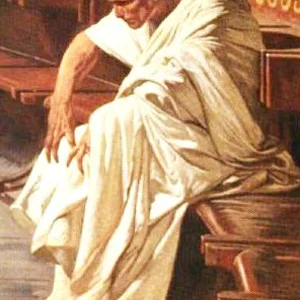
Maecenas wore the toga of the equestrian order — white, edged with a purple stripe — along with the gold intaglio ring that denoted his rank. His contemporaries, including Seneca, criticized him for dressing with a studied negligence, letting his toga hang loose rather than draping it properly, as though eccentricity itself were a mark of distinction.
Housing
Maecenas resided in a sumptuous dwelling on the Esquiline Hill, surrounded by the celebrated gardens he had laid out. These horti spread over several hectares and included porticoes, fountains, greenhouses, and an observation tower from which one could gaze out over all of Rome. The estate served at once as a private palace and as a cultural salon open to the artists of the empire.
Historical Timeline
Period Vocabulary
Visual Style
Le style visuel de l'univers de Mécène s'inscrit dans l'esthétique raffinée de la Rome augustéenne : fresques ocre et rouge pompéien, jardins de marbre blanc et de cyprès, lumière dorée des lampes à huile sur des coupes d'argent ciselé.
Sound Ambience
L'ambiance sonore du cercle de Mécène mêle la douceur d'une cithare jouée lors de banquets littéraires au bruissement des rouleaux de papyrus, dans des jardins romains baignés par le murmure de fontaines et les rumeurs lointaines de la Ville éternelle.
Liens externes & ressources
Références
Œuvres
Constitution du cercle poétique augustéen
vers 40-19 av. J.-C.
Dialogue (perdu)
vers 30-10 av. J.-C.
Poèmes (perdus)
vers 30-10 av. J.-C.
Mémoires / Commentaires (perdus)
vers 20-8 av. J.-C.
Jardins de l'Esquilin (Horti Maecenatis)
vers 30 av. J.-C.