
Roman goddess of wisdom, the arts, and crafts, Minerva is the Roman equivalent of Athena in Greek mythology. Born fully armed from Jupiter's head, she protects Rome, artisans, and poets, and together with Jupiter and Juno forms the Capitoline Triad.
Minerva
Minerva
9 min read
Frequently asked questions
Key Facts
- Born fully armed from Jupiter's head, according to Roman mythology
- Roman equivalent of Athena, goddess of wisdom in the Greek pantheon
- Member of the Capitoline Triad alongside Jupiter and Juno, at the heart of Roman religious life
- The Quinquatria (March 19–23) celebrated her festival, honored especially by artisans and schoolchildren
- Her temple on the Aventine Hill served as a meeting place for guilds of craftsmen and poets
Works & Achievements
Minerva is credited with inventing the art of weaving, the quintessential symbol of civilization and social order. She taught mortal women this fundamental craft, making artisanal knowledge a divine gift passed down to Greek and Roman women.
In the contest for the guardianship of Athens against Poseidon, Athena/Minerva caused an olive tree to spring from the earth — a symbol of peace and prosperity — surpassing her rival's war horse. The city took her name in her honor, making this founding act the birth of Athenian civilization.
According to Ovid and Pindar, Minerva invented the reed flute after witnessing the lamentations of the Gorgons. But catching sight of her puffed-out cheeks reflected in a pool of water, she cast the instrument aside — whereupon the satyr Marsyas picked it up, and his arrogance earned him the fate of being flayed alive by Apollo.
In Aeschylus's *The Eumenides*, Athena/Minerva establishes the Areopagus tribunal in Athens to judge Orestes on a charge of matricide, replacing cyclical vengeance with institutional justice. This founding act symbolizes the invention of law and democracy under the aegis of divine wisdom.
In Homer's *Odyssey*, Athena/Minerva is the constant protector of Odysseus, guiding him through his trials with her wisdom and direct interventions. Sometimes taking human form, she embodies reason triumphant over adversity — a model held up in ancient education.
Commissioned by Pericles and created by the sculptor Pheidias, this colossal chryselephantine (gold and ivory) statue, standing 12 meters tall, stood at the heart of the Parthenon. An absolute masterpiece of classical Greek art, it depicted the goddess in full battle dress, holding a Nike (Winged Victory) in her right hand.
Anecdotes
Minerva was born in an extraordinary way: Jupiter, having swallowed the goddess Metis to thwart a prophecy foretelling that he would be dethroned by his own child, was struck by a terrible migraine. Vulcan then split Jupiter's skull open with an axe, and Minerva leaped out fully armed, letting out a battle cry. This birth symbolizes the idea that wisdom and reason spring directly from the most powerful intelligence.
During a famous weaving contest, the mortal Arachne dared to challenge Minerva, claiming to be a better weaver than the goddess herself. When Arachne depicted the gods' infidelities in her tapestry, Minerva, furious, tore the work apart and struck the young woman with her shuttle. In despair, Arachne hanged herself, and Minerva, moved by pity, transformed her into a spider — condemned to weave for eternity. This myth explains the origin of the scientific name for spiders: arachnids.
Minerva was one of the three deities of the Capitoline Triad, alongside Jupiter and Juno. Their shared temple on the Capitoline Hill was Rome's most important sanctuary: magistrates swore their oaths there, generals deposited their victory offerings, and the Senate could convene there in times of grave crisis. This divine association symbolized the three pillars of Roman power: sovereignty, civic motherhood, and wisdom.
Every year, from March 19 to 23, the Romans celebrated the Quinquatria in honor of Minerva. Craftsmen, teachers, physicians, and poets interrupted their work to pay tribute to their divine protectress. Even gladiators took part in these celebrations, since Minerva was also associated with defensive martial arts and carefully considered military strategy.
Minerva's Aegis — a shield or cloak adorned with the head of Medusa — had the power to petrify any enemy who looked upon it. During the Trojan War, Minerva intervened directly on the battlefield alongside the Greeks. The word *aegis* itself lives on in the English expression “under the aegis of,” still used today to mean “under the protection of.”
Primary Sources
Pallas recognizes herself in the tapestry; she tears it apart, destroys the insulting image of the gods upon it, and with the boxwood shuttle she still held, she struck Arachne, daughter of Idmon, three or four times on the forehead.
Come, Minerva, protect your Quinquatria. Those whose skilled hand guides the brush or chisel honor you; weavers, fullers, and shoemakers lay their offerings in your temple.
Minerva is said to have received her name because she excels in intellect (minuit), or because she calls things to mind and we owe our memory to her (moneat). She presided over the discovery of the arts.
Tarquinius Priscus had vowed a temple on the Capitoline to Jupiter, Juno, and Minerva; but it was his son who laid the foundations, and the temple was dedicated in the first year of the consulship under the Republic.
Minerva, enraged by the crime committed in her desecrated temple by the Greeks, had withdrawn her favor from them. She turned against her former protégés, delivering them to storms and ruin on their homeward journey.
Key Places
Located on the Capitoline Hill in Rome, this three-part temple housed the statues of Jupiter, Juno, and Minerva, the tutelary deities of the city. The religious and political heart of Rome, it was the site of consular oaths, military triumphs, and extraordinary senatorial deliberations.
This imperial forum, inaugurated in 97 AD, was entirely dedicated to Minerva and adorned with tall Corinthian columns, some of which are still partially visible today. The emperor Domitian, her most devoted worshipper, had begun its construction to glorify the goddess at the heart of Rome.
The mythical home of the Greek and Roman gods, Olympus is where Minerva sits alongside Jupiter and the other Immortals. From this celestial summit she watches, guides, and intervenes in the fate of mortals, arbitrating conflicts among the gods.
Although Minerva is the Roman counterpart of Athena, the Acropolis of Athens remains the most iconic place of worship for this goddess. The Parthenon, the temple of Athena Parthenos built in the 5th century BC, housed Phidias's famous chryselephantine statue and remains one of the most important monuments of Antiquity.
Built by the Romans in the 1st century AD in Roman Britain, this temple blended the cult of the Celtic goddess Sulis with that of Minerva, illustrating Roman religious syncretism. The site's sacred thermal waters made it a place of healing, divination, and votive offerings — thousands of inscribed lead tablets have been recovered there.
Typical Objects

Minerva is almost always depicted wearing a Corinthian or Attic war helmet, a symbol of her dual warrior and protective nature. This helmet is a reminder that she was born fully armed, ready for battle from the moment of her miraculous birth.

The aegis is a shield or armored cloak adorned with the head of Medusa at its center, capable of turning enemies to stone. An attribute shared with Jupiter, it symbolizes the absolute divine protection granted to those whom Minerva takes under her care.

Minerva's spear symbolizes her warrior role combined with strategic wisdom: she does not fight out of anger, but through defensive tactical intelligence. In many depictions, she holds it pointing downward, in a posture of protection rather than attack.

The owl (Athene noctua) is Minerva's sacred animal, a universal symbol of wisdom and knowledge. Able to see in the dark where others are blind, it represents intellectual clarity — its image adorned the famous coins of Athens, the tetradrachms.

Minerva is the patron goddess of weavers and spinners, credited with the very invention of the craft. Her loom symbolizes ordered creation, patience, and the artisanal skill she passes on to humanity.

In the founding myth of Athens, Athena/Minerva offered an olive tree to the city, a tree of peace bearing oil and food, winning out over Poseidon's war horse. Minerva inherits this symbol: the olive tree embodies civic peace, prosperity, and the gifts of civilization.
School Curriculum
Vocabulary & Tags
Key Vocabulary
Daily Life
Morning
At dawn, the priestesses of Minerva opened the doors of the Capitoline temple and lit the sacred fires while reciting hymns. Artisans — weavers, potters, blacksmiths, teachers — came to leave their first offerings before beginning their day's work, seeking the favor of their divine protectress.
Afternoon
At the height of the day, philosophers and rhetoricians gathered in the porticoes near the temples of Minerva to debate wisdom, art, and strategy. In mythological Olympus, the goddess presided over the councils of the gods, arbitrated conflicts between the Immortals, and watched over the battles she had chosen to influence.
Evening
At twilight — the hour most propitious for revelations — Minerva was invoked by those seeking inspiration: poets, seers, and schoolmasters concluding their teaching. The sacred owl would then begin its silent nocturnal flight, an emblem of wisdom watching over humankind in the darkness in the name of the goddess.
Food
As an immortal goddess, Minerva fed on ambrosia and drank the nectar of the gods, divine substances that conferred immortality and power. In the rituals held in her honor, she was offered incense, spelt-flour cakes (*mola salsa*) prepared by the Vestals, and sometimes a white heifer at major festivals such as the Quinquatria.
Clothing
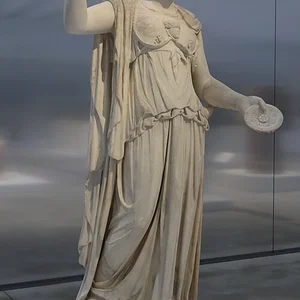
Minerva is depicted wearing a long peplos or chiton, covered by light armor. On her chest rests the aegis adorned with the head of Medusa, and her Corinthian helmet topped with a plume makes her a majestic deity, embodying the perfect union of war and wisdom.
Housing
On Olympus, Minerva dwells in a palace of marble and ivory alongside the other gods. On Earth, she resides symbolically in her temples — the Parthenon in Athens and the Capitoline temple in Rome — where her monumental statue embodies her permanent divine presence among the mortals who invoke her.
Historical Timeline
Period Vocabulary
Liens externes & ressources
Références
Œuvres
Invention du tissage
Mythologie
Don de l'olivier à Athènes
Mythologie
Invention de la flûte
Mythologie
Institution de l'Aréopage
Mythologie (repris par Eschyle, 458 av. J.-C.)
Protection d'Ulysse dans l'Odyssée
VIIIe siècle av. J.-C.
Statue Athéna Parthénos de Phidias
438 av. J.-C.