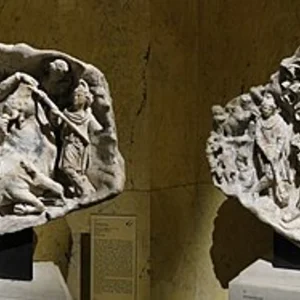

An Indo-Iranian deity of contracts and light, Mithra was venerated in Persian Zoroastrianism before becoming a mysterious solar god of the Roman Empire. His cult, Mithraism, spread among Roman soldiers from the 1st to the 4th centuries AD.
Mithra
Mithra
8 min read
Frequently asked questions
Key Facts
- Mithra appears in Vedic and Avestan texts as early as the 2nd millennium BC as a god of contracts
- In Zoroastrianism (6th century BC), he is the yazata (holy being) guardian of oaths and truth
- The Roman cult of Mithra (Mithraism) developed from the 1st to the 4th century AD, particularly within the army
- Mithraea (underground temples) have been discovered throughout the Roman Empire, from Britain to Syria
- Mithraism disappeared in the 4th century with the Christianization of the Roman Empire
Works & Achievements
A long Avestan hymn of 145 stanzas dedicated to Mithra, describing his attributes, his power, and his role as guardian of contracts. It is the most complete primary source on the Iranian Zoroastrian Mithra.
A series of frescoes depicting the mythological cycle of Mithras, exceptionally preserved by the sands of the Euphrates. These images constitute one of the most complete examples of Mithraic iconography known to date.
Sculptures in the round depicting the tauroctony with exceptional realism, enabling archaeologists to reconstruct the standardized iconographic program that adorned mithraea across the Empire.
A monumental royal monument depicting Antiochus shaking hands with Mithra-Apollo-Helios, a syncretic deity. It illustrates Mithra's role in legitimizing royal power in the Hellenistic East.
An official dedication by three Roman emperors to Mithras, described as the “protector of the Empire.” A unique document attesting to imperial recognition of the cult at the very height of its late influence.
Anecdotes
In the Avestan texts, Mithra is described as possessing “ten thousand eyes” that allow him to watch over every contract made between men. No broken oath can escape him: he traverses the entire Earth in a single day to verify that agreements are honored. This omniscience makes him the absolute guarantor of the spoken word in ancient Iranian society.
According to the mythology of the Roman Mithraic cult, Mithras is born directly from a rock — the *petra genetrix* — already brandishing a torch and a knife. Shepherds are said to have witnessed this miraculous birth. This image of a supernatural birth at the heart of the stone is depicted in every mithraeum across the Roman Empire.
The founding act of the Mithras myth is the tauroctony: the god overpowers a cosmic bull and sacrifices it by plunging a knife into its shoulder. From the wound spring wheat ears and blood that give rise to life on Earth. This cosmic sacrifice is the central image sculpted or painted in every Mithraic temple — no mithraeum was without one.
The Roman Mithraic cult was organized into seven initiatory grades, each placed under the protection of a planet: Corax (raven, Mercury), Nymphus (Venus), Miles (Mars), Leo (Jupiter), Perses (the Moon), Heliodromus (the Sun), and Pater (Saturn). Advancing through these grades required secret ordeals, and initiates of the Pater grade led the community as true spiritual fathers.
In AD 307, Emperor Diocletian, accompanied by his co-emperors Galerius and Licinius, officially dedicated a sanctuary at Carnuntum on the Danube to Mithra, whom he called the “protector of the Empire” (*fautori imperii sui*). This was one of the last great imperial consecrations of a cult rivaling Christianity, less than ten years before the Edict of Milan.
Primary Sources
We wish to worship Mithra, lord of wide pastures, who speaks the truth, who cries aloud with a strong voice, who has ten thousand eyes, great, broad-shouldered, who keeps watch without ever sleeping.
By Mithra, Varuna, Indra and the Nasatyas, gods of the Mitanni nation, may this treaty be protected and its clauses respected forever.
The pirates of Cilicia celebrated secret rites on Mount Olympus and performed the mysteries of Mithra, which persist to this day, having first been introduced by them.
Zoroaster was the first to dedicate a natural cave in honor of Mithra, creator and father of all things; the cave was for him an image of the world that Mithra had fashioned.
Deo Soli Invicto Mithrae fautori imperii sui Diocletianus, Galerius et Licinius Augustorum.
Key Places
Ceremonial capital of the Persian Empire where Mithra was venerated alongside Ahura Mazda. Achaemenid inscriptions attest to the god's role as guarantor of royal legitimacy.
Mithraic temple discovered in 1934 on the Euphrates, remarkably preserved by the sands. Its 3rd-century frescoes illustrate the complete mythological cycle of Mithras, their colors still vivid.
Mithraic temple discovered in 1954 during excavations in London, dating from the 3rd century. It bears witness to the spread of the cult as far as the northernmost provinces of the Roman Empire.
Sanctuary of King Antiochus I of Commagene (1st century BC) where Mithra is depicted in a Greco-Persian syncretic pantheon alongside Apollo and Heracles, on a summit at 2,150 metres above sea level.
Legionary fortress on the Danube where Diocletian, Galerius, and Licinius solemnly dedicated a sanctuary to Mithra in 307 AD, during an imperial conference that attempted to restore the unity of the Empire.
One of the largest mithraea in Rome, located beneath the tiers of the Circus Maximus. Like all Mithraic temples, it is subterranean and reproduces the cosmic cave of the god's birth.
Typical Objects

The central animal of the tauroctony, the bull is slain by Mithras in the founding act that gives birth to life on Earth. Its sculpted representation adorns the back wall of every mithraeum.

The conical Eastern headdress that Mithras always wears in Roman iconography, a sign of his Persian or Anatolian origin. Over the centuries it became a universal symbol of freedom in the Western tradition.

Mithras is born brandishing a torch, a symbol of the divine light he brings to the world. His two acolytes, Cautes and Cautopates, carry one torch raised and the other lowered, representing the rising and setting of the sun.

In the tauroctony scene, a scorpion grabs the genitals of the sacrificed bull, attempting to impede the creation of life. It represents a force of chaos opposing Mithras's regenerative act.

During the sacred banquet that follows the tauroctony, Mithras and the god Sol share a cup of wine. This mystical meal is recreated in the initiatory ceremonies of Mithraic communities.

A knife of Persian origin, the instrument of the cosmic sacrifice of the bull. Mithras always holds it in his right hand in representations of the tauroctony carved in mithraea.

Messenger of the god Sol, the raven is present in the tauroctony scene and lends its name to the first of the seven initiatory grades of the Mithraic cult, embodying mediation between the divine world and the human world.
School Curriculum
Vocabulary & Tags
Key Vocabulary
Daily Life
Morning
In myth, Mithras rides across the sky at dawn alongside the sun god Sol, illuminating the world of men at each sunrise. His Roman worshippers would rise before dawn to celebrate rites in the underground darkness of the mithraeum, re-enacting the primordial night of the god's birth bursting forth from rock.
Afternoon
Mithras spends the height of the day watching over contracts and pacts made between men, armed with his spear and club. In the Avestan texts, he ceaselessly traverses the entire Earth, his ten thousand eyes missing no broken oath nor any injustice committed in the light of the sun.
Evening
In the evening, after the cosmic tauroctony, Mithras shares the sacred banquet with Sol, celebrating victory over the forces of chaos. It is this mystical meal that Roman initiates re-enact in their ceremonies, reclining on stone benches around a central table lit by torches.
Food
The Mithraic sacred banquet gathers initiates around bread and water or wine — ritual foods shared in memory of the divine meal of Mithras and Sol following the bull sacrifice. Sacrificial meats were also consumed during the great communal ceremonies marking the feasts of the Mithraic calendar.
Clothing
Throughout Roman iconography, Mithras is depicted wearing a long-sleeved Eastern tunic, a cape (chlamys) billowing in the wind of his celestial course, and the characteristic Phrygian cap. His Eastern boots with curved pointed toes emphasize his Iranian origin and distinguish him from the Greco-Roman gods.
Housing
Mithras was born and dwells in the cosmic cave (spelunca or antrum), symbol of the created world and the celestial vault. His Roman temples faithfully reproduce this primordial cavern: underground, low-ceilinged, lit by torches, with a ceiling sometimes pierced with holes representing the stars of the firmament.
Historical Timeline
Period Vocabulary
Liens externes & ressources
Références
Œuvres
Mihr Yasht (Hymne à Mithra) — Avesta, Yasht 10
VIe siècle av. J.-C. (tradition orale) / IXe-XIIe siècle (transcription écrite)
Tauroctonie du Mithraeum de Doura-Europos
IIIe siècle apr. J.-C.
Bas-reliefs mithriaques de Heidelberg et Heddernheim (Germanie romaine)
IIe-IIIe siècle apr. J.-C.
Stèle d'Antiochos Ier de Commagène (Nemrut Dağı)
vers 62 av. J.-C.
Inscription de Carnuntum (Fautori Imperii Sui)
307 apr. J.-C.