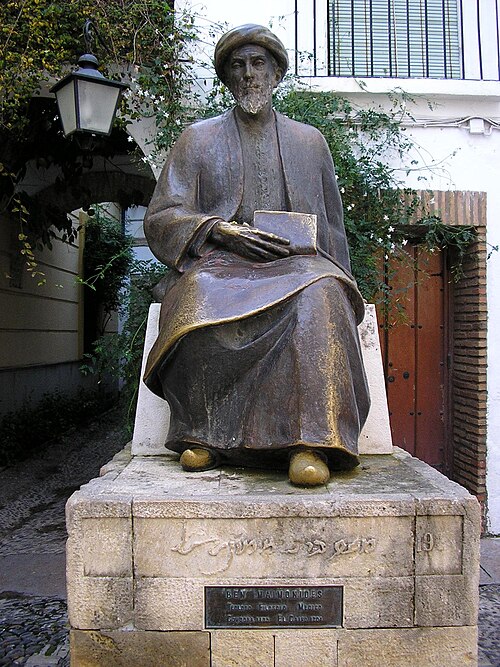
Moses Maimonides
Moses Maimonides
1135 — 1204
Égypte, Al-Andalus
A Jewish philosopher, physician, and theologian born in Córdoba in 1135, Maimonides is one of the greatest intellectual figures of the Middle Ages. He sought to reconcile Aristotelian philosophy with Jewish thought, leaving behind an encyclopedic body of work in medicine, law, and philosophy.
Famous Quotes
« Teach your tongue to say 'I do not know,' lest you invent something and be found out. »
« Truth does not become falsehood because no one sees it. »
Key Facts
- 1135: born in Córdoba, in Al-Andalus, into a learned Jewish family
- 1148: fled Córdoba following the Almohad conquest and its religious persecutions
- 1168: wrote the Commentary on the Mishnah, his first major work codifying Jewish law
- 1190: published The Guide for the Perplexed (Moreh Nevukhim), a synthesis of Aristotelian philosophy and Jewish theology
- 1204: died in Cairo, where he had become personal physician to Sultan Saladin
Works & Achievements
The first systematic and comprehensive codification of Jewish law (halakha), written in clear Hebrew to make religious law accessible to all Jews without requiring them to navigate Talmudic debates. A monumental work in fourteen volumes, still studied in religious academies around the world.
A philosophical masterpiece written in Judeo-Arabic, aimed at reconciling Aristotelian reason with biblical revelation. A founding work of medieval Jewish philosophy, it profoundly influenced thinkers such as Thomas Aquinas and Albertus Magnus.
A Judeo-Arabic commentary on the oral code of Jewish law, written during his years of wandering. It includes his thirteen fundamental principles of Jewish faith, which have since become a key reference text in Rabbinic Judaism.
A medical treatise composed at the request of an Ayyubid prince suffering from asthma, combining therapeutic prescriptions with lifestyle advice. It illustrates Maimonides' holistic and preventive approach to medicine.
A collection of 1,500 medical aphorisms drawn from the works of Galen and Arab physicians, accompanied by Maimonides' critical commentary. One of the most widely circulated medical works of the Middle Ages, translated into both Hebrew and Latin.
A systematic catalog of the 613 commandments of the Torah, with a rigorous method for classifying and justifying each one. A preparatory work for the Mishneh Torah, important for understanding medieval Jewish law.
A letter of support addressed to the Jewish communities of Yemen who were being persecuted by a local ruler demanding their conversion. It bears witness to Maimonides' moral and spiritual authority throughout the medieval Jewish diaspora.
Anecdotes
At the age of thirteen, Maimonides was forced to flee Córdoba with his family when the Almohads, a strict Berber dynasty, conquered the city and imposed forced conversion or exile on Jews and Christians. This experience of displacement left a deep mark on his entire thinking about tolerance and coexistence.
Having become personal physician to the vizier Al-Fadil in Cairo, Maimonides was in such demand that, in a famous letter to his friend Samuel ibn Tibbon, he described his exhausting days: barely back from the sultan's court, he would find his waiting room packed with Jewish, Muslim, and Christian patients whom he received well into the night, lying on his couch from sheer fatigue.
His masterwork, the Guide for the Perplexed, was written in Arabic but transcribed in Hebrew letters, so as to be accessible to Jewish intellectuals while remaining out of reach of uninitiated Arabic readers. This choice of writing reflects Maimonides' singular position at the crossroads of two great cultures.
Maimonides categorically refused to accept any salary for his role as a religious judge (dayan) or Torah teacher, believing that profiting from divine law was a moral failing. He lived solely on his income as a physician — a principle he upheld throughout his life despite persistent criticism.
Upon his death in 1204 in Cairo, the Jewish communities of Egypt and the Land of Israel observed three days of mourning. His remains were transported to Tiberias, in the Galilee, where his tomb remains a pilgrimage site visited each year by thousands of the faithful.
Primary Sources
The human intellect has limits beyond which it cannot advance. It is therefore futile to seek to demonstrate what lies beyond those limits, and any attempt to do so can only lead astray those who undertake it.
Every human being can attain the virtue of Moses our teacher, or sink into the depravity of Jeroboam. It is for each person, through their own free will, to choose which path they will take.
I shrink neither from controversy nor from criticism, for I know that truth is not established by the number of those who profess it, but by the strength of the arguments that support it.
I reside in Cairo while the Sultan lives in Fustat. My duties at the Sultan's court are very demanding. I must see him early every day. When he is unwell, or when his children or concubines fall ill, I do not leave Cairo and spend most of my day at the palace.
Be steadfast and courageous for the sake of our faith. Strengthen one another — let the elders encourage the young, let the leaders sustain the multitude — until the weakness of our faith is overcome and the light of truth shines forth.
Key Places
Maimonides' birthplace and one of the intellectual capitals of medieval Islam. He was born there in 1135 into a family of Jewish jurists and received his early education before the Almohad conquest.
The city where the Maimonides family sought refuge around 1160 after wandering through Al-Andalus. Maimonides continued his medical and philosophical studies there before fleeing eastward.
The city where Maimonides settled permanently around 1166 and spent the second half of his life. There he wrote his major works, led the local Jewish community, and served as a physician at the Ayyubid court.
The Galilean city where Maimonides' remains were brought after his death in 1204, according to his supposed wishes. His tomb (Yad Rambam) remains an important Jewish pilgrimage site to this day.
The great Mediterranean port that Maimonides passed through during his journey from Morocco. The city remained a symbol of the synthesis of ancient Greek and Eastern knowledge that inspired his entire intellectual approach.
Gallery

Maimònides
Wikimedia Commons, CC BY-SA 3.0 — No machine-readable author provided. Makinal~commonswiki assumed (based on copyright claims).

Moses Maimonides. Photogravure.
Wikimedia Commons, CC BY 4.0 — Inconnu

Basel, Universitätsbibliothek, A IV 37, f. 172v – Moses Maimonides, Sefer Moreh Nevukhim
Wikimedia Commons, Public domain — Moses Maimonides

Postcard portrait of Maimonides by Meir Kunstadt, early 1900s
Wikimedia Commons, Public domain — Meir Kunstadt

Maimonides crop1
Wikimedia Commons, CC0 — Monozigote
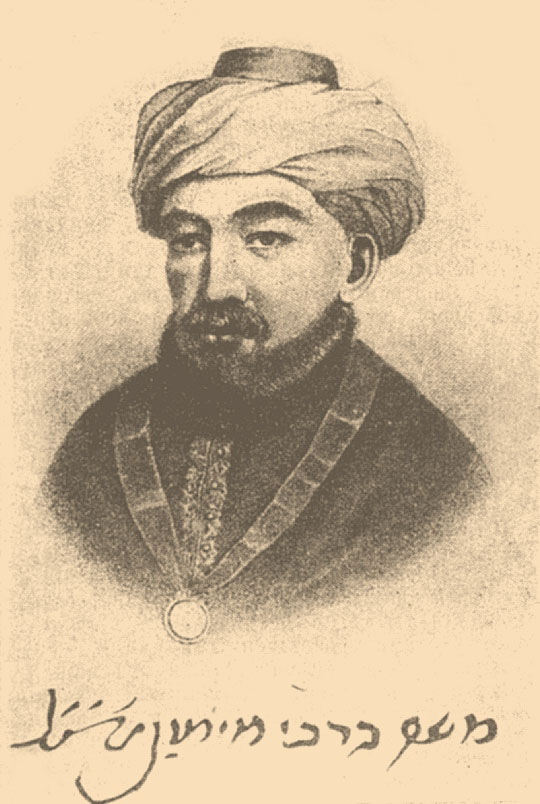
Brockhaus and Efron Jewish Encyclopedia e10 513-0
Wikimedia Commons, Public domain — Unknown authorUnknown author