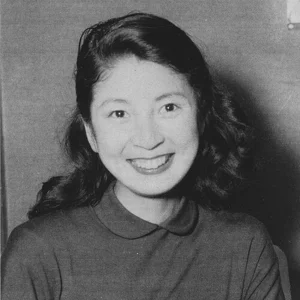

Momoko Kōchi (1932–1998) was a Japanese actress best known for her role in Ishirō Honda's original Godzilla (1954). She played Emiko Yamane, one of the main characters in this iconic film of postwar Japanese science fiction.
Momoko Kōchi(1932 — 1998)
Momoko Kōchi
Japon, empire du Japon
7 min read
Frequently asked questions
Key Facts
- 1932: Momoko Kōchi is born in Japan
- 1954: Plays Emiko Yamane in Ishirō Honda's Godzilla, produced by Toho Studios
- The film Godzilla (1954) is a metaphor for the atomic bombings of Hiroshima and Nagasaki (1945)
- She appeared in the sequel Godzilla Raids Again (1955)
- 1998: Death of Momoko Kōchi
Works & Achievements
Directed by Ishirō Honda, this landmark science-fiction film gave Momoko Kōchi her most celebrated role, that of Emiko Yamane. Considered one of the masterpieces of Japanese cinema, it serves as an allegory for the nuclear threat.
The first direct sequel to the original film, in which Momoko Kōchi reprises the role of Emiko Yamane. The film confirmed the commercial success of the kaijū eiga genre.
A Tōhō drama in which Momoko Kōchi demonstrates her versatility as an actress outside the fantasy genre.
A moving return for Momoko Kōchi in the role of an now-elderly Emiko Yamane, in what was presented as the conclusion of the original Godzilla saga. This film marks the symbolic close of her film career.
Anecdotes
Momoko Kōchi was chosen by director Ishirō Honda to play Emiko Yamane in the original Godzilla (1954) when she was just 22 years old. Her character, torn between family duty and personal feelings, reflected the moral dilemmas facing post-war Japanese society, still traumatized by the atomic bombings of Hiroshima and Nagasaki.
The filming of Godzilla took place in a Japan still rebuilding, only nine years after the 1945 surrender. The Tōhō crew used miniature sets representing Tokyo for the destruction sequences — a technical feat that impressed Japanese audiences and gave the film a deeply national resonance.
In 1955, less than a year after the release of the first film, Momoko Kōchi reprised her role as Emiko Yamane in Godzilla Raids Again (Gojira no Gyakushū). This rapid success confirmed the rise of a distinctly Japanese film genre, kaijū eiga (giant monster movies), which would go on to influence popular culture worldwide.
Forty years after the original film, Momoko Kōchi agreed to reprise the role of Emiko Yamane one last time in Godzilla vs. Destroyah (1995), an emotional return celebrated by fans in Japan and around the world. This symbolic gesture, made shortly before her death in 1998, illustrated the enduring connection audiences felt with this founding character of Japanese science fiction cinema.
Primary Sources
Tōhō studio presents its new science-fiction film, Gojira, directed by Ishirō Honda, with Momoko Kōchi in the role of Emiko Yamane, daughter of the renowned paleontologist Kyōhei Yamane.
Gojira hits Japanese screens like a solemn warning. The creature's destruction of Tokyo inevitably evokes images of the war. The cast, and notably Momoko Kōchi, carry the dramatic weight of this story with conviction.
The return of Emiko Yamane (Momoko Kōchi) in this direct sequel to the original film, directed by Motoyoshi Oda.
For the supposed conclusion of the Godzilla saga, Tōhō studio sought to reunite the cast of the original 1954 film. Momoko Kōchi returns one final time to the role of Emiko Yamane, creating a symbolic link between the two ends of the franchise.
Key Places
Momoko Kōchi's primary workplace, these studios founded in 1932 were the heart of postwar Japanese filmmaking. The entirety of the 1954 film Godzilla was shot here.
The fictional setting of Godzilla's destruction, Tokyo symbolized for Japanese audiences the vulnerability of their civilization in the face of destructive forces — a direct metaphor for the war and the atomic bombs.
The imaginary island from which Godzilla emerges in the 1954 film is inspired by the outlying islands of the Japanese Pacific. It symbolically evokes the American nuclear testing sites in the Pacific.
The city devastated by the atomic bomb on August 6, 1945; its memory deeply permeates the film Godzilla and the cultural context in which Momoko Kōchi played her most memorable roles.
One of Tokyo's most iconic commercial and cultural districts, a place of leisure and modernity for Japanese youth in the 1950s. It embodies the Japan being rebuilt that popular actresses like Momoko Kōchi were part of.
Typical Objects

The central working tool on Tōhō studio sets in the 1950s. Momoko Kōchi performed in front of these imposing analog cameras during the filming of Godzilla and its sequels.

A traditional women's garment worn by many Japanese women in daily life during the 1950s. Several scenes in Godzilla reflect this blend of traditional dress and postwar modernity.

A booklet of dialogue and acting directions given to cast members during production. For Godzilla, the screenplay co-written by Ishirō Honda and Takeo Murata was an essential working document for Momoko Kōchi.

Tōhō's technical crews built detailed miniature sets of the capital to simulate its destruction by Godzilla. These handcrafted scale models formed the visual environment in which Momoko Kōchi's characters moved.

Brightly colored lithographic posters for Tōhō films adorned the fronts of Japanese movie theaters. Momoko Kōchi's face appeared on several of these iconic posters from the 1950s and 1960s.

Introduced in Japan in the mid-1950s, the transistor radio symbolized the modernization of everyday Japanese life. It played a dramatic role in several films of the era as a vehicle for emergency broadcasts.
School Curriculum
Vocabulary & Tags
Key Vocabulary
Tags
Daily Life
Morning
Momoko Kōchi began her filming days very early, heading to Tōhō's Setagaya studios where the technical crews had been preparing sets since dawn. She would stop by the dressing rooms for makeup and hair styling — lengthy procedures required by the demands of 1950s black-and-white photography.
Afternoon
Filming afternoons stretched on under the powerful arc lights of the soundstages, which were often swelteringly hot. Intense scenes — particularly those depicting Emiko's anguish in the face of Godzilla's horror — were rehearsed multiple times at the request of director Ishirō Honda, known for his exacting standards and meticulous approach.
Evening
In the evenings after filming, Tōhō's actors and crew would sometimes gather at izakaya (Japanese taverns) in the neighborhood to unwind. Like many young actresses of the era, Momoko Kōchi would also return home to her residence in greater Tokyo to study her lines for the following day.
Food
Japanese diet in the 1950s still bore the heavy mark of postwar rationing: rice, miso soup, pickled vegetables (tsukemono), and fish formed the backbone of daily meals. The food served in the Tōhō studio canteen reflected this simple, nourishing cuisine, though the country's emerging prosperity was beginning to introduce some Western products.
Clothing
In her daily life, Momoko Kōchi wore clothing typical of young Japanese women in the 1950s: cotton kimono for ordinary days, or Western-style outfits (tailored suits, belted dresses) for public appearances or trips to the studio. On screen, her character Emiko Yamane wore understated Western-style dresses, a reflection of Japanese society's rapid modernization.
Housing
Like most Tōhō actors of her generation, Momoko Kōchi lived in an apartment in greater Tokyo, in a residential neighborhood on the inner outskirts. The housing of the era, often built from light timber in the Japanese tradition, had largely been reconstructed after the firebombing of 1945, blending traditional architecture with hastily built postwar construction.
Historical Timeline
Period Vocabulary
Visual Style
Esthétique du cinéma japonais des années 1950 : noir et blanc contrasté, lumière douce sur les visages, décors urbains détruits et costumes sobres mêlant tradition et modernité d'après-guerre.
Sound Ambience
L'ambiance sonore des studios Tōhō des années 1950 : bruits de plateau, rumeur de Tokyo en reconstruction et résonances de la bande-son orchestrale d'un Japon cherchant à exorciser le trauma de la guerre.
Liens externes & ressources
Références
Œuvres
Dernière lumière d'espoir (Saigetsu)
1955