King of Manding in the 12th century, Naré Maghann Konaté is best known as the father of Sundiata Keita, founder of the Mali Empire. According to Mande oral tradition, a prophecy foretold that he would father a conqueror who would unite the Mande peoples.
Naré Maghann Konaté(1135 — 1212)
Naré Maghann Konaté
Mali
8 min read
Frequently asked questions
Key Facts
- King of the small kingdom of Manding (Mandé) in the 12th century
- A hunter-diviner predicted that by marrying an ugly woman he would father a great conqueror
- He married Sogolon Condé, who gave birth to Sundiata Keita
- Upon his death, the throne passed to his eldest son Dankaran Touman, forcing Sundiata into exile
- His figure is central to the Sundiata epic, passed down by griots
Works & Achievements
Naré Maghann established and durably legitimized the Keïta royal lineage as the central authority of the Manding, laying the institutional and symbolic foundations upon which Sundiata would build his empire.
By marrying Sogolon despite the reservations of his court, Naré Maghann performed the foundational act that made possible the birth of Sundiata Keïta, future unifier of the Mandinka peoples and founder of Mali.
A pivotal symbolic gesture: by entrusting the dynastic bow to his young son before his death, Naré Maghann designated Sundiata as the rightful heir despite his disability, anchoring the prophecy within the order of succession.
During the reign of Naré Maghann, the relationship between the mansa and his griot was codified: the jeli Balla Fasséké was attached to the person of Prince Sundiata, ensuring the oral transmission of royal memory for future generations.
Anecdotes
According to the Manding epic passed down by griots for centuries, two unknown hunters once appeared at the court of Naré Maghann Konaté with a troubling prophecy: a plain-looking woman he would be tempted to turn away would become the mother of a legendary conqueror. The king, known for his wisdom and respect for signs of destiny, took their words seriously rather than dismissing them.
When the hunters brought him Sogolon Condé, a hunchbacked woman from the distant kingdom of Do, the court openly mocked her. Naré Maghann hesitated, but true to the prophecy and to his word, he married her despite the ridicule. This marriage, driven by faith rather than reason, would give rise to Sundiata Keita, the future founder of the Mali Empire.
Naré Maghann had several wives, including Sassouma Bérété, a highly influential woman who was jealous of the attention given to Sogolon. When Sundiata was born and grew up unable to walk, Sassouma openly triumphed, convinced the prophecy was false and that her own son Dankaran Touman would inherit the throne alone. The king, for his part, continued to believe in his young disabled son.
Before he died, Naré Maghann performed a deeply meaningful act: he entrusted Sundiata with the royal bow, symbol of Manding kingship and a pledge of dynastic legitimacy. The child could not yet walk, but this symbolic bequest sealed his destiny as a conqueror — a few years later, he would rise, defeat Soumaoro Kanté, and found the Mali Empire.
Primary Sources
King Maghan Kon Fatta received the two hunters with full honors. They said to him: 'King, we bring you a prophecy: a hunchbacked woman will come to your court; marry her, for from her womb will be born the one who will cover the Manding country with imperishable glory.'
The kings of Mali descend from an ancient lineage whose legitimacy rests on tradition and military strength. Their founding ancestor unified the peoples of the Manding through war and alliance, inheriting a small kingdom which he transformed into a regional power.
Mari-Djata was the first powerful sultan of Mali. He defeated the kings of Sosso and extended his authority over the entire western Sahel. His father had ruled a small kingdom whose legacy he inherited before expanding it beyond all measure.
Naré Fa Maghan was the king of the Manding. He cherished hunters and honored prophecies. It was he who received the word of destiny and who, through his wisdom and faith, made possible the birth of the Lion of the Manding.
Key Places
Royal residence of Naré Maghann Konaté, at the heart of the Manding homeland. It was here that the hunters bearing the prophecy were received, where Sogolon Condé lived, and where Sundiata Keita was born.
A distant territory from which Sogolon Condé, the future mother of Sundiata, originally came. The hunters brought her from Do to the court of Naré Maghann to fulfill the prophecy.
The ancestral homeland of the Manding people and cradle of the future Mali Empire. It was in these fertile savanna valleys, between the Niger River and the foothills of the Fouta Djallon, that Naré Maghann held authority.
A major Sahelian trading city whose fall in 1076 reshuffled the political balance across the entire region, paving the way for the rise of Manding kingdoms such as that of Naré Maghann.
A neighboring kingdom whose growing power under Soumaoro Kanté posed the primary threat to the Manding kingdoms, both during Naré Maghann's lifetime and after his death.
Typical Objects

A weapon and symbol of power passed from father to son within the Keïta lineage. Naré Maghann bequeathed his bow to Sundiata before his death — a founding gesture that sealed his son's royal legitimacy despite his disability.
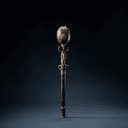
A wooden-keyed instrument with gourd resonators, regarded as both a musical and magical object in Mandinka culture. It was played during royal ceremonies and initiation rituals.

A large twenty-one-string harp-lute, the emblematic instrument of Mandinka jelis (griots). At the court of Naré Maghann, the griot played it to accompany epic recitations and royal praises during great assemblies.

A large drum used to summon chiefs, announce royal decisions, and set the rhythm of ceremonies. In the Manding, each noble clan had its own distinctive rhythm, recognized by all.
📷 CC0 · Wikimedia Commons ↗
A carved and decorated gourd vessel used for drinking and offering hospitality to distinguished visitors. Presenting a calabash filled with millet beer or scented water was a ritual act of welcome at the court of Naré Maghann.
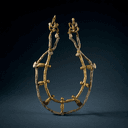
Bracelets, rings, and necklaces of gold signaled royal status; cowrie shells served as both currency and ornamentation. The Mandinka kingdoms controlled gold trade routes linking the Sahara to the coastal forests.

A prestige weapon carried by the mansa during military campaigns and ceremonies. It symbolized his military authority and his sovereign duty to protect his people.
School Curriculum
Vocabulary & Tags
Key Vocabulary
Tags
Daily Life
Morning
Naré Maghann began his day with ritual ablutions followed by prayer, in a syncretism blending Islam with Mandinka animist beliefs. He then received his jeli (griot), who recited the praises of his ancestors, reminded him of the day's visitors, and relayed news from the surrounding villages.
Afternoon
Afternoons were devoted to royal audiences: village chiefs, merchants, envoys, and warriors came to court to settle disputes, forge alliances, or pay tribute. Surrounded by his advisors and his griot, who committed every decision to memory, Naré Maghann arbitrated according to Mandinka custom and distributed gifts and favors to cement his legitimacy.
Evening
In the evening, the court gathered around a great fire to listen to the griot's tales — ancestor epics, proverbs, and royal genealogies. The men shared a communal meal in separate circles according to rank, after which drums accompanied prayers and ritual dances well into the night.
Food
The staple foods were millet and sorghum, prepared as a thick porridge (tô) or flatbreads, served with sauces made from baobab leaves, okra, and groundnuts. Meat — chicken, goat, or game — was reserved for feasts and distinguished guests. The royal court also consumed honey, kola nuts (a prized stimulant and ritual currency), and spices brought in along the trans-Saharan trade routes.
Clothing
Naré Maghann wore wide boubous of hand-spun cotton, dyed indigo or left white, embroidered with geometric patterns at the cuffs and collar, paired with a chief's cap adorned with cowrie shells and gold jewelry. During ceremonies, the skins of sacred animals (lion, leopard) were added to signify his power and his connection to the world of invisible forces.
Housing
The king lived in a vast compound of round banco (clay and straw) huts with conical thatched roofs, enclosed by a rammed-earth wall. The main royal hut, taller and more spacious than the rest, served as an audience hall and council chamber. The compound included separate huts for each wife, millet granaries raised on stilts, and quarters for guards and griots — all arranged according to a spatial hierarchy that reflected the social order of the clan.
Historical Timeline
Period Vocabulary
Visual Style
Style visuel épique et solennel d'une cour royale mandingue du XIIe siècle : robes indigo et ocre, architecture en banco, lumière chaude de la savane et motifs géométriques africains.
Sound Ambience
Ambiance sonore d'une cour royale mandingue du XIIe siècle : tam-tams royaux, kora du griot, rumeur du village et grands silences de la savane sahélienne piqués de feux de bois.
Liens externes & ressources
Références
Œuvres
Consolidation de la royauté Keïta à Dakajalan
vers 1150–1205
Alliance matrimoniale avec Sogolon Condé
vers 1170
Transmission de l'arc royal à Soundiata
vers 1205
Institution du lien entre le roi et son griot (jeli)
XIIe siècle