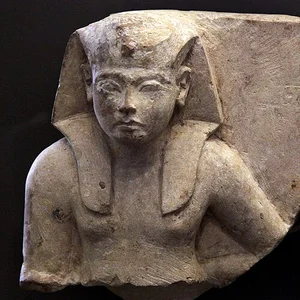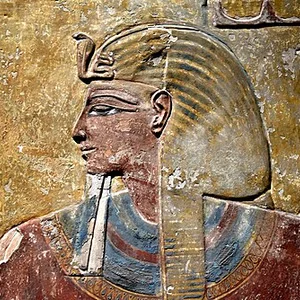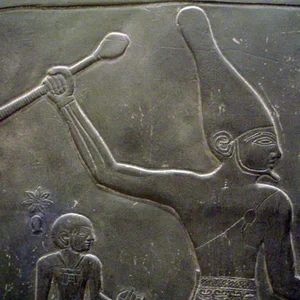

Narmer is considered the first pharaoh of unified Egypt, around 3100 BCE. He is credited with uniting Upper and Lower Egypt under a single crown, thereby founding the first Egyptian dynasty.
Narmer(3200 av. J.-C. — 3124 av. J.-C.)
Narmer
Égypte antique
8 min read
Frequently asked questions
Key Facts
- Around 3100 BCE: Narmer unifies Upper and Lower Egypt
- The Narmer Palette, discovered at Hierakonpolis, is one of the earliest historical documents depicting this unification
- He is associated with the first combined use of the double crown (pschent), symbol of the Two Lands
- His reign marks the beginning of the Thinite Period and the First Egyptian Dynasty
- Narmer is often identified with the legendary king Menes mentioned by Greek authors
Works & Achievements
A major iconographic document carved in siltstone, now housed in the Egyptian Museum in Cairo. It synthesizes for the first time the visual and symbolic canons of pharaonic kingship that would endure for three millennia.
A large limestone macehead depicting Narmer in majesty during a royal ceremony. It provides the earliest documentation of the court organization and central administration of the first unified Egyptian state.
The founding political act of ancient Egyptian civilization. Narmer united the two kingdoms of the Nile under his crown, establishing a centralized state that, in various forms, would persist until the Roman conquest in 30 BCE.
The creation of a new administrative capital at the strategic crossroads of the two Egypts. Memphis would remain for centuries the political, economic, and religious heart of the country, and the cradle of classical pharaonic civilization.
The codification of the earliest elements of the royal titulary: the serekh surmounted by the Horus falcon, the double crown, and the insignia of power (mace, heqa scepter, flail). These symbols would form the foundation of pharaonic monarchy for thirty centuries.
Anecdotes
The Narmer Palette, discovered in 1898 at Hierakonpolis by archaeologists James Quibell and Frederick Green, is one of the oldest historical documents in human history. It depicts Narmer wearing alternately the white crown of Upper Egypt and the red crown of Lower Egypt, symbolically illustrating his dominion over the two unified lands.
The name "Narmer" is written in hieroglyphs using two signs: a catfish (nar) and a chisel (mer). This combination translates as "fierce catfish" or "raging catfish" — a name of power designed to strike fear into his enemies on the battlefield.
On the Narmer Palette, the king is shown striking a kneeling enemy with a mace, under the protective gaze of the falcon god Horus. This pose, known as the "smiting scene," would be reproduced on Egyptian monuments for more than three thousand years, a testament to the enduring influence of the artistic conventions established from the very beginning.
Archaeologists discovered in Narmer's tomb at Abydos small ivory labels bearing hieroglyphic inscriptions recording goods sent to the deceased king for the afterlife. These objects rank among the earliest examples of writing in human history, placing Narmer at the very dawn of written civilization.
The Greek historian Manetho, writing in the 3rd century BC, names a certain "Menes" as the first king of Egypt and founder of Memphis. Most modern Egyptologists identify this Menes with Narmer, or possibly with his immediate successor Hor-Aha — a debate that illustrates just how difficult it is to reconstruct such a distant era from rare and fragmentary sources.
Primary Sources
Large 64 cm graywacke palette discovered in the main deposit of the temple at Hierakonpolis. The obverse shows Narmer wearing the White Crown and striking an enemy; the reverse depicts him wearing the Red Crown in triumphal procession, with two rows of decapitated corpses.
Limestone maceHead discovered at Hierakonpolis in 1898 alongside the palette. It depicts Narmer enthroned beneath a canopy during a royal ceremony, surrounded by counted prisoners and heads of cattle, bearing witness to his military and administrative power.
Small ivory and bone tags recovered from the royal tombs at Abydos by Flinders Petrie. These labels bear the serekh of Narmer alongside hieroglyphic signs recording deliveries of funerary goods, making them one of the earliest attested epigraphic corpora.
Cylinder seal impressions bearing the royal serekh of Narmer, found in funerary contexts at the Abydos necropolis and in the temple deposit at Hierakonpolis. They attest to the administrative authority of the ruler over the entire unified territory.
Key Places
The main city of Upper Egypt during the Predynastic period and the cradle of Narmer's power. It is here that the palette and ceremonial mace head bearing his name were discovered.
Capital founded at the junction of Upper and Lower Egypt, attributed to Narmer or Menes. It would remain Egypt's major administrative center for more than two millennia.
Royal necropolis of the 1st and 2nd Dynasties, where Narmer's tomb (complex B17-B18) is located. Excavations there have yielded ivory labels directly attesting to his reign.
Hometown of the 1st Dynasty, probably near present-day Girga. It gives its name to the Thinite period (1st and 2nd Dynasties), the opening chapter of pharaonic history.
Ancient capital of Lower Egypt in the Nile Delta. Its submission to Narmer symbolically represents the conquest of the north and the completion of the unification of the Two Lands.
Typical Objects

Large ceremonial schist (greywacke) palette discovered at Hierakonpolis. It is the founding iconographic document of Egyptian kingship, depicting Narmer as the absolute master of the two lands.

The preeminent weapon and royal insignia of Predynastic Egypt. Narmer is depicted wielding this mace to strike a kneeling enemy — a universal and enduring symbol of royal victory over chaos.

A tall, skittle-shaped crown reserved for the kings of Upper Egypt. Narmer wears it on the main face of his palette, signifying his dominion over the southern Nile Valley.

The flat crown with a distinctive spiral, characteristic of Lower Egypt. Narmer is the earliest known ruler depicted wearing both crowns, symbolizing the unification of the two lands under a single scepter.

A rectangular frame representing the facade of the royal palace, topped by the falcon Horus, within which Narmer's name is inscribed. It is the oldest known form of the Egyptian royal titulary and the forerunner of the cartouche.

A curved staff shaped like a shepherd's crook, a symbol of royal authority. Paired with the flail, it forms one of the pharaoh's fundamental regalia, with the earliest depictions dating back to the Thinite period.

On the Narmer Palette, a servant carries the king's sandals while Narmer advances barefoot onto sacred ground. This detail reveals the existence of a highly developed court protocol as early as the First Dynasty.
School Curriculum
Vocabulary & Tags
Key Vocabulary
Tags
Daily Life
Morning
Narmer rises at dawn in his mud-brick palace at Hierakonpolis or Memphis. Priests perform the ritual ablutions of the king and make the first offerings to the falcon god Horus, guarantor of royal legitimacy. The ruler then receives his advisors and the chiefs of the nomes for daily reports on the administration of the newly unified territory.
Afternoon
The afternoon is devoted to royal audiences, receiving tribute from the provinces, and overseeing major construction projects (palaces, funerary enclosures, royal granaries). Narmer also inspects the training of his soldiers and plans the military campaigns aimed at consolidating and expanding the borders of the new state.
Evening
At sunset, new religious rituals mark the transition from day to night, led by the temple priests. A feast brings together the king, members of his court, and the high priests around abundant food offerings. As night falls, Narmer retires to his private chambers, guarded by soldiers armed with maces and copper-tipped spears.
Food
The royal diet is rich and varied: bread made from wheat and emmer, barley beer (the universal daily drink in Egypt), beef and game, fish from the Nile, figs, dates, grapes, and onions. Ceremonial meals include roasted meats and wine imported from Canaan or produced in the Nile Delta.
Clothing
In everyday life, Narmer wears a white fine linen kilt (shendyt) held by a decorated belt, to which a bull's tail is attached as a symbol of royal strength. For ceremonies, he dons one of the two crowns (the white hedjet or the red desheret), a broad collar (usekh) of gold and semi-precious stones, and carries the heqa scepter and the flail.
Housing
Narmer resides in a palace of sun-dried mud brick, surrounded by an enclosure with a niched façade characteristic of the 'palace-façade' architectural style. The interior walls are whitewashed and decorated with paintings depicting hunting scenes and military victories. The complex includes inner courtyards, grain stores, artisan workshops, and quarters for servants and guards.
Historical Timeline
Period Vocabulary
Visual Style
Art égyptien archaïque de la période thinite : reliefs plats en schiste, compositions hiératiques à échelle hiérarchique, palette dominée par l'ocre et la terracotta, rehaussée de bleu lapis-lazuli et de vert malachite, premiers hiéroglyphes intégrés aux scènes de victoire royale.
Sound Ambience
Ambiance sonore de l'Égypte thinite naissante : cérémonies royales au bord du Nil, vent du désert sur les roseaux, artisans au travail dans les ateliers du palais et chants rituels des prêtres d'Horus.
Liens externes & ressources
Références
Œuvres
Palette cérémonielle de Narmer
Vers 3100 av. J.-C.
Massue cérémonielle de Narmer
Vers 3100 av. J.-C.
Unification de la Haute et de la Basse-Égypte
Vers 3100 av. J.-C.
Fondation de Memphis
Vers 3100 av. J.-C.
Établissement du protocole royal et du titulaire pharaonique
Vers 3100 av. J.-C.