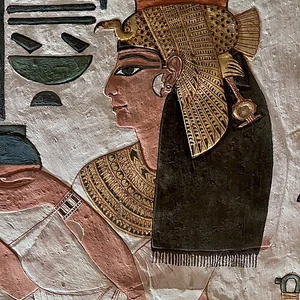

Great Royal Wife of Ramesses II, Nefertari is one of the most celebrated queens of ancient Egypt. Her tomb in the Valley of the Queens, with its exceptionally well-preserved paintings, reflects her extraordinary status. Ramesses II dedicated the smaller temple at Abu Simbel to her, where she was depicted at the same scale as the pharaoh himself.
Nefertari(1289 av. J.-C. — 1254 av. J.-C.)
Nefertari
Égypte antique
8 min read
Frequently asked questions
Key Facts
- Around 1279 BC: she became Great Royal Wife of Ramesses II at the start of his reign
- Ramesses II dedicated the smaller temple at Abu Simbel to her, consecrated to Hathor — an extremely rare honor for a queen
- Her tomb QV66 in the Valley of the Queens is considered the most beautiful in ancient Egypt
- She was associated with the goddesses Hathor and Isis, reflecting a near-divine status during her lifetime
- She likely played a role in diplomacy, particularly in connection with the Egyptian–Hittite peace treaty (c. 1259 BC)
Works & Achievements
A 520 m² tomb with exceptionally well-preserved paintings illustrating chapters from the Book of the Dead and Nefertari's journey into eternity. Widely regarded as the absolute masterpiece of New Kingdom Egyptian funerary art.
A rock-cut sanctuary dedicated jointly to the goddess Hathor and Queen Nefertari, unique in all of Egyptian history. The six colossi on the façade alternately depict Ramesses II and Nefertari at equal height — breaking a convention that had previously reserved such prominence for the gods alone.
A royal letter sealing the Egyptian-Hittite alliance in the wake of the great peace treaty, bearing witness to the active diplomatic role played by Egyptian queens on the international stage. A document of exceptional historical value, preserved in the archives of Boğazköy in Anatolia.
Numerous sculpted and painted scenes showing Nefertari taking part in major religious ceremonies alongside Ramesses II. These reliefs confirm her active presence and central role in the public, religious, and diplomatic life of the kingdom.
Anecdotes
The tomb of Nefertari (QV66), discovered in 1904 by Egyptologist Ernesto Schiaparelli in the Valley of the Queens, is considered the most beautiful tomb ever carved in Egypt. Its brilliantly colored paintings depict scenes from the Book of the Dead and stand as testimony to the exceptional care lavished upon a queen who was particularly dear to her husband.
Ramesses II dedicated the smaller temple at Abu Simbel to Nefertari and the goddess Hathor — a unique honor in all of Egyptian history. On the façade, her colossi are carved at the same height as those of the pharaoh, breaking a millennia-old convention that had reserved such privilege for the gods alone.
Around 1258 BC, following the signing of the Egyptian-Hittite peace treaty, Nefertari wrote a personal letter to Puduhepa, queen of the Hittites, to strengthen the diplomatic alliance between the two empires. This document, discovered in the archives of Boghazköy in Anatolia, is one of the oldest known correspondences between two reigning queens.
Nefertari's full name was Nefertari-Merytmut, meaning "The beautiful companion, beloved of Mut." Ramesses II referred to her in his texts as "the beloved of Mut," the great mother goddess of Thebes, underscoring her religious significance as much as her role as his wife.
A scene in tomb QV66 shows Nefertari playing senet, an Egyptian board game that symbolized the soul's journey toward eternity. The image is far from incidental: it signifies that the queen confronts and triumphs over fate, securing her place among the blessed in the afterlife.
Primary Sources
"For the great royal wife Nefertari, beloved of Mut, Ramesses II had this temple carved into the mountain of Nubia, for eternity."
"I, your sister, rejoice that you are in good health. May the gods of Egypt and the gods of Hatti grant you peace and prosperity."
"O Nefertari, justified, you enter the afterlife in peace; you are welcomed by Osiris, lord of the eternal West. Your ka lives on forever."
"The great royal wife Nefertari-Merytmut, beloved of the king, living, hale and whole for ever and ever, accompanies the mighty bull."
Key Places
Nefertari's tomb, adorned with the finest funerary paintings of the New Kingdom, depicting her initiatory journey toward eternity guided by the gods. Restored by the Getty Conservation Institute between 1986 and 1992, it is accessible to only a very small number of visitors in order to preserve it.
Rock-cut sanctuary dedicated jointly to Nefertari and the goddess Hathor, whose façade features colossal statues of the queen at equal height to those of Ramesses II — an unprecedented honor in Egyptian royal art. Relocated in 1968 during the construction of the Aswan High Dam to save it from the rising waters of Lake Nasser.
Vast temple complex where Nefertari is depicted alongside Ramesses II in numerous religious and ceremonial scenes. It was at Karnak that the stelae commemorating the peace treaty with the Hittites were carved, with the queen prominently associated with that historic accord.
The magnificent capital built by Ramesses II in the eastern Nile Delta, where the royal court resided and where Nefertari spent most of her life as queen. The site corresponds to modern-day Qantir, which has been excavated by archaeologists since the 1980s.
Typical Objects
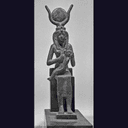
A headdress composed of a solar disk flanked by cow horns and tall ostrich feathers, worn by Nefertari in all her official depictions. It symbolizes her identification with Hathor, goddess of love, beauty, and motherhood.
📷 CC0 · Wikimedia Commons ↗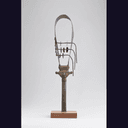
A sacred percussion instrument dedicated to Hathor, which queens shook during religious ceremonies to ward off evil forces. Nefertari is frequently depicted holding a sistrum, marking her role as high priestess of the goddess.
📷 CC0 · Wikimedia Commons ↗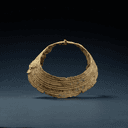
A broad, semicircular collar made of rows of beads in gold, lapis lazuli, carnelian, and turquoise, emblematic of royal and divine status. Nefertari wears spectacular examples of it in the paintings of her tomb, associated with her divine protection.
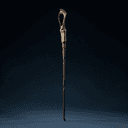
A falcon-headed scepter of power carried during official rituals, symbolizing the queen's sacred authority. It granted her the ability to intercede with the gods for the prosperity of Egypt.

The looped cross, the universal symbol of eternal life in ancient Egypt. In the paintings of QV66, the gods regularly offer an ankh to Nefertari, signifying that she is welcomed and given life in the afterworld.
📷 CC BY-SA 4.0 · Wikimedia Commons ↗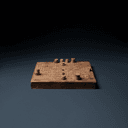
A board game of squares and pieces representing the soul's journey toward eternity, played both as entertainment and as a funerary ritual. A famous scene in tomb QV66 shows Nefertari playing senet, confronting fate and triumphing over death.
School Curriculum
Vocabulary & Tags
Key Vocabulary
Tags
Daily Life
Morning
Nefertari rose at dawn to attend sunrise rituals in the palace chapels, where priestesses shook sistrums and recited hymns to Ra and Hathor. As Great Royal Priestess, she played an active role in these ceremonies before being adorned by her handmaidens according to a strictly codified protocol.
Afternoon
Afternoons were devoted to ceremonial duties: audiences with dignitaries, overseeing the royal workshops under her patronage, and managing the vast estate of the Great Royal Wife — which included agricultural lands, granaries, and dedicated craftsmen. Nefertari also took part in diplomatic correspondence with foreign courts.
Evening
Court evenings unfolded at banquets where musicians, acrobats, and dancers performed before the assembled guests. Nefertari presided alongside Ramesses II, adorned in her finest jewels, taking part in the libations and offerings to the royal ancestors that closed each day.
Food
The royal table featured fine bread shaped into cones or animal forms, roasted meats (beef, duck, goose), fish from the Nile, vegetables (lettuce, onions, leeks), dates, figs, and grapes. High-quality beer and wine imported from the Levant and Nubia were among the drinks served at official meals.
Clothing
Nefertari wore fine pleated white linen robes, nearly translucent, sometimes accented with red or blue embroidery and tied beneath the bust in the style of the New Kingdom. Her ceremonial outfits were completed by a broad usekh collar, solid gold bracelets, and gilded leather sandals. The Hathoric crown distinguished her official appearances.
Housing
The royal palace of Pi-Ramesses in the Nile Delta served as her primary residence, with apartments decorated in frescoes depicting gardens and Nilotic scenes. During major religious festivals in Thebes — such as Opet — the court stayed in annex palaces near the temples of Karnak and Luxor, along the riverbank.
Historical Timeline
Period Vocabulary
Visual Style
Style des peintures de la tombe QV66 : canon égyptien classique en vue de profil, aplats de lapis-lazuli, ocre rouge, malachite et or sur fond crème caractéristique du Nouvel Empire thébain.
Sound Ambience
Ambiance sonore de la cour royale égyptienne du XIIIe siècle av. J.-C. : sistres sacrés d'Hathor, chants sacerdotaux, flûtes de roseaux et souffle du vent chaud sur les falaises de Thèbes.
Liens externes & ressources
Références
Œuvres
Tombe QV66, Vallée des Reines
vers 1260–1254 av. J.-C.
Temple d'Hathor et Néfertari à Abou Simbel
vers 1264–1244 av. J.-C.
Correspondance diplomatique avec la reine hittite Puduhepa
vers 1258 av. J.-C.
Représentations à Louxor et Karnak
vers 1279–1254 av. J.-C.
Rechercher
See also
Related Characters

Aten
Unas
2374 av. J.-C. — 2349 av. J.-C.
Tutankhamun
1340 av. J.-C. — 1323 av. J.-C.
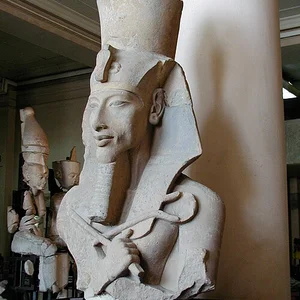
Akhenaten
1400 av. J.-C. — 1335 av. J.-C.
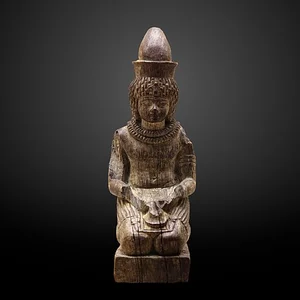
Amenhotep III
1399 av. J.-C. — 1350 av. J.-C.
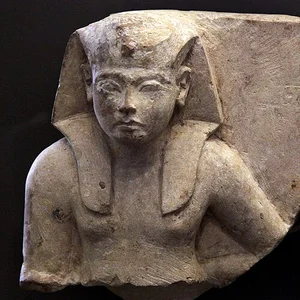
Ay
1400 av. J.-C. — 1400 av. J.-C.