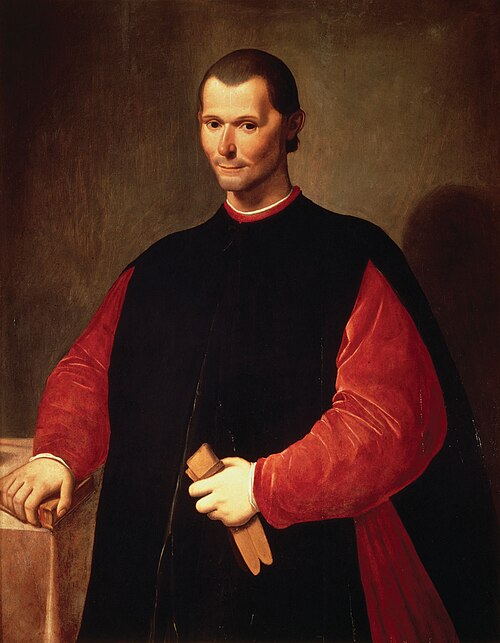
Niccolò Machiavelli
Niccolò Machiavelli
1469 — 1527
République florentine
Florentine diplomat and thinker of the Renaissance, Machiavelli is the author of The Prince (1513), a founding work of modern political philosophy. He analyzes power with unflinching realism, separating morality from political action.
Famous Quotes
« The ends justify the means. »
« It is better to be feared than loved, if you cannot be both. »
« Anyone who decides to act virtuously in every way among so many who are not virtuous will meet his downfall rather than his preservation. »
Key Facts
- Born in Florence in 1469
- Secretary of the Florentine chancellery from 1498 to 1512
- Wrote The Prince in 1513, following his political disgrace
- Author of Discourses on the First Decade of Titus Livy (1517)
- Died in Florence in 1527
Works & Achievements
A political treatise addressed to Lorenzo II de' Medici, analyzing how to acquire and maintain power. A founding work of modern political philosophy, it separates political effectiveness from traditional morality.
A commentary on ancient Roman history used as a basis for reflection on republics, civic liberty, and institutions. Considered Machiavelli's masterwork on republican thought.
A dialogue on military organization, arguing for an army of citizen-soldiers rather than mercenaries. The only work published during his lifetime, it extends his practical reforms of the Florentine militia.
A five-act comedy and masterpiece of Italian Renaissance theater. It portrays cunning and hypocrisy through a romantic intrigue, revealing Machiavelli's literary talent beyond his political writings.
A history of Florence from its origins to the death of Lorenzo the Magnificent, commissioned by Pope Clement VII. It applies Machiavelli's method of political analysis to the history of his own city.
A short diplomatic treatise written in the course of his duties, illustrating the necessary harshness of power. It foreshadows the theses of The Prince on firmness in handling rebellions.
Anecdotes
After the fall of the Florentine Republic in 1512, Machiavelli was arrested, tortured, and exiled to his estate at Sant'Andrea in Percussina. It was in this forced destitution that he wrote The Prince, hoping to win back the favor of the Medici with the work. His plan failed: the Medici never granted him the position he had hoped for.
In a letter to his friend Francesco Vettori, Machiavelli described his routine in exile: during the day, he chopped wood and played cards with peasants; in the evening, he put on his court clothes and read the Ancients to write his works. This image of a man torn between everyday hardship and intellectual greatness has become famous.
The word 'Machiavellianism' was coined against him during his own lifetime: his enemies spread the idea that The Prince was a manual for tyrants, even a book inspired by the devil. Pope Clement VIII had his works placed on the Index in 1559 — a condemnation that paradoxically boosted his fame across Europe.
Machiavelli was also a playwright. His comedy The Mandrake (1518) is considered one of the finest comedies of the Italian Renaissance. It portrayed cunning, corruption, and clerical hypocrisy with sharp wit — a surprising side of a thinker known for his austere political writings.
During his diplomatic missions, Machiavelli met Cesare Borgia in 1502. He was both fascinated and unsettled by this brutal and calculating man. Borgia became for him the model of the new prince: resolute, unscrupulous, and able to adapt to fortune's whims. This encounter left a deep mark on his political thought.
Primary Sources
A prince must know how to make use of both the beast and the man… he must choose among the beasts the lion and the fox: for the lion cannot protect itself from traps, and the fox cannot defend itself from wolves.
Men are so simple and so ready to obey present necessities, that one who deceives will always find those who allow themselves to be deceived.
When evening comes, I return home and go into my study… I step into the ancient courts of men of antiquity and, welcomed by them with affection, I feed on the food that alone is mine.
A prince who does not understand war cannot be respected by his soldiers, nor can he trust them.
The divisions between the nobles and the people were in Rome a cause of liberty; in Florence, they were a cause of servitude.
Key Places
Seat of the Florentine republican government where Machiavelli worked for fourteen years as chancellor's secretary. From here he directed diplomatic missions and military reform.
Rural estate where Machiavelli was exiled after 1512. It was here, in solitude and disgrace, that he wrote The Prince and the Discourses. The Albergaccio, the village inn, served as his refuge.
Machiavelli traveled here on a diplomatic mission and met Cesare Borgia in 1502–1503. This formative experience shaped his thinking on power and the model of the effective prince.
Machiavelli was buried here in 1527. A cenotaph was erected in the 18th century bearing the inscription "Tanto nomini nullum par elogium" (No praise is worthy of so great a name).
City held by Cesare Borgia where Machiavelli was sent on a mission in 1502. There he closely observed Borgia's methods of governance, which would become the central model for The Prince.
Gallery
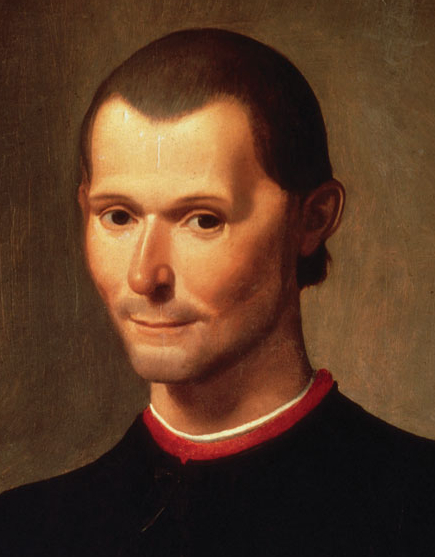
Portrait of Niccolò Machiavelli
Wikimedia Commons, Public domain — Santi di Tito

Portrait of Niccolò Machiavellilabel QS:Lit,"Ritratto di Niccolò Machiavelli"label QS:Lfr,"Portrait de Niccolò Machiavelli"label QS:Lde,"Porträt von Niccolò Machiavelli"label QS:Len,"Portrait of Nicc
Wikimedia Commons, Public domain — Santi di Tito

Firenze - Florence - Palazzo Vecchio - 2nd Floor - Vecchia Cancelleria - Portrait of Machiavelli by Santi di Tito
Wikimedia Commons, CC BY-SA 4.0 — Txllxt TxllxT
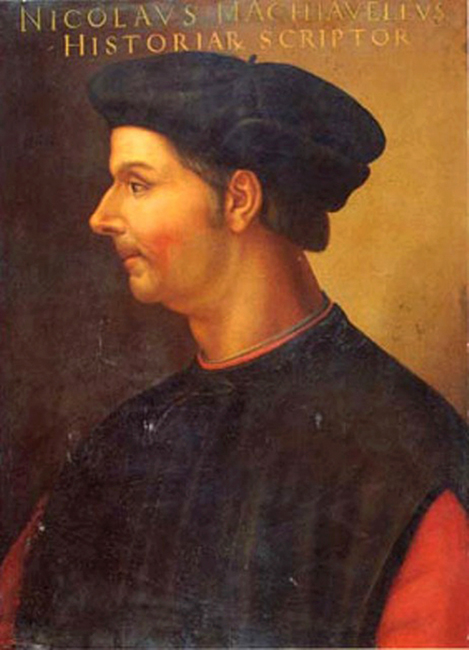
Portrait of Niccolo Machiavelli
Wikimedia Commons, Public domain — Cristofano dell'Altissimo

Portrait of Niccolò Machiavelli (1469–1527)
Wikimedia Commons, Public domain — Follower of Santi di Tito

Niccolo Machiavelli uffizi
Wikimedia Commons, CC BY-SA 3.0 — The original uploader was Frieda at Italian Wikipedia.

Niccolò Machiavelli
Wikimedia Commons, Public domain — Ridolfo del Ghirlandaio

Tombe Nicolas Machiavel Florence
Wikimedia Commons, CC0 — Jebulon

Machiavel Offices Florence
Wikimedia Commons, CC0 — Jebulon

Machivelli
Wikimedia Commons, CC BY-SA 4.0 — Ttaps