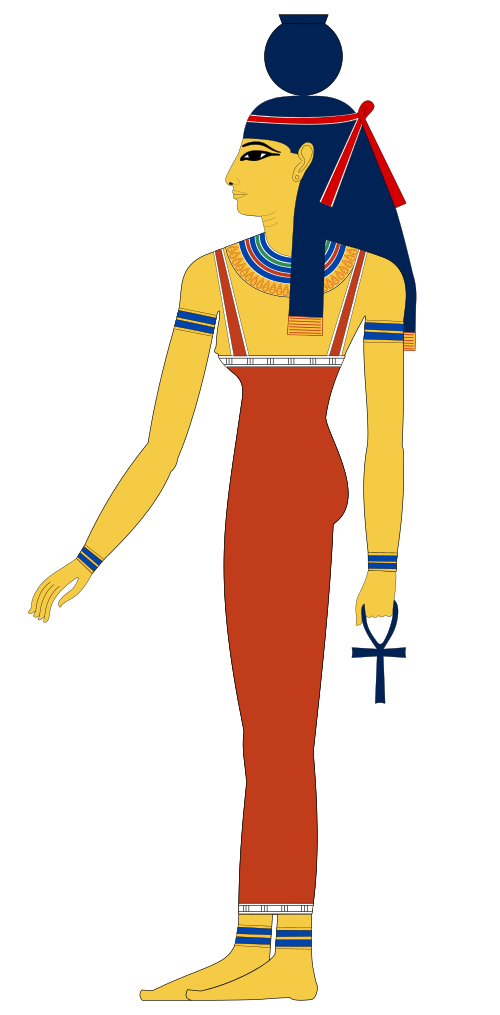
Nut
Nut
Goddess of the sky in ancient Egyptian mythology, Nut is depicted as a woman arched over the earth, covering the world with her star-studded body. Daughter of Shu and Tefnut, wife of Geb, she is the mother of Osiris, Isis, Seth, and Nephthys.
Key Facts
- Nut is among the deities of the Ennead of Heliopolis, the oldest Egyptian theological college (c. 2700 BCE)
- She appears as early as the Pyramid Texts (c. 2350 BCE), among the oldest known religious writings
- Depicted as a curved woman with a body spangled with stars, she forms the celestial vault arching over Geb (the earth)
- Each evening she swallows the sun god Ra and regenerates him, giving birth to him anew every morning
- Her arms and legs symbolize the four cardinal points; she is a central figure on sarcophagi, protecting the dead
Works & Achievements
The oldest religious corpus in human history, carved into the pyramids of the late Old Kingdom. Nut is invoked as the protective mother of the deceased pharaoh, welcoming him among the imperishable stars.
Building on the Pyramid Texts but made accessible to non-royal elites, this corpus extends Nut's protective role to the entire Egyptian aristocracy and cements her image as the universal mother of the dead.
An illustrated cosmological text describing in detail the sun's journey through Nut's body during the twelve hours of night. It is the primary iconographic source for the monumental depictions of the goddess found in royal tombs.
A masterpiece of New Kingdom funerary art, this ceiling presents Nut in a double monumental representation framing the complete text of the Book of Day and Night. It is the most accomplished visual synthesis of the goddess's mythology.
A monumental Ptolemaic composition blending Greek astrology with Egyptian mythology, depicting Nut arched around the zodiac. Brought to France in 1821, it is now housed in the Musée du Louvre and stands as a testament to the remarkable endurance of Nut's cult.
The interior of the young pharaoh's golden sarcophagus is adorned with Nut, wings outstretched, sheltering the deceased within her celestial body. This piece perfectly illustrates the central role Nut played in Egyptian royal eschatology.
Anecdotes
Every evening, Nut swallowed the sun god Ra, who journeyed through her body during the night to be reborn at dawn from her mouth or womb. This nightly voyage symbolized death and daily rebirth, and the Egyptians saw it as the guarantee that day would return — an immutable cosmic cycle upon which the order of the world depended.
According to the Heliopolitan myth, Nut and Geb were locked in such a tight embrace that no space existed between them. It was their own father, the air god Shu, who forcibly separated them by lifting Nut upward, thereby creating the sky, the earth, and the vital space necessary for life to appear.
Ra was furious that Nut had swallowed the stars, and he forbade her from giving birth during any of the 360 days of the year. Thoth, god of wisdom, then won five extra days by playing dice against the Moon, allowing Nut to give birth to Osiris, Horus the Elder, Seth, Isis, and Nephthys outside the calendar — which explains the origin of the five epagomenal days in the Egyptian calendar.
Egyptian sarcophagi were systematically decorated on the inside of the lid with an image of Nut, arms outstretched, arching over the deceased. This representation symbolically transformed the coffin into a protective sky: the dead person was enveloped by the goddess just as the Earth is embraced by the firmament, ensuring their rebirth in the afterlife.
In the temple of Dendera, a monumental astronomical bas-relief depicts Nut curved around the Egyptian zodiac, swallowing the sun in the west and giving birth to it in the east. This masterpiece of the Ptolemaic period illustrates how the ancient cult of Nut, thousands of years old, remained vibrant until the final hours of ancient Egyptian religion.
Primary Sources
O Nut, spread yourself over me, that I may be placed among the imperishable stars which are in you, and that I may not die.
Nut, the Great One, mother of the gods, stretched out above the earth, receives the deceased in her protective arms and grants him the breath of eternal life.
The body of Nut is the sky. She swallows the sun in the evening in the west and gives birth to it in the morning in the east. The stars are her adornments and the gods travel within her.
Nut, goddess of the sky, receives the deceased in her celestial dwelling. She is the mother of all the gods, she whose arms stretch from one horizon to the other.
Hail to you, Nut the Great, who gives birth to the gods, whose body is the starry firmament, who receives the sun in the evening and brings it forth anew in the morning.
Key Places
Major religious center of ancient Egypt where the cosmogony of the Ennead was developed, of which Nut is a founding member. It was here that priest-astronomers elaborated the solar theology that assigned Nut her role as mother of the sun.
This Ptolemaic temple houses an exceptional astronomical bas-relief depicting Nut arched around the Egyptian zodiac. The famous 'Dendera Zodiac', partially transported to the Louvre in 1821, is its most spectacular element.
The ceilings of this royal tomb feature two monumental representations of Nut fully illustrating the Book of Day and the Book of Night. It is one of the most complete and best-preserved iconographies of the goddess.
The Pyramid Texts carved inside this pyramid contain the earliest written mentions of Nut, dating to around 2350 BC. This site represents the textual origin of the goddess's myth as it has come down to us.
In Egyptian cosmology, Nut IS the sky — her arched body, supported by Shu, forms the visible firmament. This mythical realm stretching between two horizons is her natural domain, home to the stars, the souls of the righteous, and the traveling sun.