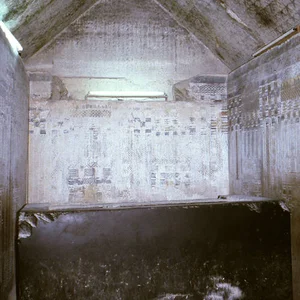

Unas was the last pharaoh of the Fifth Dynasty of ancient Egypt, reigning around 2375–2345 BCE. His pyramid at Saqqara is world-famous for containing the Pyramid Texts, the oldest known corpus of religious writings in human history.
Unas(2374 av. J.-C. — 2349 av. J.-C.)
Unas
Égypte antique, Ancien Empire de l'Égypte
8 min read
Frequently asked questions
Key Facts
- Last pharaoh of the Fifth Dynasty, reigning c. 2375–2345 BCE
- His pyramid at Saqqara is the first to contain Pyramid Texts carved on its interior walls
- The Pyramid Texts are the oldest known religious writings in human history
- Though modest in size, his pyramid is exceptionally rich in hieroglyphic inscriptions
- His reign marks the transition to the Sixth Dynasty and the decline of the Old Kingdom
Works & Achievements
The earliest known religious corpus in human history, carved on the walls of the pyramid of Unas. These magical spells influenced all subsequent Egyptian funerary texts, up to and including the Book of the Dead in the New Kingdom.
The most striking religious text of the Old Kingdom, describing the pharaoh devouring the gods in order to absorb their cosmic powers. This poem is one of the most widely discussed passages in all of modern Egyptology.
A monumental ensemble comprising the pyramid, a funerary temple, a decorated causeway stretching 750 metres, and a valley temple. Despite its modest dimensions, the richness of its interior decorative programme is unmatched for its era.
The processional causeway of Unas is adorned with rare scenes: emaciated figures ravaged by famine, craftsmen at work, and the maritime transport of granite columns. These reliefs constitute an exceptional record of daily life under the Old Kingdom.
Anecdotes
The Pyramid Texts carved in the burial chamber of Unas at Saqqara are the oldest known written religious texts in human history. These magical spells, traced in hieroglyphs highlighted with blue-green pigment, were meant to ensure the pharaoh's resurrection and eternal life among the imperishable stars of the night sky.
One of the most striking spells in the Pyramid Texts is the Cannibal Hymn (spells 273–274): it describes Unas devouring the gods themselves in order to absorb their cosmic powers. "Unas is the bull of heaven who lives on the being of every god." This spellbinding text is in fact a metaphor for the magical assimilation of divine power.
The pyramid of Unas is surprisingly small compared to those of his predecessors — roughly 57 meters on each side at the base — yet its interior is of unparalleled richness. The entrance corridor, 37 meters long, is covered with thousands of carefully incised hieroglyphs, making this pyramid a true dwelling place of the divine word.
The processional causeway leading to the pyramid of Unas, stretching 750 meters, was decorated with exceptional bas-reliefs. Among them are famine scenes depicting emaciated figures — evidence of a likely drought — and the maritime transport of granite columns from Aswan, a rare record of the monumental logistics of the Old Kingdom.
In the Pyramid Texts, Unas is associated with the constellation of Orion (known as Sah in Egyptian), the celestial home of the god Osiris. According to these spells, the deceased pharaoh ascends to the sky as an imperishable star and takes his place among the gods, immortalized for eternity in the night firmament.
Primary Sources
"Unas has appeared crowned as lord of the horizon... Unas devours men, feeds upon gods... He eats their magic, swallows their spirits. The great ones are his morning meal, the lesser ones his evening meal."
"O Unas, you have not departed dead, you have departed living. Sit upon the throne of Osiris, your scepter in hand, to command the living and the dead."
Fragment of a stele recording the reigns of Old Kingdom pharaohs, with yearly notations of Nile flood levels, royal building projects, and temple foundations.
Famine scenes depicting emaciated skeletal figures, and the transport of granite columns by boat from Aswan — direct visual testimony of activities during the reign of Unas.
Key Places
The funerary monument of Unas at Saqqara, the royal necropolis of Memphis. His modest pyramid contains the earliest Pyramid Texts in human history, inscribed on its inner walls of white limestone.
Capital of the Old Kingdom and seat of Unas's royal palace. Memphis was also the city of the god Ptah, who created the world through speech — an echo of the magical spells carved inside the pyramid.
The great center of the solar cult of Ra, to which the Fifth Dynasty was deeply devoted. The priests of Heliopolis are believed to have composed a large portion of the spells found in the Pyramid Texts.
The mythological cosmic realm traversed by the pharaoh after death, populated by deities, guardians, and trials. The Pyramid Texts map out this celestial journey to guide Unas toward the imperishable stars.
The Fifth Dynasty necropolis where Unas's predecessors rest (Sahure, Neferirkare, Niuserre). The Abusir Papyri discovered here document the organization of royal funerary temples during this period.
Liens externes & ressources
Références
Œuvres
Les Textes des Pyramides
vers 2345 av. J.-C.
L'Hymne cannibale (formules 273-274)
vers 2345 av. J.-C.
Complexe pyramidal de Saqqara
vers 2375-2345 av. J.-C.
Chaussée aux bas-reliefs de famine
vers 2375-2345 av. J.-C.
Rechercher
See also
Related Characters

Aten
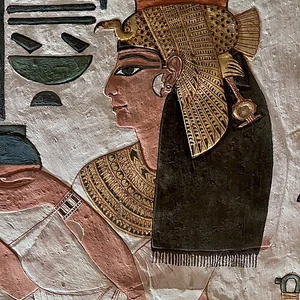
Nefertari
1289 av. J.-C. — 1254 av. J.-C.
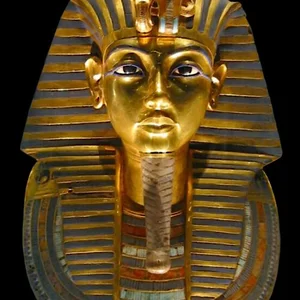
Tutankhamun
1340 av. J.-C. — 1323 av. J.-C.
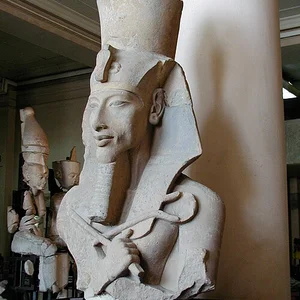
Akhenaten
1400 av. J.-C. — 1335 av. J.-C.
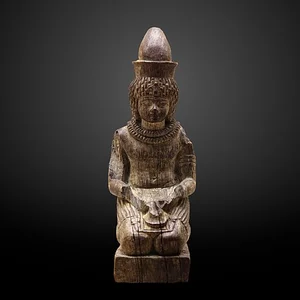
Amenhotep III
1399 av. J.-C. — 1350 av. J.-C.
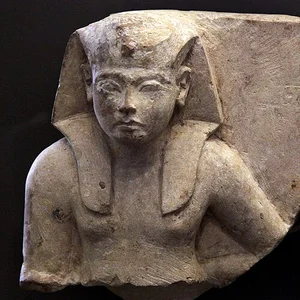
Ay
1400 av. J.-C. — 1400 av. J.-C.