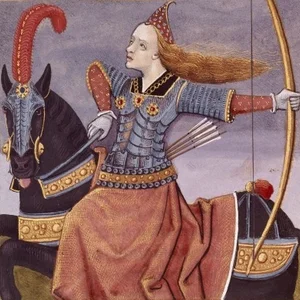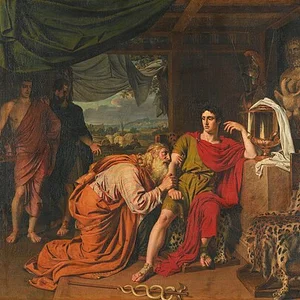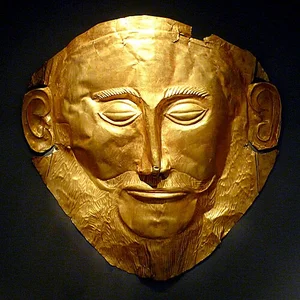

Trojan prince, son of Priam and Hecuba, Paris triggers the Trojan War by abducting Helen, wife of the Spartan king Menelaus. His judgment among the three goddesses determines the fate of Troy.
Paris
Paris
9 min read
Frequently asked questions
Key Facts
- Judgment of Paris: he chooses Aphrodite and receives in return the most beautiful woman in the world, Helen
- Abduction of Helen from Sparta, wife of Menelaus, triggering the Trojan War
- Death of Achilles: Paris kills the Greek hero with an arrow guided by Apollo to his heel
- At Paris's birth, an oracle predicted he would be the ruin of Troy — Priam ordered him abandoned on Mount Ida
- Paris is killed by an arrow from Philoctetes, bearer of Heracles's bow, during the siege of Troy
Works & Achievements
The arbitration between Hera, Athena, and Aphrodite that Paris carried out on Mount Ida, awarding the golden apple to Aphrodite. This mythological act is considered the original cause of the Trojan War and one of the most frequently depicted episodes in Western art.
The central act of the Trojan myth: Paris convinces Helen to leave Sparta and her husband Menelaus, triggering the mobilization of all of Greece. Whether it was a kidnapping or a willing flight remains ambiguous depending on the ancient sources.
A single combat intended to end the war by pitting the two men directly responsible for the conflict against each other. Paris's failure, saved by Aphrodite, symbolizes the impossibility of resolving through justice a conflict willed by the gods.
Paris's arrow, guided by Apollo, strikes Achilles' heel — the only vulnerable point of the Greek hero. This act overturns the usual warrior hierarchy: the less-than-valiant archer defeats the greatest hero of the epic.
A fictional exchange of letters between Paris and Helen imagined by Ovid, which gives an inner voice to both characters and explores the Trojan prince's motivations through the lens of desire and fate.
Anecdotes
Even before his birth, Paris's fate was sealed by a dire oracle. His mother Hecuba dreamed she gave birth to a flaming torch that set all of Troy ablaze. The seers interpreted this dream as a warning: the child to be born would be the ruin of Troy. King Priam ordered the infant to be abandoned on the slopes of Mount Ida, but a shepherd took him in and raised him among the flocks.
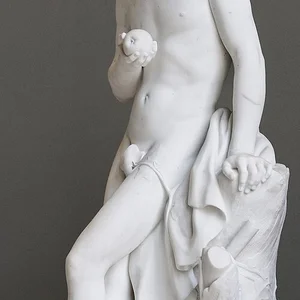
As a young shepherd unaware of his royal birth, Paris was chosen by Zeus to settle a dispute among three goddesses: Hera, Athena, and Aphrodite were quarreling over a golden apple inscribed "To the fairest." Each offered him a gift in exchange for his favor — power over kingdoms, wisdom and victory in battle, or the love of the most beautiful mortal woman. Paris chose Aphrodite's gift, thereby earning himself the eternal hatred of Hera and Athena.
Invited to Sparta by King Menelaus, Paris violated the sacred laws of hospitality — xenia — by fleeing with Helen, his host's wife. This act, considered a grave offense against gods and men alike, triggered the mobilization of all of Greece. Menelaus called upon his brother Agamemnon, and a coalition of Greek kings assembled a fleet of a thousand ships to march on Troy.
In a single combat arranged to spare thousands of lives, Paris faced Menelaus in a duel before both armies. Defeated and on the verge of being killed, he was saved at the last moment by Aphrodite, who wrapped him in a cloud and whisked him away to his chamber in Troy. This episode captures Paris's ambiguous role: handsome and favored by the gods, yet lacking the warrior's courage expected of a Trojan prince.
Paris met his end near the close of the war, struck by an arrow fired by Philoctetes using the bow of Heracles — a weapon that legend held was the only one capable of bringing about Troy's fall. Mortally wounded, Paris begged his first wife, the nymph Oenone, to heal him using her gifts as a prophetess and healer. Hurt by his abandonment of her, she refused at first — then, overcome by remorse, rushed to his side. Too late. She threw herself onto Paris's funeral pyre, unable to survive the man she had loved.
Primary Sources
Thus Paris, like a god, strode down from lofty Pergamos. He bore his bow, his quiver, and his sword, and in his hands brandished two bronze-tipped spears, challenging the finest of the Argives.
It was not of my own will that I came to you, Helen: a god was guiding me. Do not resist what a god has willed. Aphrodite promised me that you would be mine.
Hecuba, while she was pregnant, dreamed that she gave birth to a blazing torch, and that the fire spread over the entire city and consumed it. Priam consulted the seers, who answered that the child would be the ruin of his homeland.
It was Paris whom his mother bore to be the ruin of Troy. He judged the three goddesses on Mount Ida and chose Aphrodite; from that came the slaughter, the destruction of our towers, and the deaths of our kings.
Because of a woman seized by an unjust judge, Troy was consumed by the flames of war, and the old kings perished along with their sons.
Key Places
The royal city of which Paris is prince, founded according to legend by Ilus on the shores of the Hellespont. This is where most of his life unfolds and where the war he triggered comes to an end.
The mountain range where Paris was abandoned at birth and where he lived as a shepherd. It was on these slopes that the famous judgment of the three goddesses took place, a pivotal moment in Trojan mythology.
The royal city of Menelaus, husband of Helen. Paris was received there as a guest and left with Helen, violating the sacred laws of hospitality and triggering the war.
The home of the Greek gods, where the fate of the golden apple was decided. It was from Olympus that Hera, Athena, and Aphrodite descended to Mount Ida to submit their quarrel to the judgment of Paris.
The port in Boeotia where the Greek fleet assembled before sailing for Troy. This site marks the beginning of the military response to Paris's abduction of Helen.
Typical Objects

Thrown by Eris at the wedding of Peleus and Thetis, this apple bearing the inscription "To the fairest" was handed to Paris so he could judge between three goddesses. His decision set off a chain of events that led to the Trojan War.

Paris is portrayed in the Iliad as a formidable archer rather than a hand-to-hand warrior, which earns him the contempt of heroes like Diomedes. Yet it is his bow, guided by Apollo, that brings down the near-invulnerable Achilles.

A conical ornate headdress worn by Paris in ancient iconography, symbolizing his Eastern origins and his status as a Trojan prince. This cap later became a symbol of liberty in Western culture.

An instrument associated with Paris in certain traditions that depict him as a refined, musical, and seductive prince — in stark contrast with the warrior ideal embodied by his brother Hector.

Before being recognized as a prince, Paris lived as a shepherd on Mount Ida. This crook symbolizes his years of simple life and his privileged connection to the gods, who revealed themselves to him in that pastoral setting.

In several accounts, Aphrodite protects and glorifies her champion by granting him a special radiance in battle. Paris wears gleaming armor that stands in contrast with the martial valor it is meant to represent.
School Curriculum
Vocabulary & Tags
Key Vocabulary
Tags
Daily Life
Morning
On Mount Ida, Paris rose at dawn to lead his flocks to the highland pastures. He spent his mornings watching over the animals, repairing his shepherd's tools, and practicing archery to hunt and protect the herds from predators.
Afternoon
Afternoons were devoted to watching the flocks in the heat, sometimes lying in the shade of pine trees, playing the lyre or conversing with pastoral deities. It was during these quiet hours that, according to legend, the famous Judgment of the three goddesses took place.
Evening
At nightfall, Paris returned to his rustic shelter, prepared a simple meal, and tended the fire. Once recognized as a prince, his evenings transformed into royal banquets in Priam's palace, surrounded by musicians, servants, and Helen.
Food
As a shepherd, Paris lived on goat's cheese, barley bread, olives, wild fruits, and roasted meat during festivals. At the royal table of Troy, meals included grilled meats, fish, wines from Lemnos, and refined dishes served in bronze and gold cups.
Clothing
Paris is depicted wearing the conical Phrygian cap, dressed in an embroidered Eastern tunic cinched at the waist with a leather belt. He wore laced sandals at the ankles, a light chlamys over one shoulder, and in battle, an ornate bronze breastplate and greaves on his legs.
Housing
As a shepherd, Paris lived in a wood-and-daub hut on Mount Ida, with few comforts. Recognized as a prince, he took up residence in Priam's great palace at Troy — a vast building with stone columns, banquet halls, private apartments decorated with frescoes, and terraces overlooking the plain.
Historical Timeline
Period Vocabulary
Visual Style
Esthétique Âge du Bronze égéen : teintes terracotta, rouge mycénien et or bruni, inspirée des céramiques attiques à figures rouges et des fresques romaines représentant les épisodes troyens.
Sound Ambience
Mélange de paysages pastoraux du mont Ida, des bruits de la cité troyenne en temps de guerre et du fracas de bronze des batailles homériques, ponctué par la mer de l'Hellespont.
Liens externes & ressources
Références
Œuvres
Le jugement de Pâris
Avant la guerre de Troie (légendaire)
L'enlèvement (ou la fuite) d'Hélène
Vers 1225 av. J.-C. (légendaire)
Le duel contre Ménélas
Pendant la guerre de Troie (légendaire)
La mort d'Achille
Pendant la guerre de Troie (légendaire)
Les Héroïdes, Lettre XVI-XVII (Pâris et Hélène) — Ovide
Vers 15 av. J.-C.