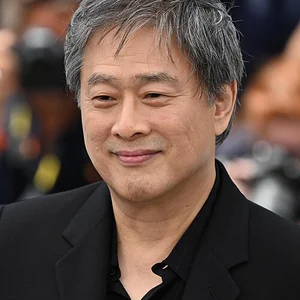

South Korean director and screenwriter born in 1963, a leading figure in the revival of Korean cinema. Known for his polished aesthetic and tales of revenge, he made his mark on the international scene with *Oldboy* (2003), which won the Grand Prix at the Cannes Film Festival.
Park Chan-wook(1963 — ?)
Park Chan-wook
Corée du Sud
6 min read
Frequently asked questions
Key Facts
- Born on August 23, 1963, in Seoul, South Korea
- Directs *Joint Security Area* (2000), a huge box-office success in South Korea
- Receives the Grand Prix of the Jury at the Cannes Film Festival for *Oldboy* in 2004
- Directs his "vengeance trilogy": *Sympathy for Mr. Vengeance* (2002), *Oldboy* (2003), *Lady Vengeance* (2005)
- Shoots his first English-language film, *Stoker*, in 2013
Works & Achievements
Thriller about the forbidden friendship between North and South Korean soldiers at the border. A huge success that introduced Park to a wide audience.
First installment of the “vengeance trilogy,” a dark tale of a kidnapping that turns to tragedy.
A masterpiece of revenge, Grand Prix at Cannes 2004. The film that brought Korean cinema to worldwide attention.
The conclusion of the vengeance trilogy, centered on a woman who plots her revenge after years in prison.
The story of a priest who becomes a vampire; Jury Prize at Cannes for this bold blend of horror and drama.
Park's first English-language film, a psychological thriller shot in Hollywood with an international cast.
A refined and sensual drama set in 1930s Korea, praised for its visual beauty and its three-part narrative.
A captivating romantic crime film that earned Park the Best Director award at Cannes.
Anecdotes
While studying philosophy at Sogang University in Seoul, Park Chan-wook had no plans to become a filmmaker. It was when he discovered Alfred Hitchcock's *Vertigo* that he had his revelation: he decided then to devote his life to cinema and founded a student film club.
His first two films were resounding commercial failures. To make a living, Park became a film critic and wrote articles for several years before *JSA* (2000) became a huge success in Korea and revived his career.
For *Oldboy*, the famous corridor fight scene was filmed in a single continuous take, without cuts, after days of rehearsal. The actor Choi Min-sik, a Buddhist, also actually swallowed several live octopuses during a scene that has since become famous.
In 2004, at the Cannes Film Festival, *Oldboy* received the Grand Prix from a jury chaired by the American director Quentin Tarantino, a great admirer of the film. This award brought Korean cinema to the attention of the entire world.
Park Chan-wook directs some projects with his brother, the artist Park Chan-kyong, under the joint name "PARKing CHANce". Their short film *Night Fishing* (2011) has the distinction of having been shot entirely with an iPhone.
Primary Sources
Park Chan-wook has often recounted that it was watching Hitchcock's *Vertigo*, during his philosophy studies, that gave him the irresistible desire to make films.
The Grand Prix of the 57th Cannes International Film Festival is awarded to *Old Boy*, directed by Park Chan-wook.
Park describes his three films *Sympathy for Mr. Vengeance*, *Old Boy* and *Lady Vengeance* as a reflection on revenge and its moral consequences, rather than as a mere series of violent films.
The Best Director Award is given to Park Chan-wook for *Decision to Leave*.
Key Places
Birthplace of Park Chan-wook and capital of a country in full transformation. It is also the heart of the Korean film industry.
University where Park studied philosophy and discovered his passion for cinema by founding a student film club.
Border zone between the two Koreas that inspired and provided the setting for *JSA: Joint Security Area* (2000), a film about the Korean division.
The world's largest film festival, where Park Chan-wook has been honored on several occasions and won international recognition.
Heart of American cinema where Park directed *Stoker* (2013), his first English-language film, before working on international series.
Liens externes & ressources
Références
Œuvres
JSA : Joint Security Area
2000
Sympathy for Mr. Vengeance
2002
Lady Vengeance
2005
Thirst, ceci est mon sang
2009
Mademoiselle (The Handmaiden)
2016