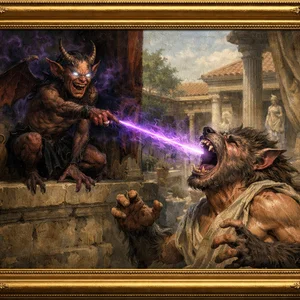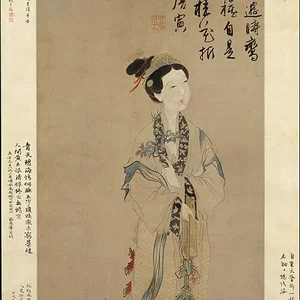

Pasiphae is a figure from Greek mythology, daughter of Helios and wife of Minos, king of Crete. Struck by an unnatural passion for a bull sent by Poseidon, she gave birth to the Minotaur — half man, half bull — who was imprisoned in the Labyrinth built by Daedalus.
Pasiphae
Pasiphae
10 min read
Frequently asked questions
Key Facts
- Daughter of Helios, god of the Sun, and the Oceanid Perseis
- Wife of Minos, legendary king of Crete
- When Minos refused to sacrifice Poseidon's white bull, the god took revenge by making Pasiphae fall in love with the animal
- She asked Daedalus to build a wooden cow so she could mate with the bull
- From this union was born the Minotaur (Asterion), who was imprisoned in the Labyrinth
Works & Achievements
A Greek tragedy now lost in which Pasiphae herself defended her passion before Minos, arguing that the gods were to blame. The surviving fragments portray a lucid and tragic Pasiphae, a victim of divine wrath.
A Greek mythological encyclopedia devoting several detailed passages to the myth of Pasiphae: her passion for the bull, the birth of the Minotaur, and the role of Daedalus. An essential reference for understanding the full cycle of Cretan legends.
A collection of Latin myths presenting Pasiphae across several entries, covering her divine birth, her curse, the construction of the Labyrinth, and the fate of her children. Hyginus emphasizes the punishing nature of divinely inflicted passion.
Ovid uses the story of Pasiphae as an extreme example of erotic passion to illustrate the uncontrollable power of desire. His treatment is at once mocking and fascinated, in the elegant and occasionally ironic style characteristic of the Latin poet.
The Sicilian historian recounts versions of the Cretan myth and alludes to Pasiphae's magical powers, at times offering euhemeristic rationalizations that seek to ground the mythological narratives in historical reality.
Anecdotes
Pasiphae is the daughter of Helios, the god of the Sun, which grants her a divine nature and formidable magical powers. Her name literally means "she who shines for all," a reference to her solar lineage. This dual nature — mortal as the wife of Minos, yet divine as the daughter of a god — makes her a figure caught between two worlds.
The ancients did not portray Pasiphae's passion for the white bull as natural madness, but as divine punishment: Poseidon had sent the bull to Minos to be sacrificed, but the king, dazzled by its beauty, kept it for himself. The god of the sea took revenge by afflicting Pasiphae with an irresistible desire for the animal, making her an innocent victim of her husband's pride.
To satisfy her passion, Pasiphae sought the help of Daedalus, the brilliant inventor who had taken refuge at Minos's court. He built her a hollow wooden cow covered in real hide, inside which she could conceal herself. This episode is one of the strangest in all of Greek mythology and fascinated the poets and philosophers of Antiquity — most notably Ovid in his Art of Love.
Pasiphae was also a powerful sorceress. According to some versions of the myth, she punished Minos's infidelities by casting a spell on him: whenever he approached another woman, he would release serpents and scorpions instead of seed. Only Procris, an Athenian woman who traveled to Crete, managed to cure him using a magic herb. This sorceress side of Pasiphae is often overshadowed by the scandal of the Minotaur.
Pasiphae is also the mother of Ariadne and Phaedra, two of mythology's most celebrated tragic figures. Ariadne would help Theseus kill the Minotaur — her own half-brother — only to be abandoned on the island of Naxos. Phaedra, who married Theseus, would die after confessing a forbidden passion for her stepson Hippolytus. Pasiphae's descendants thus seem forever marked by the doom of impossible passions, as though Poseidon's curse were passed down from generation to generation.
Primary Sources
Poseidon, angered at Minos, inspired in Pasiphae a passion for the bull. Pasiphae, enamored of the animal, appealed to Daedalus, who built a wooden cow... She hid inside it and coupled with the bull. Thus she gave birth to the Minotaur, who had the face of a bull and the body of a man.
Pasiphae made haste to seduce the bull; she did not blush to rival the heifers. One who loved a beast — and a foreign beast at that — deserved to be loved by a beast.
Poseidon, to punish Minos for refusing to sacrifice a magnificent bull to him, inspired a passion for the animal in Pasiphae, his wife. Pasiphae, aided by Daedalus, conceived the Minotaur, also called Asterion.
Daedalus, that ingenious craftsman, built the Labyrinth with its countless winding passages, to conceal Pasiphae's shame and the monstrous offspring born of her guilty passion.
It is said that Pasiphae, daughter of the Sun, was endowed by nature with magical powers and that she knew the art of herbs and potions, by which she took revenge upon those who offended Minos.
Key Places
Capital of the kingdom of Minos and residence of Pasiphae as queen, Knossos is the heart of the myth. It was here that the Labyrinth was built and where the Minotaur — Pasiphae's monstrous child — lived.
A structure designed by Daedalus on Minos's orders to imprison the Minotaur, the Labyrinth is both the symbol of Pasiphae's shame and the prison of her offspring. Its inescapable architecture represents the impossibility of breaking free from the curse.
The celestial home of her father, the sun god Helios, this palace symbolizes Pasiphae's divine origins. It is from him that she inherited her radiant nature and her supernatural powers as a sorceress.
The domain of Poseidon, the god who sent the white bull and cursed Pasiphae. The sea is where the curse originated and where the conflict between Minos and the gods played out — a conflict in which Pasiphae was the primary victim.
The island where Theseus abandoned Ariadne, Pasiphae's daughter, after she had helped him slay the Minotaur. This place symbolizes how the family tragedy of Pasiphae continued through her daughter.
Typical Objects

The central object of the myth, this artificial cow built by the ingenious craftsman Daedalus allowed Pasiphae to approach the white bull. It symbolizes both human ingenuity twisted in service of monstrous desire and the fatal complicity between the queen and the inventor.

A creature of supernatural beauty sent by the god of the sea, this bull is the instrument of divine retribution against Minos. It is also the vessel of the curse that falls upon Pasiphae and leads to the birth of the Minotaur.

As a daughter of Helios and an accomplished sorceress, Pasiphae mastered the art of potions and plants with magical properties. She used these herbs to wield her powers, most notably to cast spells upon her unfaithful husband.

A symbol of her status as queen of Crete alongside Minos, the crown serves as a reminder that Pasiphae, despite her curse, remained a divine sovereign whose authority over the island was never in question.

Although it is Ariadne who hands the thread to Theseus, it is indirectly tied to Pasiphae — Ariadne's own mother. The thread allows one to navigate the Labyrinth built to conceal Pasiphae's offspring, forming a symbolic bond between mother and daughter.

An attribute of her father Helios, the sun is closely associated with Pasiphae, whose very name evokes radiant, all-encompassing light. In some traditions, she is identified with the moon — the celestial body that shines for all in the night, a nocturnal reflection of her solar father.
School Curriculum
Vocabulary & Tags
Key Vocabulary
Daily Life
Morning
Pasiphae awakens in the royal apartments of the Palace of Knossos, lit by the raking morning light that filters through the Minoan light wells. As queen and daughter of Helios, she performs the first libations to the rising sun, sometimes attending the sacred rites of the priestesses. Her morning also belongs to a sorceress: she consults her herbs and prepares her potions in the inner storerooms of the palace.
Afternoon
The afternoon sees Pasiphae presiding over court activities: judging domestic affairs, overseeing the palace storerooms and royal treasury. She sometimes walks in the gardens or attends the sacred bull-leaping games — a Cretan ceremony in which acrobats vault over bulls — rites that have taken on a dizzying significance for her since the divine curse.
Evening
In the evening, Pasiphae retires to her apartments or attends royal feasts and banquets in the presence of Minos and the Cretan nobles. According to traditions that describe her as a sorceress, she also performs nocturnal rites linked to her solar and lunar lineage, invoking the gods beneath the starlight. The night weighs upon her with a secret grief and a shame she carries in silence.
Food
Like all of the Minoan court, Pasiphae feeds on the riches of Crete: barley and wheat bread, olive oil, olives, figs, honey, fish, and seafood from the Mediterranean. Royal banquets are graced with wine mixed with water according to Greek custom. As a daughter of a god and a sorceress, she also consumes herbs and preparations with ritual properties.
Clothing
Pasiphae wears the characteristic Minoan court costume: a dress with tiered flounced skirts in bright colors, an open bodice leaving the chest bare according to Minoan tradition, a cinched waist belt, and an elaborate headdress with a diadem and serpentine ornaments evoking her divine nature. Her gold jewelry bears motifs of bulls, sacred horns, and solar symbols recalling her father Helios.
Housing
Pasiphae resides in the great Palace of Knossos, a vast multi-story architectural complex lit by light wells and adorned with colorful frescoes depicting the sea, dolphins, and sacred bulls. Her royal apartments include bathrooms and water drainage systems that testify to the sophistication of Minoan civilization. Beneath the palace, the Labyrinth — the forced dwelling of her son the Minotaur — forms the subterranean and shadowy underside of her home.
Historical Timeline
Period Vocabulary
Visual Style
Le style visuel de Pasiphaé s'inspire des fresques minoennes de Cnossos : silhouettes élancées, couleurs vives bleu-mer et ocre solaire, ornements serpentins et symboles taurins, entre éclat solaire hérité d'Hélios et ombre menaçante du Labyrinthe.
Sound Ambience
L'ambiance sonore de Pasiphaé mêle la sérénité du palais crétois et le grondement sourd de la menace divine : vagues de la Méditerranée, mugissements lointains venant du Labyrinthe, rituel des prêtresses et tonnerre de Poséidon sur la mer.
Liens externes & ressources
Références
Œuvres
Les Crétois — Euripide (perdu)
Ve siècle av. J.-C.
Bibliothèque — Pseudo-Apollodore
Ier-IIe siècle apr. J.-C.
Fabulae — Hygin
Ier-IIe siècle apr. J.-C.
Art d'aimer (Ars Amatoria) — Ovide
Vers 1 av. J.-C.
Histoire — Diodore de Sicile, Livre IV
Ier siècle av. J.-C.