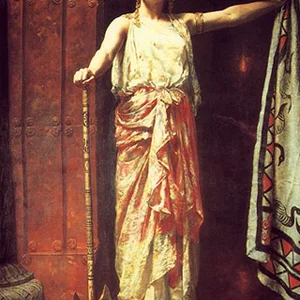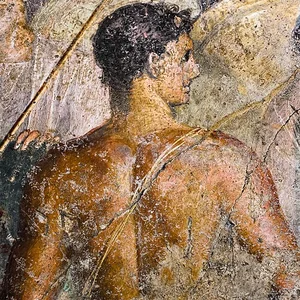

Hero of Greek mythology, king of Phthia in Thessaly. Son of Aeacus and grandson of Zeus, he is famous for his marriage to the Nereid Thetis and for being the father of Achilles.
Peleus
Peleus
9 min read
Frequently asked questions
Key Facts
- Son of Aeacus, king of Aegina, and grandson of Zeus — belongs to the lineage of demigods
- Participates in the Calydonian Boar Hunt and the expedition of the Argonauts alongside Jason
- His marriage to the Nereid Thetis on Mount Pelion brought together all the gods of Olympus
- The failure to invite Eris to the wedding triggers the dispute among the three goddesses, the origin of the Trojan War
- Father of Achilles, the greatest hero of the Iliad, whose fate is sealed from birth
Works & Achievements
After his exile from Aegina, Peleus was purified by Eurytion in Phthia and received a third of his kingdom. He eventually became king of Phthia and ruler of the Myrmidons, founding a royal lineage descended from Zeus, of which Achilles would be the ultimate glory.
Peleus took part in this great collective hunt organized by Meleager, which brought together the finest heroes of Greece. His presence at this landmark event places him among the towering heroic figures of the Greek mythic age.
Peleus sailed with Jason aboard the Argo to win the Golden Fleece in Colchis, at the edge of the known world. This collective adventure, celebrated by Apollonius of Rhodes, confirms his place as a hero of the first rank among the generation that preceded the Trojan War.
An extraordinary marriage between a mortal and a sea goddess, their wedding was a divine event with cosmic consequences. This union produced Achilles and indirectly set the Trojan War in motion through the apple of Eris, thrown during the wedding banquet.
Peleus entrusted Achilles' upbringing to the centaur Chiron and passed on to him the divine spear of the gods. This paternal role makes him the essential link between the lineage of Zeus and the greatest hero of the Iliad, ensuring the continuity of an inherited excellence.
Anecdotes
Peleus and his half-brother Phocus were both sons of Aeacus, king of Aegina and grandson of Zeus. During a discus-throwing contest, Peleus accidentally killed Phocus. Forced into exile, he had to wander far from his homeland in search of a ruler willing to purify him of this unintentional killing — an essential rite in the Greek heroic world.
To win the Nereid Thetis, Peleus had to seize her on the shore and hold on through her successive transformations: she became water, fire, a lion, then a serpent in her attempts to escape. Guided by the centaur Chiron, Peleus refused to let go until she returned to her true form and agreed to marry him.
The wedding of Peleus and Thetis on Mount Pelion was the most celebrated event of the heroic age: all the gods of Olympus were invited, except Eris, goddess of Discord. Enraged at being excluded, she threw a golden apple inscribed 'for the fairest,' igniting the rivalry between Hera, Athena, and Aphrodite that would lead, years later, to the Trojan War.
To make Achilles invulnerable, Thetis attempted each night to burn away his mortal part in sacred fire — or, according to other traditions, to dip him in the Styx. Peleus, horrified to see his wife holding their infant son over the flames, abruptly interrupted her. This paternal intervention had fatal consequences: Achilles kept his vulnerable heel, the one part never submerged in the river of the Underworld.
As a wedding gift, Peleus received an ash-wood spear carved by Chiron on Mount Pelion, its tip forged by Hephaestus himself. A weapon of divine power, it was passed down to Achilles and became one of the most formidable arms of the entire Trojan War: Homer notes that no other Greek warrior was capable of wielding it.
Primary Sources
Peleus gave him that spear, the glory of his father, when he sent him to Troy; but no other of the Achaeans could wield it — only Achilles knew how to handle it.
Peleus, the most righteous of heroes, captured Thetis alone, without the help of any man, and received as his bride the daughter of Nereus at his father's golden palace.
Peleus, son of Aeacus and Endeis, accidentally killed Phocus during a pentathlon, was exiled to Phthia where he was purified by Eurytion, then took part in the Calydonian boar hunt and the expedition of the Argonauts.
Thetis, taking on every shape, resisted Peleus's embrace; but he held her fast until she returned to her original form and consented to the marriage he desired.
Among the heroes who sailed with Jason on the Argo was Peleus, the noble son of Aeacus and father of the future Achilles.
Key Places
Kingdom of Peleus in Thessaly, at the heart of mainland Greece, where he ruled over the Myrmidons. It was here that he raised his son Achilles before the latter left to fight at Troy, and where the fate of the most illustrious lineage in Greek epic was decided.
Island in the Aegean Sea where Peleus was born, son of King Aeacus. He was forced to flee his homeland after accidentally killing his half-brother Phocus, carrying with him the burden of that crime, which would shape his destiny as a wandering hero.
Wooded mountain in Thessaly, home of the centaur Chiron, the wise tutor of heroes. It was on its slopes that Peleus captured Thetis and that their divine wedding was celebrated in the presence of all of Olympus — an event that would set the Trojan War in motion.
Port city of Thessaly from which Jason and the Argonauts, including Peleus, set sail in search of the Golden Fleece. This mythical harbor, corresponding to the modern-day region of Volos, was the departure point for one of the greatest collective adventures in Greek mythology.
Typical Objects

Cut by the centaur Chiron from an ash tree on Mount Pelion and tipped with iron by Hephaestus, this spear was given to Peleus at his divine wedding. Passed down to Achilles, it became the iconic weapon of the Trojan War, impossible to wield for anyone who did not belong to the royal line of Phthia.

The gods presented Peleus with a complete suit of armor forged by Hephaestus, god of fire and the forge, as a wedding gift. A symbol of the divine favor granted to this exceptional mortal, it was later worn by Achilles beneath the walls of Troy.

As king of Phthia and sovereign of the Myrmidons, Peleus held a scepter, the emblem of dynastic power descending from the lineage of Zeus. This staff represented his legitimate authority over his people and his right to dispense justice.

An essential piece of war equipment for any Mycenaean hero, Peleus's circular bronze shield protected him in battle and on heroic expeditions such as the Calydonian Boar Hunt and the voyage of the Argonauts.

A ritual cup made of precious metal used to pour liquid offerings to the gods. As a descendant of Zeus and husband of a goddess, Peleus performed these rites daily to maintain divine favor over his kingdom and his lineage.
School Curriculum
Vocabulary & Tags
Key Vocabulary
Tags
Daily Life
Morning
Peleus rises at dawn in his palace at Phthia and presides over the ritual sacrifices that open the royal day: wine libations poured on the altar of the sacred hearth in honor of Zeus, his ancestor, and the Olympian gods. He then inspects his Myrmidon warriors assembled in the courtyard of the megaron, checking the upkeep of their bronze weapons and armor.
Afternoon
Afternoons are devoted to martial training: javelin throwing, wrestling, foot racing, and sword fighting — disciplines that Peleus masters with the vigor of a hero of divine lineage. He also presides over councils of his nobles, settling land disputes and military alliances from his throne, royal scepter in hand, surrounded by his advisors.
Evening
In the evening, Peleus gathers his fellow warriors in the great hall of the megaron for a ritual banquet: spit-roasted meats, Thessalian wine, and barley bread are shared communally. A bard sings to the sound of the phorminx of the deeds of heroes past, keeping alive the heroic memory that shapes the identity of the Myrmidon warriors.
Food
Peleus's diet is that of a Bronze Age warrior king: roasted beef, mutton, and pork, barley and wheat bread, Thessalian ewe's milk cheeses, olives, figs, and dried grapes. Wine diluted with water and served in bronze cups is the drink of royal banquets, offered ritually to the gods before being consumed.
Clothing
Peleus wears a short fine-linen tunic (chiton) fastened with bronze fibulae, suited to training and daily palace activities. In battle dress or at official ceremonies, he dons his full bronze armor: greaves, muscle cuirass, horsehair-crested helmet, and round shield. A purple woolen cloak (himation) marks his rank as king.
Housing
Peleus rules from the royal palace of Phthia, a Mycenaean-style megaron with wooden columns: a large central hall with a permanent sacrificial hearth, a carved wooden throne, and royal apartments surrounding a colonnaded inner courtyard. The walls are decorated with brightly colored warrior frescoes and the floors paved with stone; the fortress overlooks the fertile plains of Thessaly, visible from afar.
Historical Timeline
Period Vocabulary
Visual Style
Style inspiré de la céramique grecque archaïque et de l'art mycénien, mêlant la chaleur dorée du monde héroïque terrestre au bleu profond du domaine marin de Thétis.
Sound Ambience
Ambiance sonore mêlant les vents marins de la mer Égée, le fracas des armes héroïques thessaliennes et les résonances mystiques des noces divines sur le mont Pélion.
Liens externes & ressources
Références
Œuvres
Conquête et fondation du royaume de Phthie
Âge mythique
Participation à la chasse au sanglier de Calydon
Âge mythique
Expédition des Argonautes
Âge mythique
Union avec la déesse Thétis
Âge mythique
Transmission héroïque à Achille
Âge mythique