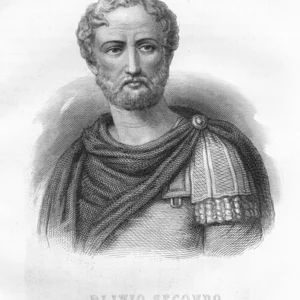

Pliny the Elder was a Roman scholar and officer of the 1st century AD, author of the encyclopedic Natural History. A naturalist curious about everything, he died in 79 AD while attempting to observe the eruption of Mount Vesuvius that destroyed Pompeii.
Pliny the Elder(20 — 79)
Pliny the Elder
Rome antique
8 min read
Frequently asked questions
Famous Quotes
« There is no book so bad that some good cannot be got out of it.»
« The sun is the soul of the world.»
Key Facts
- Born in 23 AD in Comum (northern Italy).
- Wrote Natural History, an encyclopedia in 37 volumes covering cosmology, geography, zoology, botany, and mineralogy.
- Served as a cavalry officer and later commanded the Roman fleet at Misenum.
- Died on August 25, 79 AD during the eruption of Vesuvius, at Stabiae, while attempting to rescue survivors.
- His nephew Pliny the Younger recounts his death in two letters addressed to Tacitus.
Works & Achievements
A monumental encyclopedia in 37 books dedicated to Titus, covering astronomy, geography, zoology, botany, and mineralogy. The first comprehensive encyclopedic work of Antiquity and a major source for medieval science.
A military treatise written during his campaigns in Germania, covering the equestrian and ballistic techniques of the Roman cavalry. Lost, known only through mentions by his nephew.
A history of the Roman wars against the Germanic peoples, begun during his military service on the Rhine. Lost, but extensively cited by Tacitus in his own Annals.
A handbook on rhetoric and the training of the orator, from childhood through mastery of the art of public speaking. Lost, it reflects Pliny's deep interest in education.
A contemporary Roman history continuing the work of the historian Aufidius Bassus, covering the reigns of Claudius and Nero. Lost, but recognized as an important source by ancient historians.
Anecdotes
Pliny the Elder slept so little that he worked even at night by the light of an oil lamp. His nephew Pliny the Younger recounts that he had texts read to him during meals, while traveling by litter, and even in the bath, constantly dictating notes to a secretary.
During the eruption of Vesuvius in August 79 AD, Pliny commanded the Roman fleet at Misenum. Rather than flee, he sailed toward the flames to rescue friends and observe the phenomenon at closer range. He died asphyxiated by volcanic gases on the beach at Stabiae, a victim of his own scientific curiosity.
His masterwork, the Natural History, assembled the knowledge of nearly 2,000 Greek and Latin works into 37 books. In it, Pliny describes the stars, animals, plants, and minerals with an encyclopedic appetite unmatched in Antiquity, citing some 500 different authors.
Pliny served as a cavalry officer in Germania under Emperor Claudius. It was during these military campaigns that he began writing a treatise on throwing javelins on horseback, demonstrating that the soldier and the scholar were one and the same man.
A close friend of Emperor Vespasian, Pliny would join him each morning before dawn to work. He enjoyed such a reputation that it was said of him that he had never wasted an hour: every free minute was devoted to reading or dictating.
Primary Sources
Tu solebas putare esse aliquid in his Vespasiane Auguste... opus hoc natura, hoc est vita describitur.
Erat Miseni classemque imperio praesens regebat. Nonum kal. Septembres hora fere septima mater mea indicat ei apparere nubem inusitata et magnitudine et specie.
Interim e Vesuvio monte pluribus locis latissimae flammae altaque incendia relucebant, quorum fulgor et claritas tenebris noctis excitabatur.
Omnium rerum incertissima nativitas: soli homini dubium vivere incipiat, soli datum quod paeniteat vixisse.
Mundus et hoc quod nomine alio caelum appellare libuit, cuius circumflexu degunt cuncta, numen esse credi par est, aeternum, inmensum, neque genitum neque interiturum umquam.
Key Places
Pliny the Elder's hometown, today known as Como in northern Italy. This prosperous city in the Po Valley provided him with a thorough education before his departure for Rome.
Pliny built his career here, frequented the imperial libraries, and maintained close ties with the court of the Flavian emperors. He wrote the greater part of the Historia Naturalis in the city.
The naval base where Pliny commanded the imperial Tyrrhenian fleet. It was from here that he set sail on August 24, 79 AD to observe the eruption of Vesuvius.
A town buried by the eruption of Vesuvius, on whose beach Pliny died, asphyxiated by sulfurous gases. Today known as Castellammare di Stabia, south of Naples.
The iconic volcano of the Bay of Naples whose eruption in 79 AD both fascinated and killed Pliny. His observation of this catastrophe stands as the final great naturalist inquiry of his life.
Pliny served here as a military officer and conducted his earliest naturalist observations on the fauna, flora, and Germanic peoples, recording his findings in his military writings.
Typical Objects

Pliny constantly dictated to a secretary who recorded his notes on wax tablets. These reusable writing surfaces were the everyday working tool of every Roman scholar.

The Historia Naturalis was written and circulated in the form of papyrus scrolls. Pliny consulted thousands of them to compile his encyclopedia, having texts read aloud to him even during meals.

Pliny often worked at night by the light of a clay or bronze oil lamp. His nephew reports that he would begin studying well before dawn.

To avoid wasting a single moment, Pliny had himself carried through Rome in a litter while having texts dictated or read to him. This enclosed vehicle allowed him to combine travel with intellectual work.

As a cavalry officer in Germania, Pliny wore standard Roman military equipment. His military experience informed his treatise on the use of the javelin on horseback.

Pliny collected and directly examined samples from the natural world. The Historia Naturalis describes hundreds of medicinal plants, gemstones, and animals that he had studied firsthand or had others study for him.
School Curriculum
Vocabulary & Tags
Key Vocabulary
Tags
Daily Life
Morning
Pliny rose well before dawn, often at midnight or one in the morning depending on the season. He immediately began studying, having texts read aloud to him by lamplight while dictating his notes to a trusted secretary. In the early hours, he would sometimes go to Vespasian to work alongside the emperor.
Afternoon
Afternoons were devoted to the baths (balneum), a favored moment when he continued to have books read to him while being rubbed down. He then attended to his administrative duties as procurator or fleet commander. Every journey by litter was used to dictate or listen to a reader.
Evening
Evening meals were simple and quick, always accompanied by someone reading aloud. Pliny could not tolerate unproductive silence: he would dictate between bites. After supper, he took a short nap before resuming his nightly studies.
Food
Pliny followed a sober diet typical of the Roman equestrian tradition: bread, vegetables, olives, cheese, dried or roasted meat, and fish in season. Like any self-respecting Roman, he drank wine diluted with water, but sparingly so as not to waste time or dull his mind.
Clothing
As an equestrian, Pliny wore a white wool toga adorned with the angusticlavus (a narrow purple stripe). On military service, he wore a bronze cuirass and the paludamentum (the red military cloak). In his day-to-day life, when working in his library, he preferred a light linen tunic, far more practical for study.
Housing
Pliny owned a villa at Comum and a house in Rome, as well as an official residence at Misenum as commander of the fleet. These homes contained private libraries stocked with thousands of papyrus scrolls. The rooms were decorated with frescoes, mosaics, and marble columns, in the aristocratic Roman style of the first century.
Historical Timeline
Period Vocabulary
Visual Style
L'imagerie de Pline l'Ancien oscille entre la sérénité de la bibliothèque romaine aux teintes ocre et rouge pompéien, et le drame saisissant de l'éruption du Vésuve éclairant la baie de Naples.
Sound Ambience
Un mélange de la vie intellectuelle romaine — chuchotements de secrétaires, parchemins feuilletés — et des sons dramatiques de la baie de Naples lors de l'éruption du Vésuve en 79 apr. J.-C.
Liens externes & ressources
Références
Œuvres
Historia Naturalis (Histoire naturelle)
77 apr. J.-C.
De iaculatione equestri (Du lancer de javelot à cheval)
vers 46-47 apr. J.-C.
Bellorum Germaniae libri XX (Guerres de Germanie en 20 livres)
vers 47-58 apr. J.-C.
Studiosi libri III (Le Studieux, en 3 livres)
vers 50-60 apr. J.-C.
A fine Aufidii Bassi libri XXXI (Suite d'Aufidius Bassus, en 31 livres)
vers 60-70 apr. J.-C.