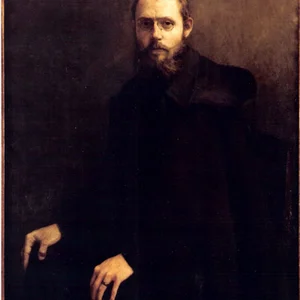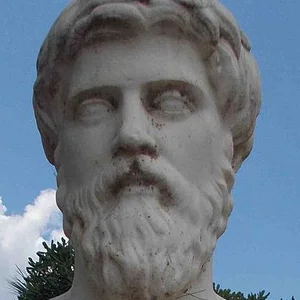

Greek philosopher, biographer, and moralist living under the Roman Empire (c. 46–120 AD). Author of the celebrated Parallel Lives, in which he compares great Greek and Roman figures. His Moralia establish him as a major reference in ancient thought.
Plutarch(40 — 120)
Plutarch
Rome antique
8 min read
Frequently asked questions
Famous Quotes
« The soul is a traveler passing through the world as through an inn.»
« It is not history that I am writing, but lives.»
« Flattery is a sweet but harmful food.»
Key Facts
- Born around 46 AD in Chaeronea, Boeotia (Greece)
- Author of Parallel Lives, paired biographies of 50 Greek and Roman figures
- Author of the Moralia, a collection of 78 philosophical and ethical treatises
- Priest of Apollo at Delphi toward the end of his life
- Died around 120 AD; his work profoundly influenced the European Renaissance
Works & Achievements
A collection of 23 pairs of biographies comparing a great Greek figure with a great Roman one (Alexander/Caesar, Solon/Publicola…). A foundational work that profoundly influenced the European Renaissance and the modern understanding of Antiquity.
A collection of 78 essays covering ethics, philosophy, religion, politics, and science. These texts make Plutarch an essential source for understanding moral thought and everyday life in the Greco-Roman world.
A philosophical treatise dedicated to a friend, outlining the paths to inner serenity. Plutarch develops a practical wisdom rooted in Platonism, written to be accessible to a broad and educated readership.
A collection of conversations held at dinner parties, blending scientific and philosophical questions with historical anecdotes. A valuable document on the intellectual and social practices of the Greco-Roman elite in the 1st century AD.
A pedagogical treatise long attributed to Plutarch, advocating an education that combines nature, habit, and reason. It had a lasting influence on educational theory in Late Antiquity and the Renaissance.
A philosophical and dramatic dialogue weaving together a Theban political conspiracy with a reflection on the nature of Socrates' divine sign. An important testament to Plutarch's Neoplatonic spirituality.
Anecdotes
Plutarch was appointed priest of the sanctuary of Apollo at Delphi, probably around 95 AD, and he carried out this role with great devotion until the end of his life. He actively contributed to restoring the oracle's prestige, writing several philosophical treatises on the nature of Delphic prophecy.
To write his Parallel Lives, Plutarch undertook extensive research in Greek and Roman libraries, yet he admitted in his Life of Demosthenes that he had difficulty reading Latin. He therefore had to rely on Greek sources and the help of Roman friends to complete his portraits of Latin figures.
Plutarch remained deeply attached to his hometown of Chaeronea in Boeotia, turning down honors and positions that would have taken him away from this modest city. He wrote: 'I live in a small town, and I choose to stay there so that it does not become even smaller.' This loyalty to his roots is often cited as a testament to his wisdom.
According to a later tradition, Emperor Trajan reportedly granted Plutarch the insignia of the consulship and asked him to make no administrative decisions in Illyricum without first consulting him. While modern historians debate the authenticity of this account, it speaks to the high regard in which the Romans held this Greek philosopher.
In his Table Talk, Plutarch records lively discussions held at banquets bringing together philosophers, physicians, and scholars. These texts reveal a man of boundless curiosity, debating topics ranging from the origins of sympathy between certain animals to the question of whether water or fire was discovered first — a reflection of the encyclopedic learning typical of his era.
Primary Sources
It is not histories that I am writing, but lives; and in the most glorious deeds there is not always an indication of virtue or vice, but often a small thing, a word, or a jest reveals a man's character better than battles where thousands fall.
It is not in places, nor in foreign lands, nor in changes of condition that we must seek peace of mind, but within ourselves.
The wise man must make useful use of everything. An enemy is useful to those who know how to turn him to advantage and who regard the enmity itself as a school of vigilance.
Solon was the first to give the Athenians a law forbidding anyone to speak ill of the dead. It is pious to respect those who are no more, just to spare those who are absent, and good policy not to perpetuate hatred.
Philosophy is the only discipline that teaches us to do what must be done: to honor the gods, to respect one's parents, to cherish one's elders, to obey the laws, to submit to those in authority, and to love one's friends.
Key Places
Plutarch's hometown, to which he remained deeply attached throughout his life despite his travels. He taught there, welcomed disciples, and wrote the bulk of his work there.
Site of the famous sanctuary of Apollo where Plutarch served as a priest during the last decades of his life. He dedicated several philosophical works there to the nature of divination and oracles.
The city where Plutarch studied philosophy under Ammonius, attending the Platonic Academy. There he acquired the foundations of his philosophical thought and his vast literary culture.
The capital of the Empire, which Plutarch visited on several occasions to teach, meet notable figures, and conduct research. His stays in Rome allowed him to collect sources on the great Latin figures he paired with their Greek counterparts.
Typical Objects

The primary writing medium of Antiquity, on which Plutarch wrote and consulted his sources. His works, being quite extensive, required dozens of scrolls to be copied and circulated.

A common tool for taking quick notes during research or philosophical discussions. Plutarch likely used them to jot down anecdotes and quotations before incorporating them into his works.

An indispensable light source for late-night reading and writing sessions. In Antiquity, scholars like Plutarch frequently worked by the flickering light of such lamps after sunset.

The iconic ritual object of the sanctuary of Apollo at Delphi, where the Pythia delivered her oracles seated on a tripod above a crack in the rock. As a priest of Delphi, Plutarch devoted several philosophical treatises to this object.

A shallow vessel used during religious ceremonies to pour liquid offerings to the gods. In his capacity as a priest, Plutarch regularly presided over such rituals at Delphi and described their significance in his writings.

Plutarch aligned himself with Platonic philosophy and very likely kept representations of his intellectual inspiration. His library and workspace were adorned with images of the philosophers he admired.
School Curriculum
Vocabulary & Tags
Key Vocabulary
Daily Life
Morning
Plutarch rose early, as ancient custom dictated. He began his day with ritual ablutions, followed by prayers and libations to the gods — especially Apollo, whose priest he was. He then devoted the first part of the morning to reading papyrus scrolls, taking notes on his wax tablets.
Afternoon
The afternoon was dedicated to teaching and philosophical discussion with his students and visiting guests passing through Chaeronea. Plutarch ran a small school in his home, offering commentary on Plato and exploring questions of morality and religion. On days when the great sanctuary was open, he would travel to Delphi to fulfill his priestly duties.
Evening
Plutarch's evenings were often spent at philosophical banquets (symposia), bringing together friends, intellectuals, and notable visitors. Wide-ranging topics were debated — religion, science, history — in a cultivated and convivial atmosphere. Afterward, by the light of his oil lamp, he would set down the day's conversations and reflections in writing.
Food
Plutarch was a vegetarian by philosophical and moral conviction, refusing to kill animals for food — a position he defended in his treatise 'On the Eating of Flesh.' His diet consisted mainly of vegetables, legumes, cheeses, olives, figs, and barley bread — the common fare of ancient Greece. Wine, always diluted with water, was consumed in moderation during meals and symposia.
Clothing
Plutarch wore the typical dress of educated Greco-Roman men of his era: a chiton (linen tunic) covered by a himation (a large draped woolen cloak) in white or natural tones. When performing his priestly duties at Delphi, he wore purified ritual garments of white, in accordance with religious requirements. His dress was simple and dignified, in keeping with his philosophical ideals of temperance.
Housing
Plutarch lived in a comfortable house in Chaeronea, a modest town in Boeotia. His home likely included a well-stocked library, a garden, and a reception room where he welcomed students and visitors. True to his philosophy, he preferred this familiar setting to the wealth and prestige that Rome or Athens could have offered him.
Historical Timeline
Period Vocabulary
Visual Style
Esthétique gréco-romaine impériale : architecture de marbre, lumière dorée méditerranéenne et palette de teintes chaudes évoquant le monde intellectuel et spirituel de Plutarque.
Sound Ambience
Ambiance sonore du monde gréco-romain du Ier-IIe siècle : cadre sacré de Delphes et vie quotidienne d'un lettré béotien, entre rituels religieux et discussions philosophiques.
Liens externes & ressources
Références
Œuvres
Vies parallèles (Βίοι Παράλληλοι)
v. 100-120 apr. J.-C.
Œuvres morales (Ἠθικά — Moralia)
v. 80-120 apr. J.-C.
De la tranquillité de l'âme (Περὶ εὐθυμίας)
v. 90-100 apr. J.-C.
Propos de table (Συμποσιακά)
v. 100-110 apr. J.-C.
De l'éducation des enfants (Περὶ παίδων ἀγωγῆς)
v. 80-100 apr. J.-C.
Sur le signe de Socrate (Περὶ τοῦ Σωκράτους δαιμονίου)
v. 100-115 apr. J.-C.