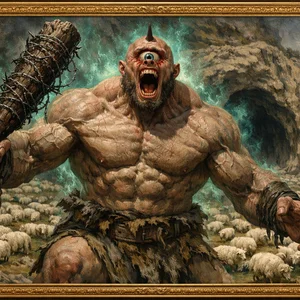

A one-eyed Cyclops, son of Poseidon and the nymph Thoosa, Polyphemus is one of the monstrous giants of Greek mythology. Famous for imprisoning Odysseus and his companions in his cave, he is ultimately blinded by the hero, who outsmarts his revenge by calling himself “Nobody.”
Polyphemus
Polyphemus
9 min read
Frequently asked questions
Famous Quotes
« “Nobody is killing me! Nobody is tricking me — by cunning, not by force!” (Odyssey, Book IX — words attributed by the Homeric tradition)»
Key Facts
- Son of Poseidon and the nymph Thoosa, one of the Cyclopes living in Sicily
- Imprisons Odysseus and his companions in his cave and devours several of them
- Blinded by Odysseus using a sharpened wooden stake heated in the fire, after being made drunk
- Tricked by the stratagem of the name “Nobody” (Outis in Greek), he is unable to get help from the other Cyclopes
- His blinding triggers Poseidon’s wrath, which hounds Odysseus throughout his entire journey home
Works & Achievements
The founding text that establishes the myth of Polyphemus: the cave, the cannibal feast, Odysseus's cunning, the blinding, the escape under the sheep, and the curse to Poseidon. It is the primary source for the entire subsequent tradition.
The only complete surviving Greek satyr play, it stages the Homeric episode with a chorus of Satyrs. Euripides adds a reflection on barbarism, freedom, and intoxication.
A pastoral poem presenting a Polyphemus in love with Galatea, consoling himself in his heartache through song and poetry. This bittersweet, comic reinterpretation of the Homeric monster proved highly influential.
Ovid takes up the motif of Polyphemus's jealousy toward Acis, whom Galatea prefers: the Cyclops crushes the shepherd under a boulder, which is transformed into a river. This text would become a major source for Baroque painting and opera.
Virgil has Aeneas encounter Achaemenides, left behind in Sicily by Odysseus, allowing a brief reappearance of the blinded Polyphemus on the shore. The passage underscores the terror the Cyclops still inspires.
A Baroque musical composition in which Polyphemus is cast as a deep bass voice — thundering and consumed by jealousy. One of the most celebrated settings of the myth to music, it is still regularly performed today.
Anecdotes
When Odysseus finds himself a prisoner in Polyphemus's cave, he has the cunning to introduce himself under the name “Outis,” which means “Nobody” in ancient Greek. After blinding the Cyclops with a burning stake, Polyphemus howls in pain and his neighbors, rushing over to find out who has hurt him, hear him answer “Nobody!” Thinking it a hallucination, they leave without helping him — it is one of the most celebrated tricks in all of world literature.
To escape from the cave sealed by a colossal boulder, Odysseus and his companions tie the Cyclops’s sheep in groups of three and slip beneath the belly of the middle animal. Polyphemus, now blind, feels along the back of each beast to make sure no one is getting out, but does not think to feel their undersides — a ruse that illustrates how intelligence can triumph over brute strength.
In a separate poetic tradition — the pastorals of Theocritus (3rd century BC) — Polyphemus appears in an unexpected light: he is in love with the sea nymph Galatea and sings her clumsy serenades on the shores of Sicily. This lovesick, hapless Cyclops, unable to win the affections of the one he loves, would go on to become a comic figure taken up by Ovid in the *Metamorphoses*.
After being blinded, Polyphemus addresses his father Poseidon directly to beg him to curse Odysseus. He states his prayer with precision: may the hero never return home — or if he does, may it be late, alone, on a foreign ship, and may he find nothing but misery waiting in Ithaca. Poseidon grants this prayer, which accounts for the hero’s ten years of wandering.
Polyphemus is the only Cyclops in the *Odyssey* to be named and to have a fully developed personality. Unlike the other Cyclopes, described as savage beings living without laws or cities, he is a shepherd and a cheesemaker — he tends his flocks with care, milks his ewes morning and evening, and stores his cheeses in wicker baskets. This realistic detail makes his actions all the more monstrous: he is not merely a beast, he has habits — yet he eats men raw.
Primary Sources
“Cyclops, you asked me my glorious name, and I will tell you; give me in return the guest-gift you promised me. My name is Nobody; Nobody is what my mother, my father, and all my companions call me.”
The only complete satyr play preserved from Antiquity, featuring Polyphemus, Odysseus, and the chorus of Satyrs. Euripides retells the episode from the Odyssey, adding a burlesque and philosophical tone on the themes of barbarism and civilization.
“O Galatea, white as curdled milk, tender as a lamb, playful as a heifer… why do you flee from one who loves you?” Polyphemus sings of his unrequited passion for the sea-nymph Galatea from the rocks of Sicily.
Polyphemus, enamored of Galatea, crushes beneath a boulder the shepherd Acis whom the nymph preferred to him. The gods transform Acis’s blood into a river. Ovid develops the tragic and jealous dimension of the character.
Aeneas and his companions encounter Achaemenides, a companion of Odysseus left behind in Sicily, who describes the blinded Polyphemus wandering along the shore. Virgil extends the Homeric myth by weaving it into the founding Latin epic.
Key Places
A vast sea-side cave, traditionally identified in the vicinity of Mount Etna in Sicily. This is where Odysseus and his men are imprisoned, where they blind the Cyclops, and where they escape by clinging beneath the sheep.
In the *Odyssey*, the Cyclopes live on a fertile and wild island, with no cities or laws, content with whatever nature provides. This place is the antithesis of the civilized Greek world and serves as a moral foil.
Sicily's active volcano, associated with Polyphemus in many later traditions. Some authors locate his cave there and interpret its eruptions as the Cyclops's rage or the fire from his forge.
The waters before which Polyphemus serenades Galatea in the tradition of Theocritus and Ovid. This Sicilian seascape becomes the setting for the lovesick Cyclops's pastoral romance.
Typical Objects

Sharpened to a point and hardened in fire by Odysseus, this stake is the weapon with which the hero blinds Polyphemus in his sleep. It is the central object of the most famous episode in the *Odyssey*.

A colossal block of rock that Polyphemus moves alone to close and open the entrance to his cave. Twenty-two wagons could not have budged it, according to Homer — a symbol of the Cyclops's superhuman physical scale.

Odysseus offers Polyphemus an exceptionally potent wine, a gift from Maron, priest of Apollo, which was meant to be diluted with water but is drunk neat. The intoxication that follows is the essential precondition for the blinding.

Polyphemus's cave is described as a fully working dairy: shelves of cheeses, pails of milk, curds draining off their whey. These details paint a Cyclops who is at once brutish and surprisingly industrious.

A massive club used to guide and protect his flock. For Polyphemus, this staff rivals the mast of a ship in size — a hyperbolic proportion that marks him unmistakably as a giant.

Blinded and furious, Polyphemus tears the summit from a mountain and flings it toward the voice of Odysseus rowing away. The boulder sends up a wave that nearly swamps the ship — a gesture of helpless rage that has become iconic.
School Curriculum
Vocabulary & Tags
Key Vocabulary
Daily Life
Morning
Polyphemus rises at dawn and begins by milking his ewes and goats, pouring the milk into large vessels. He prepares his cheeses in woven baskets following the shepherd's ritual, before letting his flocks into the cave's passageway. He rolls the enormous boulder aside to open the entrance to daylight.
Afternoon
During the day, Polyphemus leads his flocks across the island's slopes and watches over his animals, armed with his gigantic crook. He neither farms nor trades, living directly off what nature and his sheep provide. Tradition portrays him as a loner who never mingles with the other Cyclopes, each of whom lives in his own isolated cave.
Evening
When the flocks return, Polyphemus seals the cavern with his boulder and lights a fire — it is at this moment that he discovers Odysseus's men hiding inside. He prepares his meal by seizing two companions, whom he eats raw, then falls into a heavy sleep. The night of the Homeric episode is the one when Odysseus makes him drink the powerful wine before driving a stake into his eye.
Food
Polyphemus feeds mainly on milk, fresh cheeses, and meat — but also, in the Homeric episode, on human flesh, which he consumes raw. Homer stresses this cannibalistic aspect to underscore the Cyclops's absolute inhumanity, the very opposite of the laws of hospitality (*xenia*) that were sacred to the Greeks. Wine, which he has never tasted, floors him on first contact, so potent is it.
Clothing
Ancient texts give no precise description of Polyphemus's clothing. Inferred from his savage nature, both ancient and modern depictions dress him in raw, untreated animal hides, confirming his status as a being who lives entirely outside any craft-based civilization. He wears neither jewelry nor armor.
Housing
Polyphemus's cave is vast and arranged as a combined sheepfold and dairy: it holds shelves of cheeses, pens for lambs and kids separated by species, and jars of milk. The boulder that blocks the entrance is enormous — an image of brute force substituted for any form of architecture. There is no domestic hearth, no furniture — only a rock floor and livestock.
Historical Timeline
Period Vocabulary
Liens externes & ressources
Références
Œuvres
Homère, Odyssée, Chant IX
VIIIe siècle av. J.-C.
Euripide, Le Cyclope
Vers 412 av. J.-C.
Théocrite, Idylle XI (« Le Cyclope »)
Vers 270 av. J.-C.
Virgile, Énéide, Livre III
Vers 19 av. J.-C.
Haendel, Acis and Galatea (oratorio-opéra)
1718