
Priam is the last king of Troy in Greek mythology, father of fifty sons including Hector and Paris. His reign is defined by the Trojan War, triggered by the abduction of Helen. He dies during the fall of the city, killed by Neoptolemus.
Priam
Priam
Troie
9 min read
Frequently asked questions
Famous Quotes
« Remember your father, Achilles, godlike as you are — he is of the same age as I am. (Iliad, XXIV, Homer)»
Key Facts
- Priam rules over Troy at the time of the war triggered by the abduction of Helen by his son Paris
- He watches from the city walls as Menelaus and Paris fight in single combat (Iliad, III)
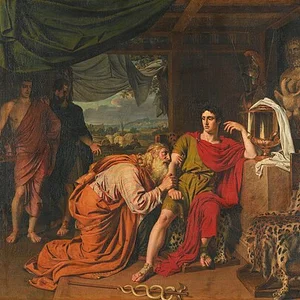
- After Hector's death, he goes alone to the Greek camp to beg Achilles to return his son's body (Iliad, XXIV)
- He is killed by Neoptolemus, son of Achilles, during the fall and sack of Troy
- According to tradition, he had fifty sons and fifty daughters, including Cassandra, Helenus, and Polyxena
Works & Achievements
The foundational epic of Western literature in which Priam plays a central role; Book XXIV, devoted to his encounter with Achilles, is considered one of the greatest passages in the history of poetry.
The Latin epic at the heart of Rome's founding myth, whose Book II describes the fall of Troy and the death of Priam — a poignant symbol of civilizations crushed by fate.
A Greek tragedy about the fate of Trojan women after the city's fall, evoking the death of Priam and questioning the moral legitimacy of war — written during the Peloponnesian War.
An epic filling the gap between the Iliad and the Odyssey, recounting the death of Paris and Priam's final days leading up to the night Troy was sacked.
According to mythological tradition, Priam inherited a weakened city following Heracles' raids and transformed Troy into the most powerful metropolis in Asia Minor, making it a major commercial and cultural crossroads of the Aegean world.
Anecdotes
On the fateful night of the Trojan Horse, Priam refused to listen to his daughter Cassandra, who was crying out her prophecy: the city was about to burn. Apollo had granted her the gift of foresight, but had cursed the Trojans never to believe her. This collective blindness in the face of the obvious cost Priam his life and sealed the end of Troy.
The most moving scene in the Iliad unfolds in Book XXIV: the aged king Priam crosses enemy lines alone, guided by the god Hermes in disguise, to beg Achilles to return the body of his son Hector. He kisses the hands of the warrior who had killed his children, and Achilles, deeply moved, weeps alongside him. Homer here brings two enemies together in shared, universal grief.
Homer presents Priam as father of fifty sons, the most celebrated being Hector, Troy's invincible champion, and Paris, whose reckless act — abducting Helen, wife of the Greek king Menelaus — triggered the war. An oracle had warned Hecuba before Paris's birth that this child would bring ruin upon the city; Priam had him exposed on a hillside, only to later acknowledge him as his own.
The death of Priam is recounted by Virgil in the Aeneid with intense pathos: the old king, donning his armor to defend his burning palace, is struck down by Neoptolemus, son of Achilles, at the very foot of the altar of Zeus Herkeios, protector of the hearth. Killing a suppliant at a sacred altar was an act of sacrilege that deeply shocked the ancient world.
In his youth, Priam had himself endured captivity: the hero Heracles, in retaliation for a betrayal by his father Laomedon, besieged Troy and enslaved the young prince. His sister Hesione paid his ransom. This memory of humiliation made the final fall of the city — which Priam had rebuilt and raised to its height of glory — all the more tragic.
Primary Sources
"Remember your father, Achilles, godlike as you are. He is the same age as I am, standing on the grim threshold of old age... But I, of all sorrows, Zeus has saved the bitterest for me. I had noble sons in the wide land of Troy, and I believe not one of them remains."
"Such was the end of Priam's fate. This was his death — he who had seen Troy in flames and Pergamon in ruins, he who had ruled over so many peoples and lands, once sovereign of all Asia."
"Priam then called to Helen: Come here, dear child, sit beside me to see your first husband, your allies and your friends. I do not blame you; the gods alone are to blame — it is they who unleashed upon me the deadly war of the Achaeans."
"Troy is no more. Only its name still remains. The great city has perished. The gods destroyed it — and Priam with it."
Key Places
Royal capital of Priam, identified with the archaeological site of Hisarlik in modern-day Turkey. A city of towering walls dominated by the citadel of Pergamon, Troy stood at the crossroads of trade routes between the Aegean and the Black Sea.
A sacred mountain range overlooking the plain of Troy, serving as a temporary dwelling of the gods in Greek mythology. It was on its slopes that Paris, son of Priam, grew up as a shepherd and delivered his famous judgment among the three goddesses.
A divine river flowing through the plain of Troy, the setting of the war's bloodiest battles. Homer gives it a voice and a personality — its banks bore witness to Hector's combat and the deaths of many of Priam's sons.
A vast military encampment set up on the beach facing Troy, where a thousand Achaean ships were beached for ten years. It was here that Priam ventured alone into the night to find Achilles' tent and implore the warrior in the name of their shared humanity.
Home of the gods, from which Zeus, Hera, Apollo, and Athena watched over the Trojan War and intervened on behalf of one side or the other. The fate of Priam and his city was decided there just as much as on the battlefield.
Typical Objects

Symbol of Priam's sovereignty over Troy, the golden scepter is mentioned in the Iliad during the councils of elders and war councils. It embodies the legitimate authority of the basileus over his subjects and allies.

Chests of gold, embroidered garments, finely wrought cups, and precious bronze that Priam gathers to reclaim his son Hector's body from Achilles. This treasure represents both the legendary wealth of Troy and the despair of a father.

The royal garment par excellence in the Aegean world, purple dye extracted from the murex snail was reserved for kings and gods. Priam wears it during ceremonies, audiences, and official sacrifices, marking his sacred rank.

A domestic altar dedicated to Zeus as protector of the hearth, erected in the inner courtyard of Troy's royal palace. It is at its foot that Priam meets his death during the fall of the city — a sacrilege that deeply shocked the religious conscience of the ancient world.

Built according to tradition by Apollo and Poseidon for Laomedon, Priam's father, these formidable fortifications withstood ten years of Greek siege. Their breach through the cunning of the Trojan Horse symbolizes the limits of human power in the face of fate.

A gold or silver vessel used by Priam to pour wine onto altars before every important decision. Libations to the gods mark the rhythm of the king's daily life, whose piety Homer consistently emphasizes.
School Curriculum
Vocabulary & Tags
Key Vocabulary
Tags
Daily Life
Morning
Priam begins his day before dawn with libations of unmixed wine at the altar of Zeus Herkeios in the palace courtyard, reciting prayers for the protection of Troy. He then makes his way to the citadel walls to observe the positions of the Greek armies on the plain and hold council with his sons and generals.
Afternoon
The king receives ambassadors from allied peoples — Lycians, Phrygians, Carians — who have come to reinforce Troy's defenses. He oversees the distribution of food and weapons to the troops, and presides over animal sacrifices whose entrails are read by seers to obtain omens before battle.
Evening
Royal evenings are held in the great megaron around a banquet where bards sing the deeds of ancestors. Priam, worn down by grief for his fallen sons, then retires to the inner chambers with Hecuba, sharing with her the day's news and their fears for the future of their surviving children.
Food
Royal diet of the Bronze Age: roasted meats (beef, mutton, and boar) cooked over embers, barley and wheat bread, fresh cheeses, olives and dried figs, Thracian wines diluted with water drunk from chased gold cups, and honey cakes with sesame at ceremonial banquets.
Clothing
Priam wears long cloaks of fine wool dyed in Phoenician purple, fastened at the shoulders with heavy gilded bronze fibulae, over a floor-length white linen tunic. His head is bound with a golden diadem. During mourning rites, he tears his garments, covers himself with ashes, and wraps his head in a dark veil, following Homeric funerary customs.
Housing
Priam's palace on the citadel of Pergamon is described by Homer as a complex of fifty rooms of polished stone, with porticoes, colonnaded courtyards, and separate apartments for his married sons. The walls are adorned with frescoes, the floors covered with wool rugs, and cedar chests inlaid with ivory hold the treasures accumulated over generations.
Historical Timeline
Period Vocabulary
Visual Style
Style Bronze tardif égéen et anatolien : palais aux teintes ocre, pourpre et or sous une lumière dramatique de torches et de cités en flammes, mêlant grandeur royale et tragédie du destin.
Sound Ambience
Ambiance d'une citadelle royale de l'Âge du Bronze assiégée : vie de cour raffinée, rites religieux incessants et omniprésence sourde de la guerre aux portes de la cité.
Liens externes & ressources
Références
Œuvres
L'Iliade d'Homère
VIIIe siècle av. J.-C.
L'Énéide de Virgile
Ier siècle av. J.-C.
Les Troyennes d'Euripide
415 av. J.-C.
La Suite d'Homère de Quintus de Smyrne
IIIe-IVe siècle apr. J.-C.
Reconstruction de Troie (règne légendaire)
~XIIIe siècle av. J.-C.